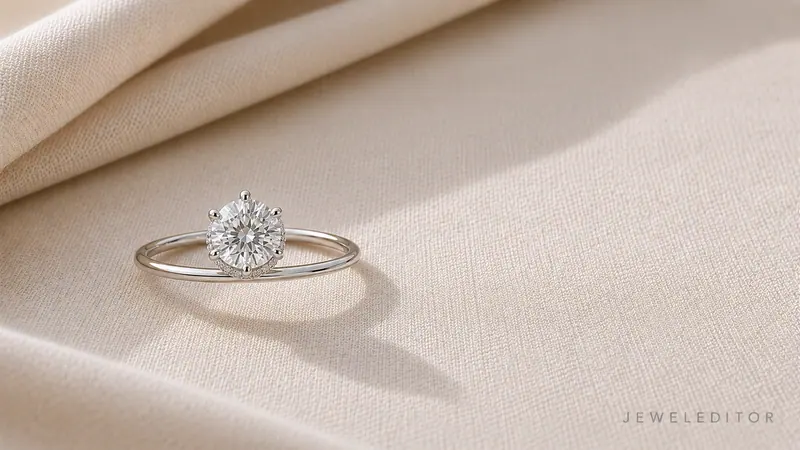
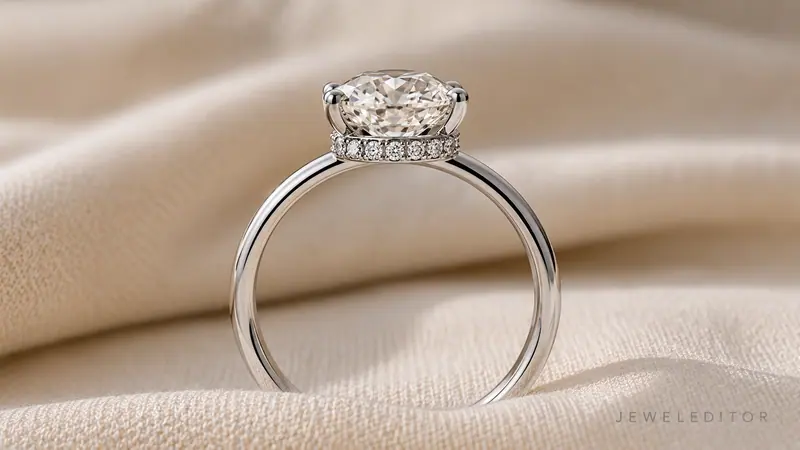
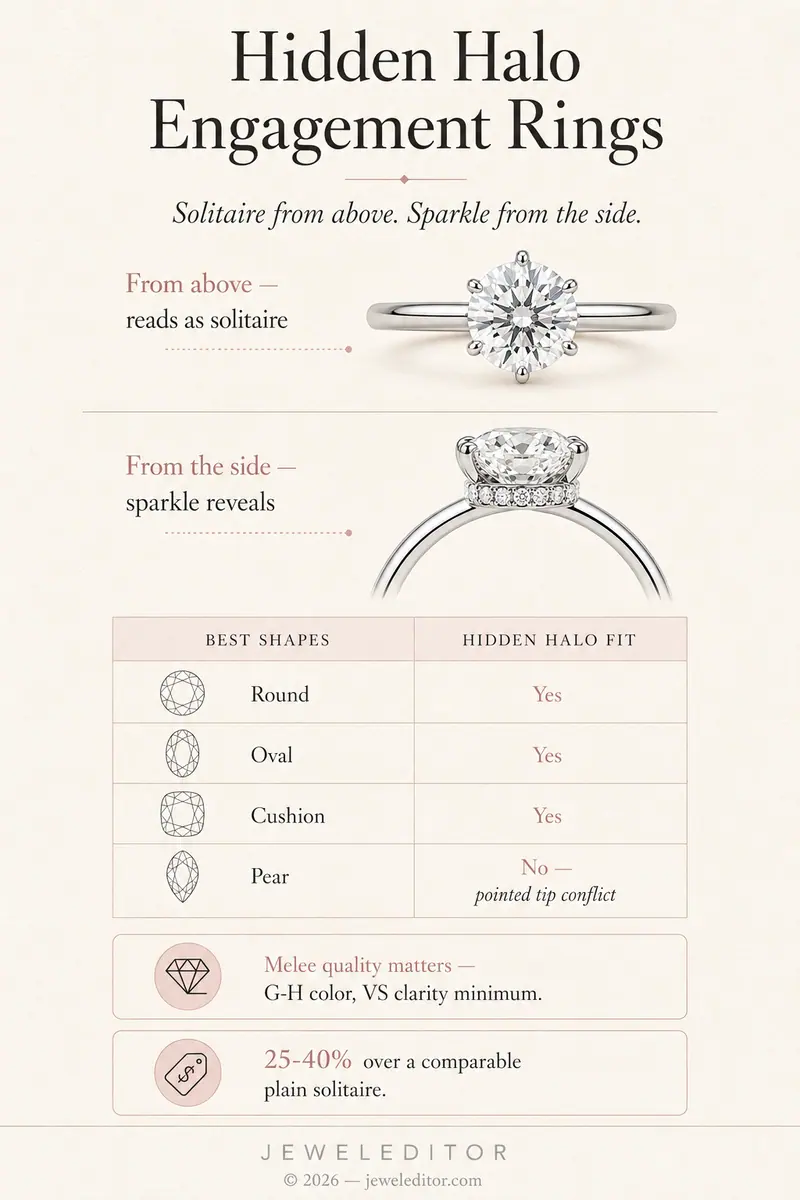
A hidden halo engagement ring has a small ring of accent diamonds positioned underneath the center stone, visible only from the side profile. From above, it reads as a solitaire. From the side, it reveals a secret sparkle band. The effect is subtle and modern, adding side-profile detail without competing with the center stone.
That's the definition. This guide is the rest of the case: when the hidden halo is the right move, when it's an upsell to skip and how to buy one without paying for melee diamonds that don't earn their place in the setting.
What a hidden halo actually is
The hidden halo is one of the newer engagement-ring detail conventions to reach mainstream popularity. It emerged around 2018-2020 as a modern alternative to the traditional visible halo, and has stayed in heavy rotation since.
Mechanically, it's straightforward: instead of a ring of small accent diamonds (called "melee") set around the perimeter of the center stone at the level of the girdle, the hidden halo positions those melee diamonds underneath the center stone, set into the basket or the gallery (the structural metalwork that holds the center stone above the band). The center stone covers the halo from above. The halo only becomes visible when the ring is viewed from the side, typically when the wearer or someone next to them is looking at the ring from a low angle.
The result is a setting that performs two functions:
- From above: the ring reads as a clean solitaire. The eye sees the center stone, the prongs and the band. Nothing else.
- From the side: a visible band of small diamonds glints under the center stone, adding detail and sparkle the top-down view doesn't reveal.
This is the "quiet sparkle, loud detail" framing in the headline. Quiet because the face-up view stays minimal; loud because the side view is unmistakable.
The hidden halo differs structurally from three adjacent setting types worth distinguishing:
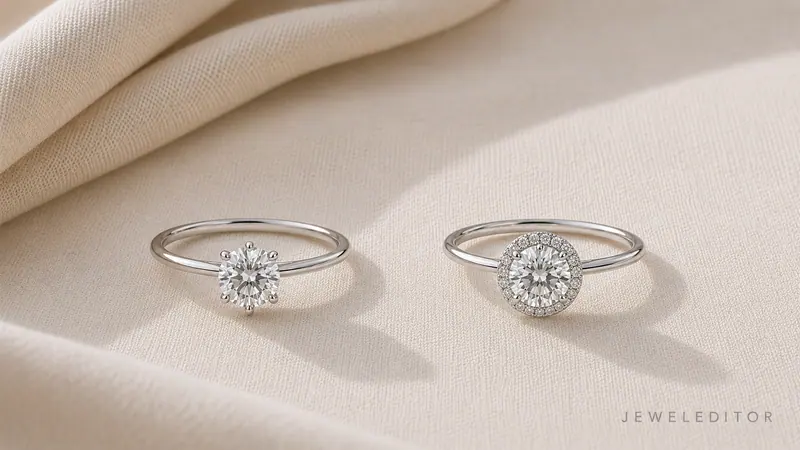
- Visible halo: accent diamonds set around the perimeter of the center stone at girdle level, visible from above. Adds face-up sparkle and visual size.
- Hidden halo: accent diamonds set below the center stone, visible from the side only. Adds side-profile detail; face-up look stays clean.
- Double halo: two concentric rings of accent diamonds, both visible from above. Adds maximum face-up sparkle.
- Cathedral solitaire with side accents: the band rises to the stone with accent diamonds along the rising shoulders, visible from the side but reading as a shoulder detail, not as a halo ring.
The hidden halo specifically refers to the band-of-melee-under-the-stone configuration. Some retailers use "peek-a-boo halo" or "secret halo" as alternate terms for the same setting.
Why hidden halo is having a moment
Three reasons, in the order they typically come up in buyer conversations:
1. It looks like a solitaire from above
The solitaire is the cleanest, most timeless engagement-ring silhouette, and the most universally flattering. The hidden halo preserves that face-up minimalism while adding the side-profile detail.
For buyers who want the visual purity of a solitaire but also want some additional detail beyond a plain prong setting, the hidden halo is the natural compromise. You don't sacrifice the top-down cleanness for the side-view interest.
2. The reveal is a feature, not a bug
There's a deliberate "show off when you want to" dynamic built into the hidden halo design that fits modern engagement-ring sensibilities. Worn casually, the ring reads quiet. Held up to the light at a side angle (for someone admiring it, for a photo, for a specific moment), the halo reveals. That reveal is what the buyer is paying for.
This is the under-marketed aspect: the hidden halo is not just a "subtle halo." It's a setting designed for the reveal moment.
3. Generational aesthetic shift
The Knot's 2025 Jewelry & Engagement Study reports that engagement-ring style preferences among buyers under 35 have shifted decisively toward "modern minimalist" and "quiet luxury" aesthetics, a category in which the hidden halo sits centrally. The visible-halo peak was 2015-2018; the hidden halo has been the rising alternative since 2020.
The same generational shift is driving the resurgence of bezel settings (see our bezel setting engagement rings guide) and the move toward east-west settings on fancy shapes. The unifying theme is restraint: engagement rings designed to recede into the hand rather than broadcast from it.
Hidden halo vs visible halo: the honest comparison
Both setting types use the same fundamental element (a ring of small melee diamonds), but they place that ring differently and produce different visual effects. The honest side-by-side:
| Property | Hidden halo | Visible halo |
|---|---|---|
| Face-up look | Clean solitaire | Halo-set (visible accent ring) |
| Side profile | Visible sparkle band | Visible sparkle ring (continuation of face-up halo) |
| Visual size effect | Subtle (side only) | Pronounced (face-up + side) |
| Style era | Modern, 2020s | Peak 2015-2018, still strong |
| Premium vs solitaire | +25-40% | +30-50% |
| Premium vs other halo | +10-20% (more skilled setting work) | reference |
| Best center-stone shapes | Round, oval, cushion | Round, oval, cushion, pear, emerald |
| Maintenance | Standard halo cleaning + occasional melee re-tipping | Same |
The hidden halo costs slightly more than a visible halo at the same melee count and metal because the setting work is more intricate. Positioning melee diamonds in the gallery below the center stone (with the right clearance, the right angle to catch side light and the right structural integration) requires more skilled bench work than setting a perimeter halo at the girdle.
The visible halo wins on face-up size enhancement. If the buyer is optimizing for "how big does the ring look from above," visible halo delivers that more directly. The hidden halo wins on face-up minimalism + side-profile detail: quiet from above, loud from the side.
Neither is objectively better. Match the choice to what the wearer actually wants. If the wearer prefers solitaires but wishes there were "a little something more," hidden halo is the natural fit. If the wearer wants a ring that reads as a halo from across the room, the visible halo is what delivers that.
Which center-stone shapes work with a hidden halo
The shape compatibility comes down to a single mechanical question: does the silhouette of the center stone integrate cleanly with the curved or rectangular silhouette of the halo ring below?
Strong fit:
- Round-brilliant: the natural pairing. Round center + round halo + clean concentric geometry. Round-brilliant is the dominant center-stone shape across hidden halo inventory at every major US retailer.
- Oval: works very well. The hidden halo's curve matches the oval's curvature, and the side-profile reveal complements the oval's elongation. Oval is the dominant non-round center stone across hidden halo inventory.
- Cushion: works well. The cushion's rounded-square corners flow into a hidden halo without geometric tension.
Awkward fit:
- Pear: the pointed tip creates a directional silhouette that the curved halo can't follow cleanly. The halo either has to be teardrop-shaped (rare and expensive) or it leaves a visual "tail" at the point.
- Marquise: same problem as pear, two pointed tips amplifying it. For the marquise-specific case for and against halos, see our marquise diamond engagement rings guide.
- Trillion: the 60° corners fight the curve of a continuous halo. Rarely attempted; rarely successful.
Possible but expensive:
- Emerald cut: works if the halo is rectangular and precisely sized to the emerald's footprint. This is bench work most retailers don't routinely offer; custom setting required.
- Asscher: similar to emerald; a square hidden halo is technically possible but custom only.
If you've already chosen a center-stone shape and you specifically want a hidden halo, this is the constraint check. Round, oval or cushion is the comfort zone. Pointed shapes need a different setting type.
What to look for when buying a hidden halo
The buying-decision framework, hidden-halo-specific.
Melee diamond quality is non-negotiable
The single most common compromise in cheap hidden halo settings is low-quality melee, the small accent diamonds used in the halo ring. Cheap melee shows up as dull, slightly yellow or eye-visibly included. When the halo's job is to provide the side-profile sparkle that justifies the premium, dull melee defeats the purchase.
What to specify:
- Color: G-H minimum. Same eye-clean standard you'd apply to the center stone. K-grade melee reads visibly warm; J-grade is the absolute minimum acceptable.
- Clarity: VS minimum. Melee diamonds at SI clarity often show visible inclusions even at small sizes, because the cut volume per stone is so small.
- Cut: round-brilliant melee, ideal cut. Most reputable retailers default to this; verify on the listing.
Cheap retailers will use "I-VS2" or "J-SI1" melee in hidden halo settings without disclosing it. The melee count alone isn't the right metric. Quality per melee diamond matters more.
Halo height affects the reveal
The hidden halo should be just below the girdle of the center stone, with enough vertical clearance that the melee diamonds catch side light but the halo doesn't peek out from the face-up view.
If the halo is set too high, it becomes visible from above and the "hidden" framing breaks. If it's set too low, the center stone covers it entirely from every angle including the side, and the halo never reveals.
The sweet spot: viewing the ring from slightly above level (the way someone glances at the wearer's hand) should show no halo; tilting toward a clearer side angle should reveal the full halo band.
Setting metal
- Platinum: durability gold standard, premium price, holds the small melee securely
- 14k white gold: practical alternative, slightly cheaper, requires rhodium replating every few years to maintain the white finish
- 14k yellow gold: works well, particularly with G-H melee that complements yellow metal
- Sterling silver: avoid; it tarnishes against skin oils and isn't durable enough for a halo setting
Center stone choice
The hidden halo's value proposition is the side-profile detail, but the center stone is still doing 80% of the visual work. Don't compromise on center-stone quality to afford the halo.
For the broader 4Cs framework on color, clarity, cut and carat allocation, see our Diamond Color Scale GIA guide for the color decision, our lab-grown diamonds for engagement rings guide for the lab-vs-natural decision and our engagement rings under $5,000 budget guide for budget allocation.
Where to buy a hidden halo engagement ring
Hidden halo selection varies widely by retailer: some specialize, some carry only token inventory. Our top recommendation is the retailer with the deepest hidden halo catalog plus transparent pricing and a grading report on every center stone (GIA on natural, mostly IGI on lab-grown).
Our top recommendation is Blue Nile for three reasons specific to hidden halo:
- Strong hidden halo inventory: Blue Nile carries hidden halo variants across most of their popular solitaire lines (including the Petite Cathedral family we recommend in our budget guide). Larger selection than most competitors at this price tier.
- Transparent melee specs on every listing: Blue Nile discloses melee color and clarity grades, which is the single most important quality check on hidden halo settings. Many competitors omit this.
- 30-day return + free resize. Critical for hidden halo because the side-profile reveal depends on finger angle. What looks right at one ring size may need adjustment after a few weeks of wear.
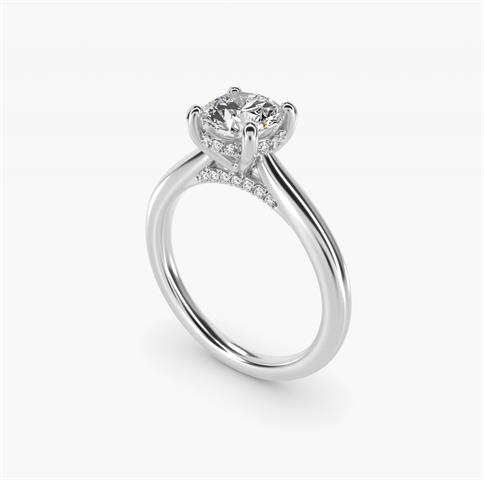
Petite Hidden Halo Solitaire Plus
14k white gold · 1.6 mm band
Best with a colorless stone
A slim band with the halo tucked under the stone: a solitaire from above, sparkle from the side.
$1,781 ring, from
$1,255 setting + $526 stone
Check price at Blue Nile: Petite Hidden Halo Solitaire Plus, 14k white gold (opens in a new tab)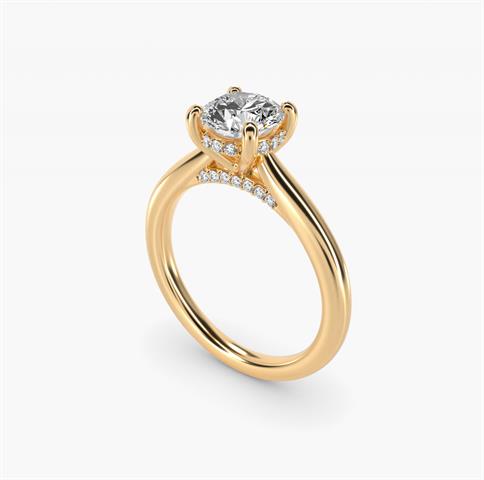
Petite Hidden Halo Solitaire Plus
14k yellow gold · 1.6 mm band
Best with a warmer stone
The same setting in yellow gold.
$1,781 ring, from
$1,255 setting + $526 stone
Check price at Blue Nile: Petite Hidden Halo Solitaire Plus, 14k yellow gold (opens in a new tab)Petite Hidden Halo Solitaire Plus
Platinum · 1.6 mm band
Best for holding the small stones
Platinum holds the small halo stones most securely over the years.
$2,291 ring, from
$1,765 setting + $526 stone
Check price at Blue Nile: Petite Hidden Halo Solitaire Plus, Platinum (opens in a new tab)Next: the diamond
We would pair these with a 1–2 ct lab-grown round, D to H color, VS2 or better.
What happens when you click: Blue Nile prices the setting and the stone separately. You open the setting, then choose a diamond, and it offers handpicked matches if you would rather not filter. Free shipping, free returns and a lifetime warranty at Blue Nile.
Prices checked September 24, 2026 at Blue Nile. Ring prices are the setting plus the cheapest stone at the spec above; most stones cost more than that. Prices change, so confirm at checkout. Product photos: Blue Nile. We earn a commission if you buy through these links.
Briefly on the others:
- James Allen: best-in-class 360° viewer, useful for inspecting the hidden halo's side profile before commit. Selection comparable to Blue Nile's.
- Brilliant Earth: strong hidden halo selection across their core collections; pricing runs slightly higher; sustainability narrative; recycled-platinum options available.
- Vrai: Diamond Foundry's lab-grown arm; modern hidden halo designs; smaller selection.
- With Clarity: currently holds the featured snippet for "hidden halo engagement ring"; strong inventory; pricing competitive on lab-grown.
If you find a specific hidden halo design you love at any of these retailers, buy it there. Editorial integrity beats brand loyalty.
Common mistakes when buying a hidden halo
Four patterns recur:
Mistake one: not specifying melee quality. Default-tier melee at cheap retailers can be I-J color and SI clarity, invisible at a glance but dull in person, especially under indoor lighting. Demand G-H color, VS clarity minimum. Confirm in writing before purchase.
Mistake two: choosing a pointed center-stone shape. Pear, marquise, trillion: the pointed tips fight the halo's curved silhouette. If you've fallen in love with a pear or marquise center, choose a different setting type (six-prong with V-tip protection works well; see our marquise guide).
Mistake three: letting the retailer set the halo too high. A hidden halo that's visible from the face-up view defeats its own purpose. Inspect from above before approving the setting. The face-up view should show no halo at all.
Mistake four: paying for the trend rather than the look. Hidden halo is a real setting with real visual benefits, but only for buyers who actually want side-profile detail. If you'd be just as happy with a plain solitaire (or a bezel or any other setting), the 25-40% premium is wasted. The trend isn't the product; the product is the side-profile reveal.
Closing: three things to take away
- Hidden halo is solitaire from above, halo from the side. That's the whole product. Buy it because you love the dual-view effect, not because it's trending.
- Melee quality decides whether the upgrade was worth it. G-H color, VS clarity minimum on the accent diamonds. Anything lower and the side-profile sparkle dulls.
- Round, oval and cushion only. Pointed center-stone shapes fight the halo geometry. If you want a pear or marquise center, choose a different setting.
If you want to run your budget against the broader spec framework, the Budget Calculator takes 30 seconds. Our recommended retailer for hidden halo is Blue Nile; we earn commissions on referrals there and disclose it because editorial integrity beats every other selling angle.
The TL;DR is this: a hidden halo engagement ring (or what some retailers also list as a hidden halo solitaire) is the quiet-luxury upgrade. Clean face-up minimalism, secret side-profile reveal. Done well, it's one of the strongest "engagement ring detail" choices in the contemporary market. Done cheaply, with bad melee, it's an expensive setting that doesn't earn its premium. Spec carefully and the upgrade is worth it.
Last audited: 2026-09-24, with every Blue Nile price rechecked against live listings that day. JewelEditor Editorial. Setting style commentary drawn from trade coverage in JCK Magazine and the International Gem Society research library, with engagement-ring trend data from The Knot's 2025 Jewelry & Engagement Study. Grading methodology for both center stones and melee diamonds drawn from the Gemological Institute of America and its 4Cs reference site. Pricing context via Mike Fried's Diamonds Pro buying guides.