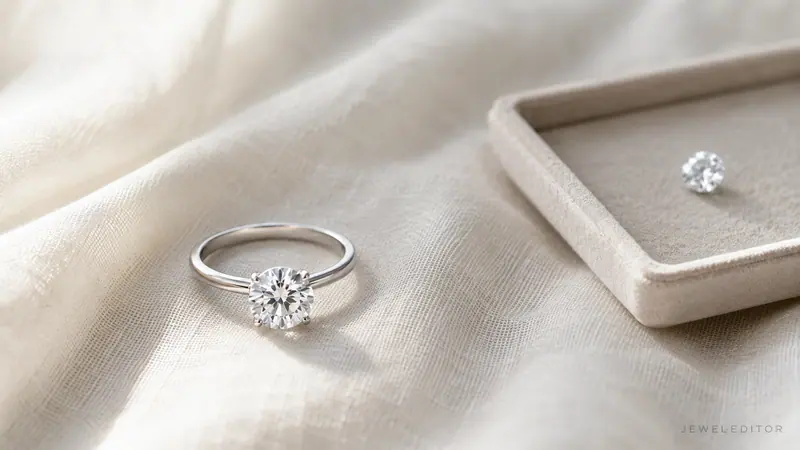
Most lab grown diamonds for engagement rings are sold on a single number: "save 60-80% versus natural." That number is real, but it's not why most buyers actually choose lab-grown. They choose lab-grown because they get roughly 2.5 times the carat at the same budget, and about double the face-up area. Size is the actual product. Savings is the marketing.
A lab-grown diamond is a real diamond, chemically identical to a natural one, grown in a lab over a few weeks instead of forming under the earth over a few billion years. This guide is the honest case for and against, plus the buying advice that doesn't show up in retailer copy.
Are lab-grown diamonds real diamonds?
Yes. And it's worth answering first because it's the most common objection buyers carry into the decision.
A lab-grown diamond has the same chemical composition (pure carbon, crystallized in the cubic diamond structure), the same hardness (10 on the Mohs scale), the same refractive index, the same dispersion and the same brilliance as a natural diamond. Under a jeweler's loupe, a 10× microscope or even most bench gemologists' eyes, the two are indistinguishable. The only reliable distinguishing tools are specialized gem-lab equipment (a spectrometer or a DiamondView fluorescence reader), and even those rely on subtle production-method signatures (HPHT or CVD), not on any difference in the diamond itself.
The Federal Trade Commission's 2018 ruling on the Jewelry Guides (16 CFR Part 23) explicitly approved calling lab-grown stones "diamonds" without qualifying language, finalizing what gemology had said for years. Lab-grown is not a "diamond simulant" (like cubic zirconia or moissanite); it is a diamond, grown via a different process.
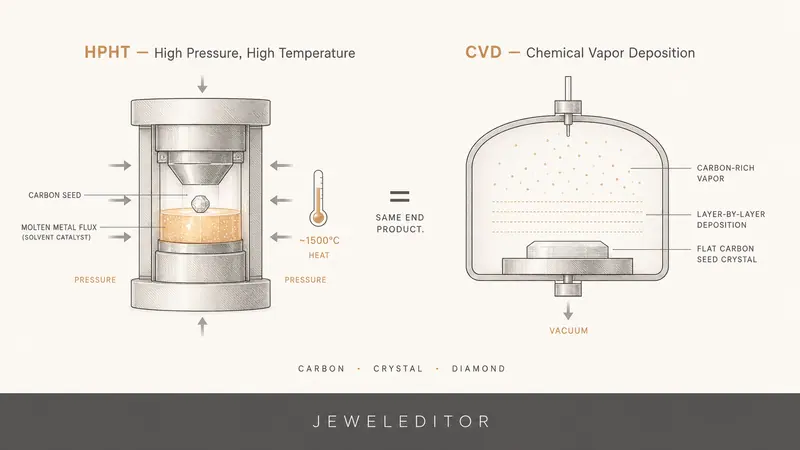
Two production methods coexist in the market:
- HPHT (High Pressure, High Temperature): simulates the geological conditions that form natural diamonds, with a small carbon seed exposed to ~5 GPa and ~1500°C. Most common in larger / higher-color-grade stones.
- CVD (Chemical Vapor Deposition): carbon atoms deposit layer by layer onto a seed crystal in a vacuum chamber. More common in smaller stones; allows tighter color control.
The end product is the same. Modern retailers rarely disclose which method produced a specific stone. For VS1+ clarity, the production method doesn't materially affect appearance.
How lab-grown compares to natural
Side by side, the practical truth:
| Property | Lab-grown | Natural |
|---|---|---|
| Chemical structure | Carbon, cubic crystal | Carbon, cubic crystal (identical) |
| Hardness (Mohs) | 10 | 10 |
| Brilliance / dispersion | Identical | Identical |
| GIA grading scale | D-Z (since 2019) | D-Z (since 1953) |
| Distinguishable to eye? | No | No |
| Distinguishable by jeweler? | No, without specialized equipment | No, without specialized equipment |
| Origin | Lab (weeks) | Underground (1-3 billion years) |
| Price at same spec | ~60-80% lower | reference |
| Resale value (5 years) | ~60-80% depreciation | ~30-50% depreciation |
| Kimberley Process required | No (not mined) | Yes (industry standard) |
The defining difference isn't visible. It's the origin story and the resale curve. Everything else is a chemistry and gemology tie.
The honest summary: if you wouldn't sell the ring under any circumstance, the resale argument is moot. That removes the single strongest reason to pay the natural premium. What's left is heritage, tradition and the geological story: all real, all subjective. Match the choice to your priorities, not to the seller's.
The honest economic case: size, not savings
Here's the reframe that the lab-grown market doesn't lead with, but should:
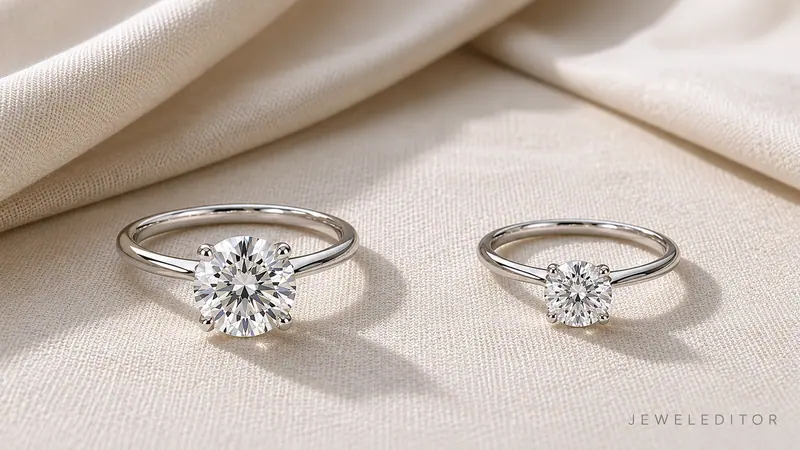
At a $5,000 budget, lab-grown gives you a 2.5-3.0 carat round-brilliant in D-F color, VS1 clarity or better, Ideal cut, about 8.7-9.3mm across the top of the stone. Natural at the same budget gives you 1.0-1.2 carats in G-H color, VS2 clarity, Excellent cut, about 6.4-6.8mm across. (Blue Nile listings, checked 24 September 2026.)
That's not "60% off the same ring." That's a noticeably bigger ring for the same money.
Most articles in this space lead with the discount. We lead with the size because that's what buyers actually shop for at the engagement-ring counter. The discount is the mechanism; size is the experience.
Two industry data points worth knowing:
- Lab-grown prices keep falling, faster than the trade press headlines suggest. Coverage in JCK Magazine has tracked steady annual declines for top color and clarity grades while natural stays flat to slightly up. Our own figures show how steep it has become: the 1.5ct D-VS1 stone this site quoted at about $3,500 in May 2026 started at about $1,010 when we rechecked Blue Nile on 24 September 2026.
- The gap with natural is now roughly tenfold at the top grades. On that same date, a 1.5ct D-VS1 lab-grown round started at about $1,010 at Blue Nile; the same spec in natural started at $9,901.
The Knot's 2025 Jewelry & Engagement Study reports the average US engagement-ring spend at $5,200. Among buyers under 35, lab-grown adoption is now a majority, driven primarily by the size advantage, not the savings story.
What to look for in a lab-grown engagement ring
The buying-decision framework. Specs first, then where the lab-grown market diverges from natural.
Cut grade is non-negotiable
Same rule as natural. Excellent cut only. A 1.0-carat Excellent-cut lab-grown looks bigger and brighter than a 1.3-carat Fair-cut at the same color and clarity, because cut determines light performance, and your eye reads light performance as "size." Walk away from "Very Good" cut at this price tier.
Grading report is non-negotiable
GIA or IGI. Both grade lab-grown on the same D-Z scale used for natural (GIA transitioned to letter grades for lab-grown in 2019, per their published methodology). AGS Laboratories ceased operations in early 2023, so any "AGS lab-grown" stone offered today is pre-2023 inventory. Walk away from any retailer that doesn't include a grading report with the stone. The 15-25% discount on un-graded lab-grown isn't worth the verification you lose.
Lab-grown D-VS1 is overpriced
This is the most under-discussed lab-grown buying trap.
Natural D-grade is rare. Of all natural diamonds graded by GIA, D-grade represents a small fraction of total output. That scarcity is the entire reason D commands a 25-35% premium over G (see our Diamond Color Scale GIA guide for the full premium structure). Lab-grown D is not rare. When a lab is calibrated for premium output, the production yield trends heavily toward D-F. Paying the D-grade premium in lab-grown is paying for the marketing of a grade label, not for the underlying scarcity that justifies the premium in natural.
G-H lab-grown used to be the practical answer for the median buyer: visually identical to D once mounted, and meaningfully cheaper. The second half of that is no longer true. When we filtered Blue Nile's 1.5-carat lab-grown rounds on 24 September 2026, D-F and G-H both started at about $1,010. Lab-grown colorless has stopped carrying a premium, so pick the stone that looks right in the video rather than the one that saves money on paper. The Color Grade Visualizer linked from the article above lets you compare grades side-by-side. On natural diamonds, where scarcity is real, the color discount still applies.
CVD vs HPHT: does it matter?
Most retailers don't disclose the production method. For VS1+ clarity stones in the D-G color range, the practical difference is minimal. A few things worth knowing:
- CVD can show subtle blue or grey undertones under fluorescent light in some cheaper / older production lines. Rare, but real. Always view a lab-grown stone in three light sources (direct sunlight, indoor incandescent, fluorescent) before committing.
- HPHT is more common in larger / higher-color stones because the process scales well for premium output.
- Both methods are legitimate. The bench-trained gemologist consensus is that production method matters less than cut grade, which matters less than light performance, which is what your eye actually reads.
Fluorescence
Lab-grown diamonds fluoresce less commonly than natural diamonds, and when they do, the fluorescence is far more common in HPHT stones than in CVD. The same buying logic applies as for natural: faint-to-medium blue fluorescence can be a value-engineering tool if you want a lower color grade to read warmer, but strong fluorescence in rare cases produces a milky appearance. View any fluorescent stone in daylight before buying.
Brand and boutique markups
Designer lab-grown brands such as Vrai, Lightbox (De Beers' lab-grown arm), Pandora and the lab-grown lines from traditional luxury houses typically carry substantial boutique markups (often 50% or more) over transparent retailers like Blue Nile, James Allen and Brilliant Earth at the same spec. The diamond inside a boutique ring is chemically the same lab-grown stone you'd find at a transparent retailer; only the brand premium changes. Pay for the stone and the metal, not for the brand premium that doesn't survive an independent appraisal.
Where to buy lab grown diamonds for engagement rings: our pick is Blue Nile
A handful of retailers do lab-grown well at the $3,000-$8,000 range; most are mediocre. We narrowed to five reputable US sellers that publish full GIA or IGI grading reports at this price tier and offer transparent pricing on loose lab-grown stones.
Our top recommendation is Blue Nile for three reasons specific to lab-grown:
- Largest US lab-grown inventory of any major retailer: tens of thousands of loose lab-grown stones in stock at any given time, across the engagement-ring spec range. Bigger inventory means you actually find the spec you want at the price you want, rather than settling.
- Transparent stone-by-stone pricing with GIA reports visible before commitment. No "starting at" tricks; every loose stone shows the full 4Cs spec and the report number.
- 30-day return policy with free shipping both ways, free first resize, lifetime warranty on the setting. Standard at this tier, but Blue Nile's execution is consistently rated above industry-norm.
We recommend Blue Nile because it's the strongest default for lab-grown specifically. We earn a commission on referrals through their affiliate program; the recommendation is editorial.
How Blue Nile compares to the rest
A 1.5ct lab-grown D-VS1 round started at about $1,010 at Blue Nile on 24 September 2026, with a solitaire setting to hold it at $935 to $1,635. Because lab-grown pricing is moving so quickly, compare two or three retailers on the day you buy rather than trusting any published figure, ours included.
Briefly, on each:
- Blue Nile: largest catalog depth, transparent stone-by-stone pricing, mostly IGI reports on lab-grown (some GIA and GCAL), free 30-day returns and one free resize in the first year. Our default recommendation.
- James Allen: best-in-class 360° viewer for remote stone inspection. Lab-grown selection smaller than Blue Nile's. Strong alternative if remote-inspection matters more than catalog breadth.
- Brilliant Earth: strong sustainability narrative (renewable-sourced lab-grown, beyond-conflict-free framing). Pricing runs slightly higher; selection more curated.
- Vrai: Diamond Foundry's retail arm. Strongest single-source traceability story (Vrai stones are grown at Diamond Foundry's facility in Washington State). Smaller catalog, more modern design language.
- Clean Origin: usually the cheapest of the five on lab-grown stones. Uses IGI grading rather than GIA. IGI is legitimate; GIA is the preferred report at this price tier.
If you find a specific stone you love at any of the four alternatives, buy it there. Editorial integrity beats brand loyalty. Blue Nile is the strongest default, not the only acceptable choice.
Editor's picks: two settings to pair with a lab grown diamond
Two settings from Blue Nile's catalog that pair well with a 1.5-carat lab-grown D-VS1 Ideal-cut stone (from about $1,010 on 24 September 2026). Each setting is independently priced; the stone is added at the design-your-own-ring step.
The value sweet spot: Petite Cathedral Solitaire in Platinum
With a 1.5-carat stone from about $1,010, the total here lands around $2,645, roughly half the $5,000 budget, leaving room for the first prong-check at year five (and for a bigger stone, if size matters more to you than the leftover). Same setting we recommend in our budget guide for engagement rings under $5,000; it's the cleanest value play at this tier.
The modern minimalist: Bezel Solitaire in 14k Yellow Gold
This is the setting from our bezel setting engagement rings guide. The combination of a bezel setting with a G-H grade lab-grown stone is the savviest pairing at this budget. The metal masks any near-colorless warmth, and the bezel adds visual weight that frames the stone without competing with it.
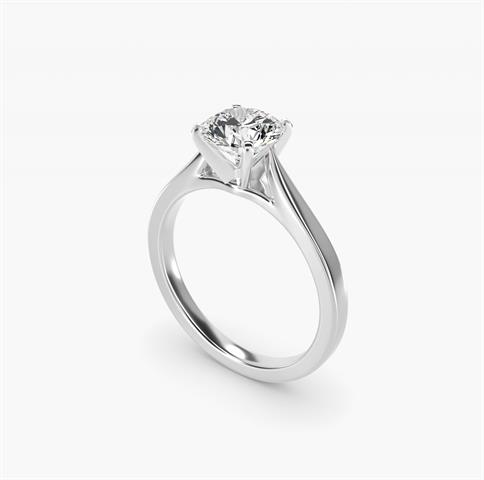
Petite Cathedral Solitaire
Platinum
Best for durability at this price
The value pick: durable platinum and a lifted stone that reads larger.
$2,645 ring, from
$1,635 setting + $1,010 stone
Check price at Blue Nile: Petite Cathedral Solitaire, Platinum (opens in a new tab)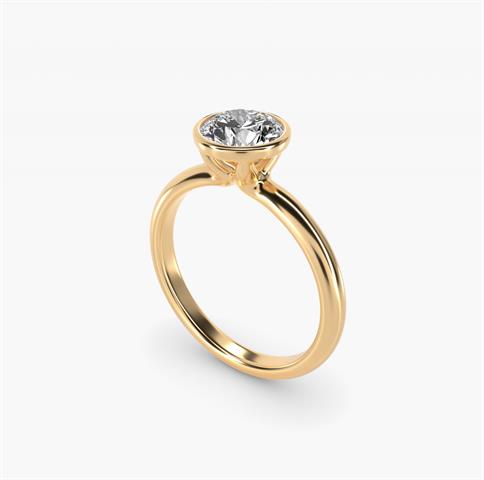
Bezel Solitaire
14k yellow gold · 2.5 mm band
Best for everyday wear
The modern pick: pairs well with a G or H lab-grown stone.
$2,320 ring, from
$1,310 setting + $1,010 stone
Check price at Blue Nile: Bezel Solitaire, 14k yellow gold (opens in a new tab)Next: the diamond
We would pair these with a 1.5–2 ct lab-grown round, G to H color, VS2 or better.
What happens when you click: Blue Nile prices the setting and the stone separately. You open the setting, then choose a diamond, and it offers handpicked matches if you would rather not filter. Free shipping, free returns and a lifetime warranty at Blue Nile.
Prices checked September 24, 2026 at Blue Nile. Ring prices are the setting plus the cheapest stone at the spec above; most stones cost more than that. Prices change, so confirm at checkout. Product photos: Blue Nile. We earn a commission if you buy through these links.
Common concerns and myths
Four objections that come up repeatedly in lab-grown buying decisions, and the honest framing for each:
"Lab-grown loses all its value over time." Resale depreciation is real: about 60-80% in the first five years for lab-grown versus 30-50% for natural. But the resale concern only matters if you'd ever sell the ring, and most engagement rings don't get resold. They stay in the family, get reset for the next generation or get insured at replacement value (which tracks current retail pricing, not original purchase). For the buyer who plans to keep or pass down the ring, depreciation is a footnote.
"My family will judge me for buying lab-grown." This perception is real but eroding fast. The Knot's 2025 Jewelry & Engagement Study reports lab-grown adoption among under-35 buyers is now a majority of new engagement-ring purchases. The "fake diamond" perception was strong in 2018-2020; by 2026 it's largely a generational artifact. If family opinion matters to you, the practical answer is to talk about it directly. Once people see a 1.5-carat lab-grown ring next to a 0.7-carat natural ring at the same budget, the conversation usually answers itself.
"Aren't natural diamonds more ethical now?" Both have honest ethics conversations, neither has a clean answer. The Kimberley Process Certification Scheme covers about 99.8% of global natural diamond production as conflict-free, with 60 participants representing 86 countries. Lab-grown has near-zero supply-chain conflict (no mining) but requires energy. Most US and European labs use renewable power; some Chinese and Indian facilities run on coal. If energy footprint matters to you, verify the source. If conflict-free sourcing matters more, both options have credible paths. Use case matters; there is no single ethical winner.
"Is it all just cheap CVD product?" No. HPHT and CVD coexist; premium lab-grown (1.5ct+ at D-G grades) is often HPHT; smaller or lower-grade stones are often CVD. Most reputable retailers don't disclose, and for VS1+ clarity it doesn't materially affect appearance. The fluorescent-light tint test (view the stone under fluorescent before committing) catches the rare cheap-CVD outliers.
Closing: three things to take away
- Lab-grown is the right move when size matters more than tradition. At $5,000, you get a 2.5-3.0 carat stone, about 2× the face-up area of natural at the same budget. You can also take the 1.5-carat version for about $2,645 and keep the rest.
- Color is no longer where the savings are. Lab-grown D isn't rare, but the market has already priced that in: D-F and G-H 1.5-carat rounds started at the same $1,010 at Blue Nile on 24 September 2026. Choose the grade you prefer on screen; on natural diamonds, dropping to G or H still saves real money.
- The resale argument applies only if you'd actually sell. Most engagement rings stay in the family. If that's your plan, the depreciation gap between lab-grown and natural is theoretical.
For the broader budget framework (what $5,000 actually buys, where to allocate between color, clarity, cut and carat), pair this guide with our Engagement Rings Under $5,000 guide. For the color-grade decision specifically, our Diamond Color Scale GIA guide includes an interactive visualizer that lets you compare any two grades side-by-side under different lighting and metal pairings.
The TL;DR is this: lab-grown isn't the cheaper option. It's the bigger option. And the bigger option is what most engagement-ring buyers actually want at this budget. The savings is the mechanism; the size is the experience. Match the choice to what the wearer will actually see.
If you want to run your own numbers, the Budget Calculator takes about 30 seconds. Our recommended retailer is Blue Nile; we earn a commission on referrals there, and we disclose that here because editorial integrity beats every other selling angle.
Last audited: 2026-09-24, with every Blue Nile price rechecked against live listings that day. JewelEditor Editorial. Lab-grown grading methodology drawn from the Gemological Institute of America and its 4Cs reference site. Industry pricing context via JCK Magazine's trade coverage of the lab-grown index and Mike Fried's Diamonds Pro pricing guide. Spending data via The Knot's 2025 Jewelry & Engagement Study. Conflict-free certification context via the Kimberley Process. FTC ruling on "diamond" terminology via the Jewelry Guides (16 CFR Part 23).