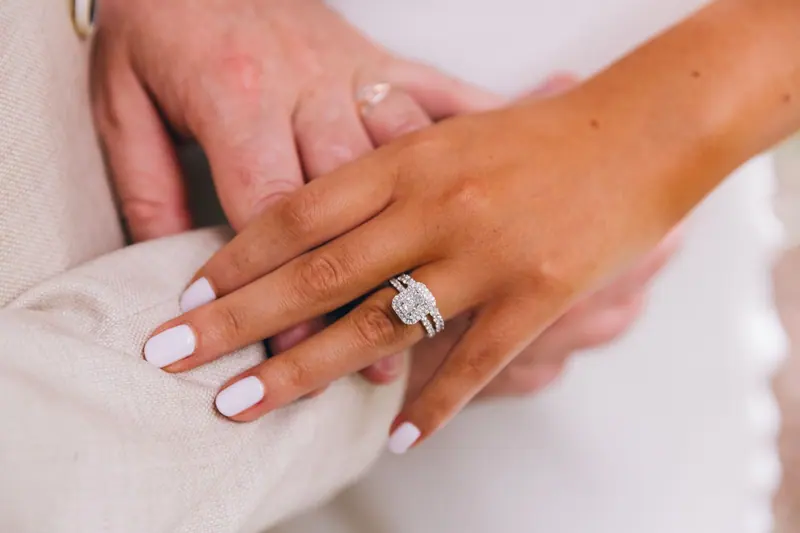
How big a 1-carat diamond actually looks
A 1.00-carat round-brilliant diamond cut to Excellent proportions has a face-up diameter of approximately 6.5 millimeters. The face-up area is about 33.2 mm².
For context:
| Carat weight | Face-up diameter (round-brilliant) | Face-up area |
|---|---|---|
| 0.50 ct | 5.2 mm | 21.2 mm² |
| 0.75 ct | 5.9 mm | 27.3 mm² |
| 1.00 ct | 6.5 mm | 33.2 mm² |
| 1.25 ct | 7.0 mm | 38.5 mm² |
| 1.50 ct | 7.4 mm | 43.0 mm² |
| 2.00 ct | 8.1 mm | 51.5 mm² |
A 1-carat stone reads as a clear, intentional engagement diamond: bigger than a "starter" stone, and below the size most couples now choose (see the average below).
What makes a 1-carat look bigger or smaller
Carat is weight, not size. Two 1-carat diamonds can look noticeably different depending on:
- Cut grade. An Excellent-cut 1.00 ct round-brilliant will face up at ~6.5mm. A Poor-cut stone with hidden weight in its depth might only show ~6.1mm, visibly smaller despite identical weight.
- Shape. Elongated shapes spread the carat weight across more surface area. A 1.00 ct marquise of about 10.2 × 5.1 mm has roughly 36 mm² of face-up area, about 10% more than a 1 ct round, and looks much longer on the finger.
- Setting. A halo setting makes the center stone read larger from above. A bezel setting can make it read slightly smaller.
- Hand size. A 1.00 ct on a size 4 finger looks much bigger than on a size 8 finger.
How a 1-carat compares to common reference points
- About one-third the diameter of a US dime (a dime is 17.9mm wide; a 1-carat round at 6.5mm is roughly 36% of that)
Is 1 carat a good engagement ring size?
Yes, though it is no longer the typical size. According to The Knot's study of couples married in 2025, the average center stone is 1.9 ct: 2 ct for lab-grown and 1.6 ct for natural. A 1 ct natural diamond is still a classic, meaningful size.
If you have a budget under $4,000 and want a natural diamond, 1 carat may push your color/clarity grades down further than you'd like, in which case a slightly smaller stone at higher grades can look better. The cheapest 1 ct natural round at G or better, VS2 or better, Excellent cut was $3,261 at Blue Nile on 7 October 2026. If you're going lab-grown, $4,000 buys a 3-carat stone: the cheapest 3 ct lab-grown round was $2,912 that day (F-VS1), per our price check.
The honest take
A 1-carat diamond is "big enough." It's not small. It will be noticed. But it's also not the size that turns heads from across the room. That conversation starts around 2 carats. If "looks substantial in photos" matters to you, consider 1.25-1.50 carats. If "looks tasteful on the hand daily" matters more, 1 carat is the safest, most flattering choice.