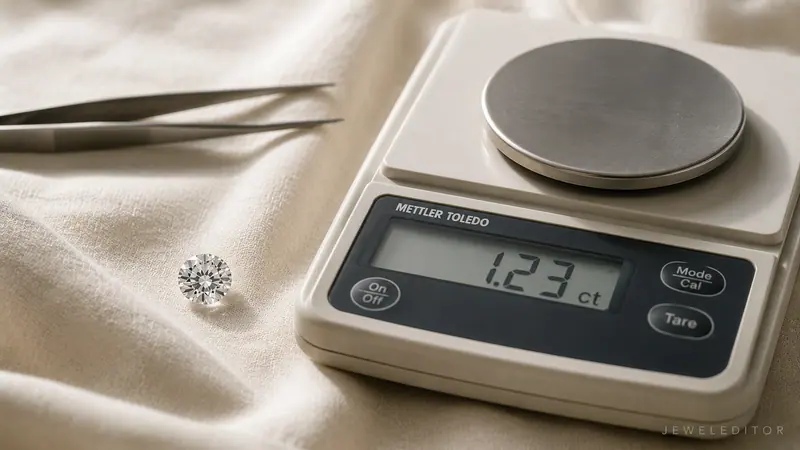
What does carat mean? In plain language: it's the unit of weight used to measure diamonds and other gemstones. One carat equals 0.2 grams (200 milligrams), about the weight of three grains of rice. The carat is one of the four Cs that determine a diamond's spec, and it's the one most buyers fixate on without fully understanding what it measures.
This guide is the working layer of carat. What it actually means, the millimeter conversions that matter to your eye, the pricing thresholds where small carat differences create big dollar differences and the cut-vs-carat tradeoff that determines what your money actually buys.
What does carat mean? The definition, plain
The carat is a unit of weight specifically used for gemstones: diamonds, rubies, sapphires, emeralds and others. The unit dates back to ancient gem trading, when small standardized weights were needed to measure stones too small for grain-scale measurement. The word ultimately derives from the Greek kerátion (the carob seed and the unit of weight derived from it), through the Arabic qīrāṭ and medieval Latin carratus. Carob seeds weigh roughly 0.2 grams on average, though seeds vary, which is why the unit was standardized to exactly 200 milligrams at the Fourth General Conference on Weights and Measures in 1907.
One carat = 0.2 grams = 200 milligrams.
A few practical reference points:
- A US penny weighs about 12.5 carats (2.5 grams).
- A US dime weighs about 11.3 carats (2.27 grams).
- A drop of water weighs about 0.25 carat.
- Three grains of rice weigh roughly one carat.
- A 1.0-carat diamond weighs roughly the same as a couple of peppercorns or a small paperclip.
The carat is divided into 100 points for precision. A 1.50-carat diamond is "150 points"; a 0.75-carat diamond is "75 points." GIA grading reports document carat weight to the second decimal place (e.g., "1.45 ct" or "1.50 ct"), making the distinction between 1.49 and 1.50 carats meaningful, both visually (barely) and in pricing (substantially, due to the magic-size threshold at 1.50).
Carat vs karat: the gold confusion
Two words, near-identical pronunciation, completely different meanings.
- Carat (with a C) measures the weight of gemstones. Used for diamonds, sapphires, rubies, etc.
- Karat (with a K) measures the purity of gold. A 24-karat ring is pure gold; an 18-karat ring is 75% gold; a 14-karat ring is 58.3% gold; a 10-karat ring is 41.7% gold.
Both terms descend from the same ancient root (the carob seed), but their evolution diverged. Gem-trade carat became the weight unit for gemstones. Goldsmith karat became the purity unit for gold alloys.
The practical takeaway for an engagement-ring buyer: a "1.5-carat diamond in a 14-karat gold setting" means a 1.5-carat-weight diamond (0.3 grams) in a setting made of 58.3%-pure gold. Two different units, two different things.
Carat measures weight, but what you see is size
The most-overlooked thing about carat as a buying spec: it measures weight, not visible size. The two correlate, but they're not the same thing.
What your eye reads when you look at a diamond from above is face-up area, the millimeter dimensions of the stone as seen from the table (top). Face-up area depends on:
- Carat weight (heavier = generally bigger)
- Cut proportions (deeper cuts have smaller face-up area for the same weight)
- Shape (different shapes have different face-up areas per carat)
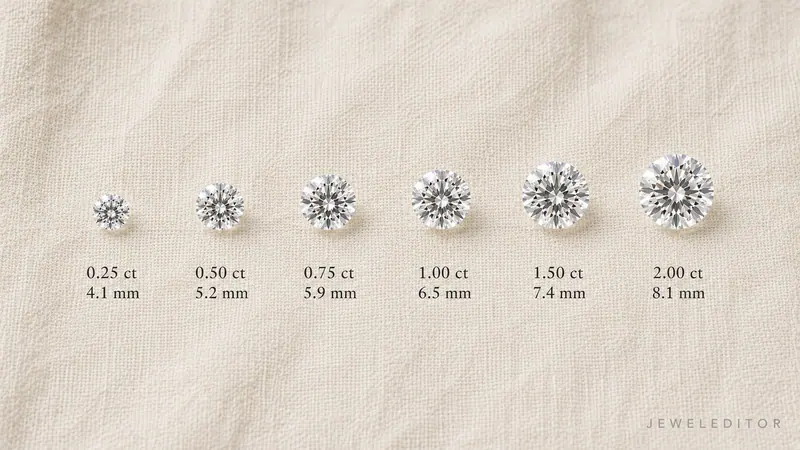
A well-cut round-brilliant 1.0-carat diamond measures about 6.5 mm in diameter. A poorly-cut 1.0-carat diamond (same weight, more pavilion depth) can measure as little as 5.8 mm in diameter. Same carat number; meaningfully different visual size.
The millimeter conversion table for round-brilliant diamonds at standard cut proportions:
| Carat | Diameter | Face-up area |
|---|---|---|
| 0.25 ct | 4.1 mm | 13.2 mm² |
| 0.50 ct | 5.2 mm | 21.2 mm² |
| 0.70 ct | 5.7 mm | 25.5 mm² |
| 1.00 ct | 6.5 mm | 33.2 mm² |
| 1.25 ct | 7.0 mm | 38.5 mm² |
| 1.50 ct | 7.4 mm | 43.0 mm² |
| 1.75 ct | 7.8 mm | 47.8 mm² |
| 2.00 ct | 8.1 mm | 51.5 mm² |
| 2.50 ct | 8.7 mm | 59.4 mm² |
| 3.00 ct | 9.3 mm | 67.9 mm² |
For non-round shapes, face-up area per carat varies significantly. The marquise has the highest face-up area per carat of any common shape (24% more than a round at the same weight); the cushion has the lowest (about 28% less than a round). For the shape-specific dimensions, see our marquise diamond engagement rings guide.
The magic-size thresholds: where prices jump
Diamond pricing isn't perfectly linear with carat weight. It has magic-size thresholds at round-number carat weights (most notably 1.00, 1.50 and 2.00) where consumer demand concentrates and prices jump.
The mechanics:
- On 24 September 2026, natural rounds at G-H color and VS2 clarity started at $2,746 once they crossed 1.00 carat.
- The same spec just under the line, at 0.90 to 0.99 carat, started at $1,960.
- That is about 40% more to cross a threshold worth roughly a tenth of a millimetre in width.
- Visually, the 6.4 mm diameter of the 0.95 ct vs the 6.5 mm of the 1.00 ct is functionally indistinguishable. You'd need calipers to detect.
The pattern repeats at 1.50 ct (a 1.45 ct stone is meaningfully cheaper than a 1.50 ct at the same spec) and 2.00 ct (a 1.95 ct stone is meaningfully cheaper than a 2.00 ct).
This is the "just-under-the-threshold" value play. For buyers who care more about value than about saying "I got her a 1-carat diamond" (or hitting any specific round-carat number), buying just under a threshold can save a third or more with no visible difference. The wearer's eye sees a 6.4 mm diamond; the budget reflects a 0.95-ct purchase.
A few caveats:
- The just-under-threshold stones have slightly lower resale value because the resale market also values round-carat numbers. If resale matters, stay at or above the threshold.
- The market for just-under-threshold stones is smaller; some retailers don't carry them. Blue Nile, James Allen and Brilliant Earth all maintain inventory of "off-size" stones; smaller retailers may not.
- Marketing language matters. A "1-carat-look" diamond at 0.92-0.95 ct is honest; a "1-carat" diamond at 0.92-0.95 ct is misleading. Always confirm precise carat weight on the GIA report.
For the broader buying-decision context at the engagement-ring tier, see our engagement rings under $5,000 budget guide, which covers the cut-vs-carat tradeoff and budget allocation across the four Cs.
Cut grade matters more than carat weight
The single most important point about carat as a buying spec: cut grade determines how big the diamond looks more than carat weight does.
A 1.0-carat Excellent-cut round-brilliant has proper proportions (pavilion depth 41-43%, table width 53-58%, crown angle 34-35°). Light enters the stone, bounces off the pavilion facets and returns through the table, creating the brilliance that the eye reads as both "sparkle" and "size."
A 1.3-carat Fair-cut round-brilliant has poor proportions: typically too-deep pavilion or too-wide table. Light leaks out the bottom instead of returning through the top. The stone reads as dull, and counterintuitively, it can look smaller than the well-cut 1.0-carat stone, because cut affects face-up brilliance, and brilliance affects how the eye perceives size.
The practical rule: optimize cut first, carat second. A 1.0-carat Excellent-cut diamond at G-color, VS1 clarity in a quality setting looks better than a 1.3-carat Fair-cut diamond at the same color and clarity in the same setting, despite the 30% weight advantage on the larger stone.
For the underlying grading methodology (including how GIA actually evaluates cut quality, why fancy shapes don't get a cut grade and what to do when the report doesn't tell you everything), see our GIA diamond grading guide. For the color-grade decision that pairs with carat (which grades you can see, which you can't), see our Diamond Color Scale GIA guide.
Carat weight in lab-grown vs natural
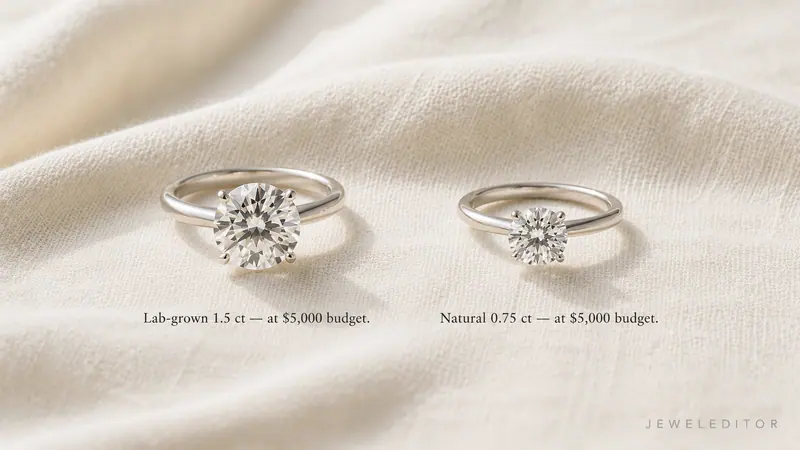
At the same dollar budget, lab-grown diamonds now give roughly 2.5 times the carat weight of natural diamonds. A $5,000 engagement-ring budget delivers a 2.5-3.0-carat lab-grown stone in D-F color, VS1 or better, or a 1.0-1.2-carat natural stone in G-H VS2 Excellent cut.
That's the lab-grown carat advantage in plain terms: same dollars, about two and a half times the carat and roughly double the face-up area.
The chemical and visual properties of the diamond are identical between lab-grown and natural at the same carat weight; only the origin (lab vs underground) and the resale-value curve differ. For the full lab-grown decision framework (including the size-not-savings reframe and the buying considerations specific to lab-grown), see our lab grown diamonds for engagement rings guide.
The carat-by-budget conversion, from Blue Nile listings checked 24 September 2026. Each row assumes about $935 of the budget goes to the setting, and uses the cheapest listing at that spec, so treat it as the ceiling rather than the average:
| Budget | Lab-grown carat | Natural carat |
|---|---|---|
| $1,500 | 1.0-1.2 ct | 0.4-0.5 ct |
| $3,000 | 2.0-2.2 ct | 0.9-1.0 ct |
| $5,000 | 2.5-3.0 ct | 1.0-1.2 ct |
| $8,000 | 3.5-4.0 ct | 1.3-1.5 ct |
| $12,000 | 4.5-5.0 ct | 1.6-1.8 ct |
For carat weight at the median US engagement-ring spend ($5,200 per The Knot's 2025 Jewelry & Engagement Study), the lab-grown carat is 2.5-3.0 (unmistakable); natural carat is 1.0-1.2 (classic and proportional).
Common carat misconceptions
Four patterns recur in buyer confusion about carat:
Misconception 1: "Bigger carat = better diamond." Carat is one of four Cs; cut grade often matters more for visible quality. A 1.0-carat Excellent-cut beats a 1.3-carat Fair-cut at the same color and clarity. Optimize for cut, then carat.
Misconception 2: "Carat means size." Carat means weight. Visible size correlates with weight but also depends on cut proportions and shape. Always look at millimeter dimensions on the GIA report, not just carat weight.
Misconception 3: "Round numbers are worth the premium." The 10-15% price jump at 1.00, 1.50 and 2.00 carats is real but functionally invisible. A 0.95 ct or 1.45 ct stone looks the same to the wearer's eye but costs 8-12% less. For value buyers, just-under-threshold is the sweet spot.
Misconception 4: "Carat affects sparkle." No. Cut affects sparkle. A 2.0-carat poorly-cut diamond can look duller than a 1.0-carat Excellent-cut. Carat affects perceived size (which the brain conflates with "presence") but not the optical performance that creates sparkle.
Closing: three things to take away
- Carat measures weight, not size. The unit is precise (1 carat = 200 milligrams) but doesn't directly translate to face-up area. Millimeter dimensions on the GIA report are what matters to your eye.
- Magic-size thresholds cost extra. Buying 0.95 ct or 1.45 ct saves 8-12% over the equivalent 1.00 ct or 1.50 ct. The savings is real; the visible difference is functionally zero.
- Cut grade decides how big the diamond looks. A 1.0-carat Excellent-cut looks bigger and brighter than a 1.3-carat Fair-cut at the same color and clarity. Optimize cut first.
For the carat-per-budget framework specifically, see our engagement rings under $5,000 guide. For the lab-grown carat advantage, see our lab grown diamonds for engagement rings guide. For the underlying GIA grading methodology that determines all four Cs (including how cut affects what carat actually looks like), see our GIA diamond grading guide.
If you want to run your specific budget against the carat-by-spec framework, the Budget Calculator takes about 30 seconds.
The TL;DR is this: carat is a unit of weight, not of size or quality. What your money buys at any carat weight depends on cut grade more than on the weight itself. Optimize cut, choose just-under-threshold weights for value and remember that the wearer's eye reads millimeters, not carats.
Last audited: 2026-09-24, with the carat-by-budget figures rechecked against live Blue Nile listings that day. JewelEditor Editorial. Carat definition and gemological methodology drawn from the Gemological Institute of America and its 4Cs reference site, with cross-references to the International Gem Society research library. Pricing context via Mike Fried's Diamonds Pro buying guides. Engagement-ring spending data via The Knot's 2025 Jewelry & Engagement Study. Industry coverage via JCK Magazine.