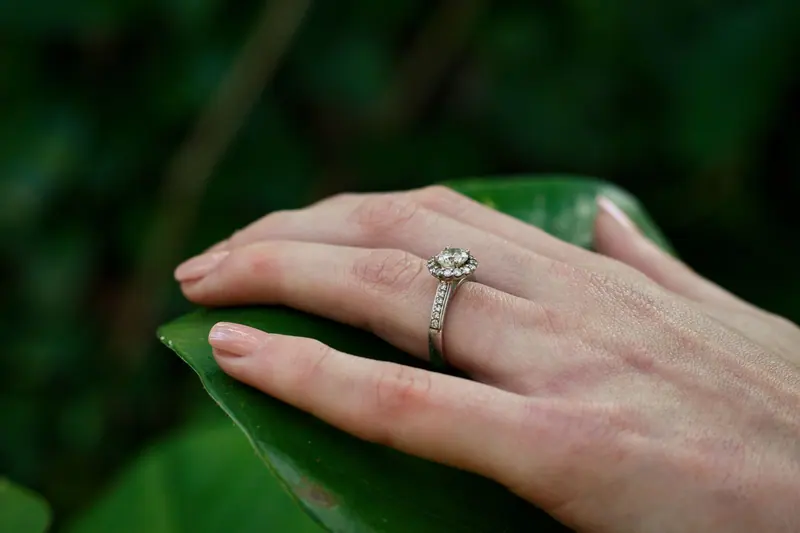
How big a 0.75-carat diamond actually looks
A 0.75-carat round-brilliant diamond cut to Excellent proportions faces up at approximately 5.9 millimeters, about 27.3 mm² of visible surface area.
For context, that's about 9% smaller in diameter (18% smaller in face-up area) than a 1.0 ct stone and 20% smaller in diameter (37% smaller in area) than a 1.5 ct stone:
| Carat weight | Face-up diameter | Face-up area | vs 0.75 ct |
|---|---|---|---|
| 0.50 ct | 5.2 mm | 21.2 mm² | -22% area |
| 0.75 ct | 5.9 mm | 27.3 mm² | baseline |
| 1.00 ct | 6.5 mm | 33.2 mm² | +22% area |
| 1.25 ct | 7.0 mm | 38.5 mm² | +41% area |
| 1.50 ct | 7.4 mm | 43.0 mm² | +58% area |
To put 5.9mm in everyday terms: it's slightly larger than a #2 pencil eraser and about the size of a green pea's diameter. On a typical size 6 finger, a 0.75 ct stone covers a clearly visible, substantial portion of the visible finger area, but not the dominant feature.
The "value sweet spot" math
This is the underrated case for 0.75 ct. Diamond prices jump significantly at every "magic size" threshold (0.50, 0.75, 1.00, 1.50, 2.00 ct) because of demand bunching at the round numbers. 0.75 ct sits below the 1.00 ct demand spike, meaning you get most of the visual presence of a 1-carat stone at roughly 60-65% of the price.
Comparing 0.75 ct vs 1.00 ct at the same color, clarity and cut, from Blue Nile listings checked 24 September 2026. Lab-grown figures are D-F, VS1 or better (Blue Nile had no G-H stones listed at 0.75 ct that day); natural figures are G, VS1:
| Type | 0.75 ct typical price | 1.00 ct typical price | Difference |
|---|---|---|---|
| Lab-grown | from $465 | from $526 | about 12% less for 0.75 ct |
| Natural | from $1,144 | from $3,402 | about 66% less for 0.75 ct |
In return for the savings, you give up 0.6mm of face-up diameter, about the difference between a #2 pencil eraser and a slightly larger #3. Most non-jewelry-people would not notice the difference on someone's hand without comparing side-by-side.
Where 0.75 ct fits culturally
Reference data from The Knot 2025 Jewelry & Engagement Study puts the US average engagement ring at 1.0-1.2 carats. So a 0.75 ct stone is smaller than the average but firmly within the engagement-ring range.
How people read it on the hand:
- Up close: A clear, deliberate diamond. Not "tiny," not "huge." Reads as tasteful.
- At arm's length: Visible as a center stone but not attention-grabbing.
- In photos: Photographs well, especially with a slim band and bright lighting. Less dominant than a 1 ct in tight close-ups.
When 0.75 ct is the right call
- Budget is under $1,500, and you'd rather have a quality 0.75 ct (Excellent cut, VS1, G color) than a sketchy 1 ct (Good cut, SI2, J color)
- You prefer the subtle, elegant look to the obvious statement
- Your partner has a small finger (size 4-5): a 0.75 ct can look proportionally larger than the same stone on a size 7-8 finger
- You value cut quality over carat: better to have a brilliant 0.75 ct than a flat 1.0 ct
- You want to leverage the magic-size pricing penalty: on natural stones that penalty is severe. On 24 September 2026 a 0.75 ct natural G-VS1 started at $1,144 against $3,402 once the weight crossed 1.00 ct, for 0.6mm of extra width
When 0.75 ct is too small
- Your partner has explicitly said they want a "big" or "noticeable" ring: 0.75 ct will not deliver that perception
- Your hand is larger (size 8+): the stone may look smaller than you expect on a wider finger
- You're shopping in the $2,000+ budget range: at that budget a lab-grown 1.5 ct ring is achievable (about $1,945 with a $935 setting), which is meaningfully more visual presence
- You expect to wear it daily for decades and want to feel it grows with you: many buyers eventually want to upgrade smaller stones
The "looks bigger" lever
If 0.75 ct's visual size feels too modest but the budget is fixed, three tactics extend the perceived size:
- Elongated shape: A 0.75 ct oval faces up roughly 6.7 × 4.8 mm, visually similar to a 0.85-0.9 ct round
- Halo setting: A 0.75 ct in a halo can read like a 1.0-1.1 ct solitaire from the right angle
- Slim band: A 1.5mm band (vs the standard 2.0mm) makes the same stone look proportionally larger
The honest take
0.75 ct is one of the smartest under-the-radar carat choices in the market. It delivers ~85% of the 1-carat visual presence at ~60% of the price, sits comfortably within the engagement-ring norm, and lets you spend the saved budget on better cut/color/clarity (which actually affect sparkle more than the carat difference). The downside is purely about perception: if "below 1 carat" feels emotionally smaller to you or your partner regardless of the actual visual difference, no amount of math will change that. But on pure aesthetics-per-dollar, 0.75 ct is hard to beat.