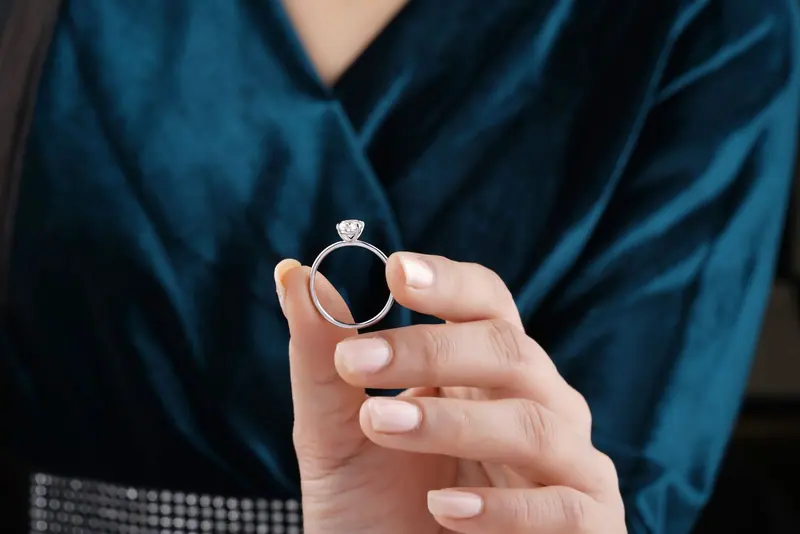
How big a 1.5-carat diamond actually looks
A 1.50-carat round-brilliant diamond cut to Excellent proportions faces up at approximately 7.4 millimeters, about 43.0 mm² of visible surface area, or roughly 30% more face-up than a 1.00-carat stone.
Here's the size ladder for reference:
| Carat weight | Face-up diameter | Face-up area | vs 1.0 ct |
|---|---|---|---|
| 1.00 ct | 6.5 mm | 33.2 mm² | baseline |
| 1.25 ct | 7.0 mm | 38.5 mm² | +16% |
| 1.50 ct | 7.4 mm | 43.0 mm² | +30% |
| 1.75 ct | 7.8 mm | 47.8 mm² | +44% |
| 2.00 ct | 8.1 mm | 51.5 mm² | +55% |
The visual jump from 1 ct to 1.5 ct is noticeable. Most people register a 1.5 ct stone as "big" or "really big" at a glance, particularly on a size 4-6 finger, where the proportional impact is larger.
What 1.5 ct costs (September 2026)
Lab-grown vs natural makes a dramatic difference at this size:
- Lab-grown 1.5 ct (G-H color, VS1 or better, Ideal cut): from about $1,010 for the stone alone, with most listings under $1,600
- Natural 1.5 ct (G color, VS1, Excellent cut): from about $8,150 for the stone alone, with most listings between $9,000 and $12,500
That's why 1.5 ct is the size where many buyers cross from natural to lab-grown: the visual impact is the same, the price difference is 5-7×.
Where 1.5 ct fits in the cultural register
1.5 carats sits in an interesting position. According to The Knot 2025 Jewelry & Engagement Study, the average US engagement ring is 1.0-1.2 carats. So a 1.5 ct stone reads as above average without crossing into "this is conspicuously expensive" territory.
In comparison:
- 0.5-0.9 ct → "tasteful," "subtle," "elegant"
- 1.0-1.2 ct → "classic," "traditional"
- 1.3-1.7 ct → "substantial," "noticeable"
- 1.8-2.5 ct → "bold," "statement"
- 3.0+ ct → "wealth signaling"
The 1.5 ct stone gets the visual impact most buyers want without putting them in the statement-piece category. It's a common sweet spot.
The "magic size" pricing penalty
Natural diamond prices jump 10-15% at the 1.50 ct threshold specifically because of demand bunching at the round number. If you're shopping naturals, a 1.45 ct stone at the same color/clarity grade is typically 10-12% cheaper than 1.50 ct with essentially zero visible difference (the diameter delta is about 0.1mm, invisible to the eye).
The same threshold effect happens at 1.00, 1.50, and 2.00 ct. Buying 0.95, 1.45, or 1.95 is the standard hack for value-conscious buyers.
The honest take
A 1.5-carat diamond is genuinely big: not a "starter" stone, not "average," and not a statement piece. It's the size where most non-jewelry-people will say "wow" when they see it without thinking "that must have cost a fortune." For most modern buyers (especially those choosing lab-grown), it's the new default ambition target: substantial visual impact at a price that no longer requires a second mortgage.