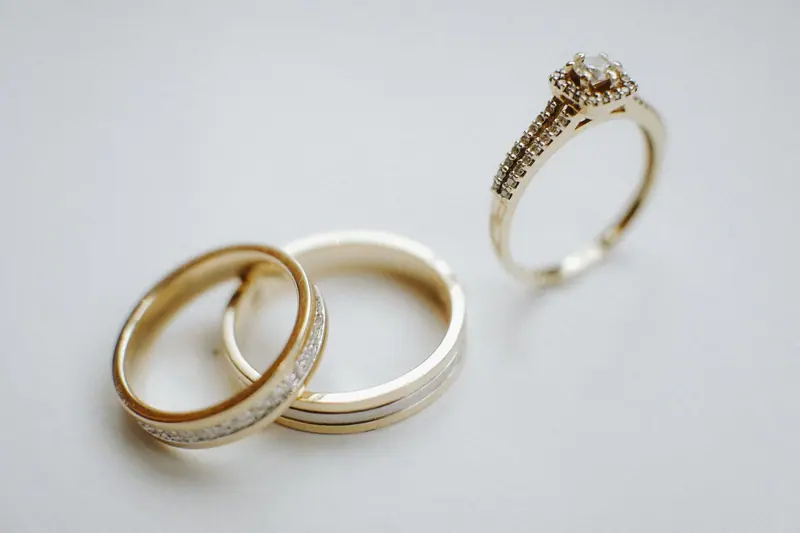
The difference between 14k vs 18k gold is how much of the metal is actually gold. 18k gold is 75% gold and 14k gold is 58.3% gold; the rest is alloy metals mixed in for strength and color. That difference shows up in three places: price, color and wear.
To put a number on the price, on 14 October 2026 we priced the same pieces in both karats at three retailers. At Blue Nile, 18k added 16% to 44% to six engagement ring settings. At Capucinne it added about $100 to almost every ring. Below is what drives that difference and how to choose.
What karat actually means
Karat measures how much of the metal is gold, in parts out of 24. Pure gold is 24 karat: the FTC's Jewelry Guides describe it as "fine (24 karat) gold." Everything below that is an alloy, and GIA spells out the two common ones: 18K is 18 parts gold and six parts alloying metals, or 75% gold, and 14K is 14 parts gold and 10 parts alloy, or 58.3% gold. By the same arithmetic, 10k is 41.7% gold.
| Karat | Gold content | Alloy content |
|---|---|---|
| 24k | 100% | 0% |
| 18k | 75% | 25% |
| 14k | 58.3% | 41.7% |
| 10k | 41.7% | 58.3% |
The label is regulated. Under the FTC Jewelry Guides, a seller may not call an alloy simply "gold": the karat has to appear right before the word, at least as prominently. The marking also has to be accurate within a small legal tolerance of three parts per thousand, or seven if the piece contains solder (16 CFR 23.3). The same Guides set the rules for jewelry that only has gold on the surface, such as gold plated and gold vermeil, which is sterling silver with a gold layer.
The price difference, measured
Here is what the same ring cost in each metal at Blue Nile on 14 October 2026. These are setting prices only, before any center stone.
| Setting | 14k | 18k | 18k costs |
|---|---|---|---|
| Petite Solitaire | $1,000 | $1,155 | +16% |
| Bezel Solitaire | $1,310 | $1,620 | +24% |
| Petite Hidden Halo | $1,255 | $1,600 | +28% |
| Tapered Cathedral | $1,240 | $1,620 | +31% |
| Classic Comfort Fit, 2.5mm | $935 | $1,310 | +40% |
| Petite Cathedral | $1,015 | $1,465 | +44% |
Two things stand out.
The premium is not a fixed percentage. Moving from 14k to 18k added $155 to the slim Petite Solitaire and $450 to the Petite Cathedral. Blue Nile does not publish metal weights, but the likeliest reason is how much metal each design uses: a cathedral's raised shoulders or a wider comfort-fit band holds more gold than a slim band, so raising its gold content costs more. If you are comparing two settings, compare their 18k prices directly rather than assuming a standard markup.
Color made no difference to price. On all six settings, 14k white, yellow and rose gold were the same price, and so were 18k white and yellow. The karat sets the price; the color is a free choice.
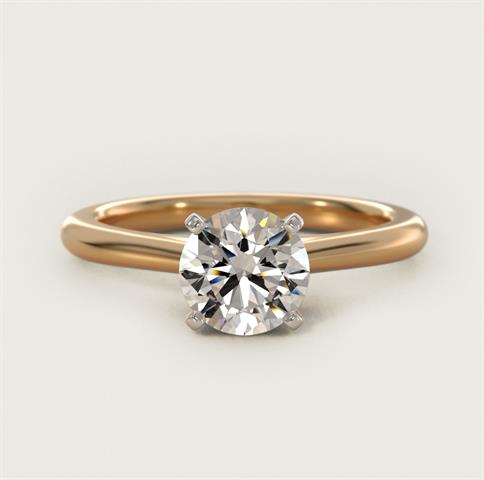
Petite Solitaire
14k yellow gold
The smallest 18k premium we found: $155 more in 18k.
$1,000 setting only
Check price at Blue Nile: Petite Solitaire, 14k yellow gold (opens in a new tab)Petite Solitaire
18k yellow gold
The same slim band with 75% gold instead of 58.3%.
$1,155 setting only
Check price at Blue Nile: Petite Solitaire, 18k yellow gold (opens in a new tab)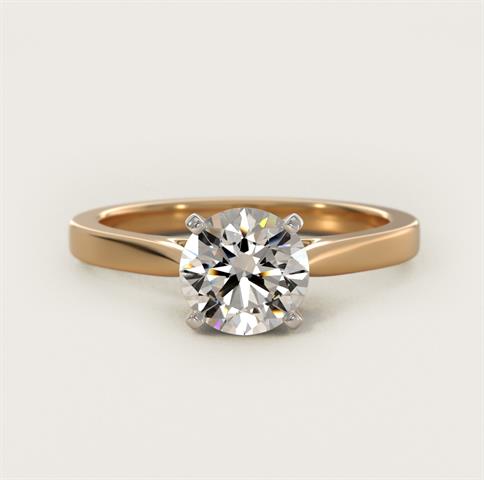
Petite Cathedral Solitaire
14k yellow gold
The largest 18k premium we found: $450 more in 18k.
$1,015 setting only
Check price at Blue Nile: Petite Cathedral Solitaire, 14k yellow gold (opens in a new tab)Petite Cathedral Solitaire
18k yellow gold
Raised shoulders lift the stone; 44% more than the 14k version.
$1,465 setting only
Check price at Blue Nile: Petite Cathedral Solitaire, 18k yellow gold (opens in a new tab)What happens when you click: Blue Nile prices the setting and the stone separately. You open the setting, then choose a diamond, and it offers handpicked matches if you would rather not filter. Free shipping, free returns and a lifetime warranty at Blue Nile.
Prices checked October 14, 2026 at Blue Nile. Setting prices only; the diamond is chosen separately. Prices change, so confirm at checkout. Product photos: Blue Nile. We earn a commission if you buy through these links.
For comparison, platinum cost 33% to 61% more than 14k on the same six settings, so 18k sits between the two. If you are weighing those, our guide to yellow vs white gold covers platinum too.
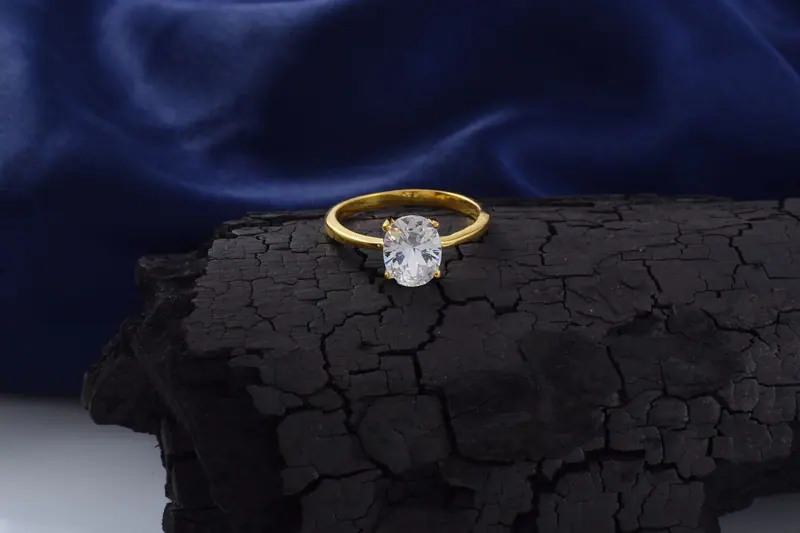
Other retailers price 18k differently
Blue Nile is one retailer, so we checked two of our affiliate partners on the same day.
Capucinne charges an almost flat fee. Across 24 of its engagement rings, priced from $650 to $7,360 in 14k, the 18k version cost $100 more on 20 of them, $110 on two and $140 on two. That is a 1% to 17% premium, and it barely changes with the size of the ring. Like Blue Nile, Capucinne charged the same price for white, yellow and rose gold within each karat, and unlike Blue Nile it sells rose gold in 18k as well.

Timber Moonstone Cluster Ring
14k gold, any color · 0.6 ct trillion moonstone
In 18k: $990, $100 more.
$890 ring, 14k
Check price at Capucinne: Timber Moonstone Cluster Ring, 14k gold, any color (opens in a new tab)
Halle Morganite Ring
14k gold, any color · 0.75 ct oval morganite, diamonds
In 18k: $1,340, $100 more.
$1,240 ring, 14k
Check price at Capucinne: Halle Morganite Ring, 14k gold, any color (opens in a new tab)
Enya Oval Lab Diamond Ring
14k gold, any color · 1.2 ct oval lab-grown diamond
In 18k: $3,400, $100 more, or 3% of the ring.
$3,300 ring, 14k
Check price at Capucinne: Enya Oval Lab Diamond Ring, 14k gold, any color (opens in a new tab)Prices checked October 14, 2026 at Capucinne. Prices change, so confirm at checkout. Product photos: Capucinne. We earn a commission if you buy through these links.
A gold chain shows the same pattern beyond rings. At WJD Exclusives, a solid 4mm Franco chain, 20 inches long, was $7,893 in 14k and $9,072 in 18k, 15% more. The two listings are not identical designs (WJD calls the 14k one a round Franco chain), and the 18k chain is listed as heavier, 43 g against 38 g, so treat it as a close pair rather than an exact match.

4mm Round Franco Chain
14k yellow gold · Solid links, 20 in, 38 g as listed
Sold from 18 in ($7,110) to 28 in.
$7,893 for 20 in
Check price at WJD Exclusives: 4mm Round Franco Chain, 14k yellow gold (opens in a new tab)
4mm Franco Chain
18k yellow gold · Solid links, 20 in, 43 g as listed
15% more than the 14k chain at the same length.
$9,072 for 20 in
Check price at WJD Exclusives: 4mm Franco Chain, 18k yellow gold (opens in a new tab)Prices checked October 14, 2026 at WJD Exclusives. Prices change, so confirm at checkout. Product photos: WJD Exclusives. We earn a commission if you buy through these links.
The lesson: what 18k costs you depends on the retailer as much as on the gold. At Capucinne, upgrading a ring to 18k was a $100 decision; at Blue Nile, the same upgrade on a setting ranged from $155 to $450. Check the 18k price of the specific piece rather than assuming a percentage.
How 14k and 18k look different
The difference is mostly in yellow gold. With 75% gold against 58.3%, 18k yellow has a deeper, warmer yellow; 14k yellow is a little paler because more of it is alloy. The difference is easiest to see with the two side by side.
White gold is a different story. Gold is naturally yellow, and GIA notes that white gold is usually plated with rhodium for a whiter look and a better shine. What you see is the plating, so 14k and 18k white gold look much the same, and both need the plating renewed as it wears.
Rose gold gets its color from copper in the alloy: GIA notes that the more copper, the pinker the hue. Blue Nile offered rose gold in 14k only on these six settings.
How they wear
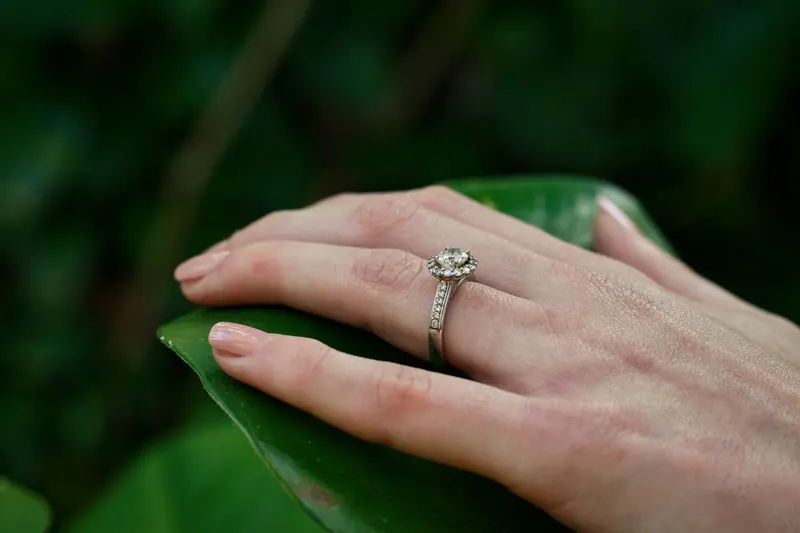
Pure gold is soft. GIA puts it plainly: higher-karat gold is purer and softer, which makes it more prone to scratches and dents. The alloy metals are what make gold hard enough for a ring.
So 14k, with more alloy, is the harder wearing of the two, and 18k shows scratches and wear sooner. That is a difference of degree, not a warning: GIA describes both 14k and 18k as suitable for everyday wear. It matters most for a ring that is worn every day for decades, and for anyone who works with their hands.
What about 10k vs 14k gold?
10k gold is 41.7% gold, so it has even more alloy than 14k. That makes it harder and cheaper, with a noticeably paler yellow. It is a reasonable choice for jewelry that takes knocks, or for keeping the cost down.
Two cautions. None of the six Blue Nile settings we priced was offered in 10k, so it is not always available for engagement rings; check what a retailer actually sells before planning around it. And with less than half its weight in gold, it suits buyers who want gold's look and durability more than its gold content.
Which should you choose?
Choose 14k if the ring will be worn every day, you want the more durable option, or you would rather put the difference toward the diamond. The $155 to $450 the 18k version adds at Blue Nile is real money: on the Petite Cathedral, the $450 premium is about four fifths of what the cheapest 1 carat lab-grown diamond cost at Blue Nile in October 2026 ($557).
Choose 18k if you want yellow gold and care about the richer color, or you simply want more gold in the piece. Accept that it costs more and shows wear sooner, and budget for occasional polishing.
For white gold, 14k is usually the sensible pick. The rhodium plating does most of the visual work, so 18k's extra gold buys you little you can see.
Don't choose by color for price reasons. At the same karat, white, yellow and rose gold cost the same, so pick the color you like.
If you are still choosing a setting, our guides to bezel settings and hidden halo settings use the same Blue Nile designs, and our guide to engagement rings under $5,000 shows how the metal fits into a full budget.
How we priced these settings
On 14 October 2026 we opened each of six Blue Nile engagement ring settings in every metal it is sold in and recorded the setting price from each metal's own product page. The same day we recorded the 14k and 18k price of 24 Capucinne rings from the store's own listings, and the closest 14k and 18k chain pair at WJD Exclusives. Every percentage on this page was calculated from those prices; the full table, with platinum, is in our research notes. Setting prices change, and a different retailer will price differently, so treat these as a snapshot of how three retailers price karat, not as a market average.
Prices checked 14 October 2026 at Blue Nile, Capucinne and WJD Exclusives. Karat definitions and marking rules from the FTC Jewelry Guides; gold content, rhodium plating and wear guidance from GIA and GIA. JewelEditor Editorial.