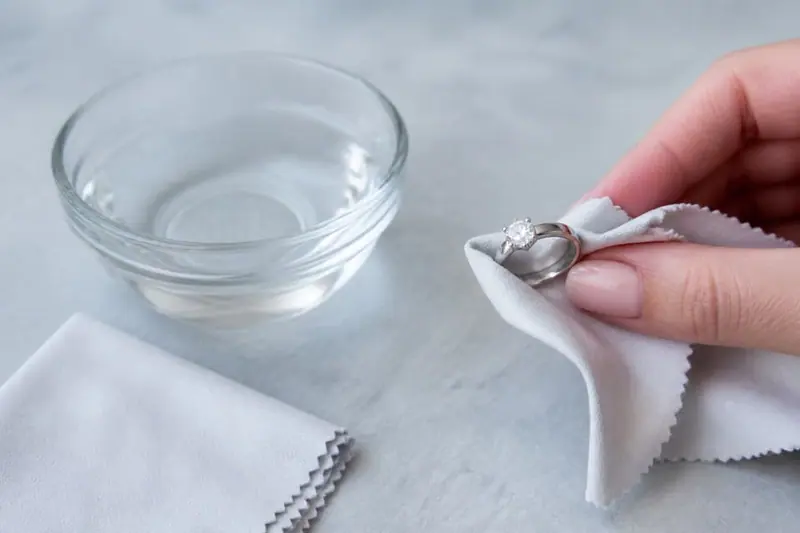
Why engagement rings need regular cleaning
Daily wear coats your ring in oils (from skin), soap residue, lotion, sunscreen, food, and microscopic dust. This buildup is invisible to you but dramatically reduces sparkle. Diamond brilliance depends on light reaching the pavilion (bottom) and reflecting back, and even a thin film of skin oil disrupts that path.
A diamond loses 30-50% of its visible sparkle within 2-3 weeks of daily wear without cleaning. Most "my ring looks duller than when I got it" complaints are just dirty diamonds, not actual damage.
The standard at-home method
What you need:
- A small bowl of warm (not hot) water
- One drop of mild liquid dish soap (Dawn, Joy, or any neutral-pH soap)
- A soft-bristled toothbrush: a baby toothbrush or a dedicated jewelry brush works best
- A lint-free cloth (microfiber or a soft cotton cloth; paper towels can scratch)
Procedure (~3 minutes):
- Mix the soap into the water until lightly sudsy
- Soak the ring for 5-10 minutes (loosens dried-on residue)
- Brush gently, especially around the prongs, under the stone, along the gallery (the underside of the setting). Don't scrub hard.
- Rinse in clean warm water: either a second bowl, or hold under a slow tap (cover the drain, just in case)
- Pat dry with the lint-free cloth. Don't rub vigorously
- Air-dry for 5 minutes before putting back on
Do this every 2-3 weeks for daily-wear rings.
What NOT to use
| Avoid | Why |
|---|---|
| Toothpaste | Abrasive: scratches gold, platinum, and many gemstones |
| Baking soda | Same: abrasive, can scratch precious metals |
| Bleach / chlorine | Damages prong solder and can break down gold alloys |
| Ammonia (in window cleaners like Windex) | Damages pearls, emeralds, opals, turquoise; OK for diamonds and platinum but risky if you have any other stones |
| Hot water | Can loosen prong settings on glued or fracture-filled stones |
| Ultrasonic cleaners (without checking compatibility first) | Safe for plain diamond solitaires in gold or platinum, but risky for certain stones (see next section) |
| Steam cleaners (on fragile stones or pavé) | Same situational rule: fine for solitaires, can dislodge stones in pavé settings |
Ultrasonic cleaners: when they're safe and when they're not
Ultrasonic cleaners (the small home appliances that vibrate at high frequency in a water bath) are excellent for diamond solitaires in platinum or gold settings. They dislodge dirt from places a toothbrush can't reach.
Safe to ultrasonic:
- Diamond solitaires (round, princess, emerald, oval, marquise, asscher)
- Setting metals: platinum, 14k/18k/22k gold, sterling silver
- Lab-grown diamonds (same as natural)
Do NOT ultrasonic:
- Emerald, opal, pearl, turquoise, coral, tanzanite, lapis lazuli: vibration can crack or damage
- Fracture-filled diamonds: the filler can dislodge (rare but ruinous)
- Heat-treated rubies and sapphires if the treatment is unstable
- Rings with loose stones or weak prongs: vibration can knock the stone out
- Antique or vintage rings: older settings are often more fragile
When in doubt, ask the jeweler who sold or repaired the ring. They'll know what's safe.
Professional cleaning: when and how often
Every 6 months, take the ring to a jeweler for a professional clean and prong inspection. Most jewelers do this free if you bought from them, and $15-$30 if you didn't.
What the professional clean adds:
- Steam or ultrasonic (deeper than home cleaning): removes buildup the toothbrush can't reach
- Prong inspection: checks for loose, bent, or worn prongs that could lose the stone
- Solder repairs if any structural issues are flagged
- Rhodium re-plating for white gold rings (every 18-24 months, usually $60-$150 add-on)
The prong inspection is the most important part. Prongs wear down with daily friction. A worn prong looks fine until the day the stone falls out. Professional inspections catch this 6+ months before a loss.
Cleaning specific setting types
Solitaires (4-prong or 6-prong): Easiest to clean. The brush reaches everywhere. Standard method works perfectly.
Halos and hidden halos: More crevices for dirt. Spend extra time around the melee diamonds. Use the toothbrush at multiple angles. Consider an ultrasonic clean every 1-2 months.
Bezel settings: Easiest to maintain: fewer places dirt can hide. Standard method.
Pavé and micro-pavé: Hardest to keep clean. Tiny stones in thin metal walls. Use the lightest touch possible with the brush. Aggressive scrubbing can dislodge stones. Recommend more frequent professional cleaning (every 3-4 months instead of 6).
Three-stone settings: Similar to solitaires but with double the surface area. Standard method, just more brush time.
What to do if your ring looks dirty between cleanings
Quick "in-the-moment" refresh:
- Hold the ring under warm running water for 30 seconds
- Rub gently between your thumb and finger to dislodge skin oil
- Pat dry
This buys you visible sparkle for a few days without a full clean. Do a proper clean within a week.
When to stop and call a jeweler immediately
- A stone is loose (you can feel or see it move)
- A prong is bent or broken
- The shank is cracked (rare but happens with daily wear over years)
- The stone looks cloudy or filmy despite cleaning (could be internal damage)
- You dropped the ring on a hard surface: get the prongs checked even if nothing looks wrong
Most of these are repairable; ignoring them risks losing the stone.
The honest take
Most engagement-ring owners under-clean their rings. A dirty diamond is the single most common reason rings look "less sparkly than they used to." Three minutes every two weeks restores 90% of original sparkle without spending a cent. Professional cleaning twice a year catches structural issues before they cost you a stone.
The single rule: don't use anything abrasive (toothpaste, baking soda) or chemically aggressive (bleach, ammonia), and your ring will last decades looking essentially new. The fancy "jewelry cleaner" solutions sold at jewelry stores are mostly the same thing as warm water + dish soap, repackaged at 10× the price.