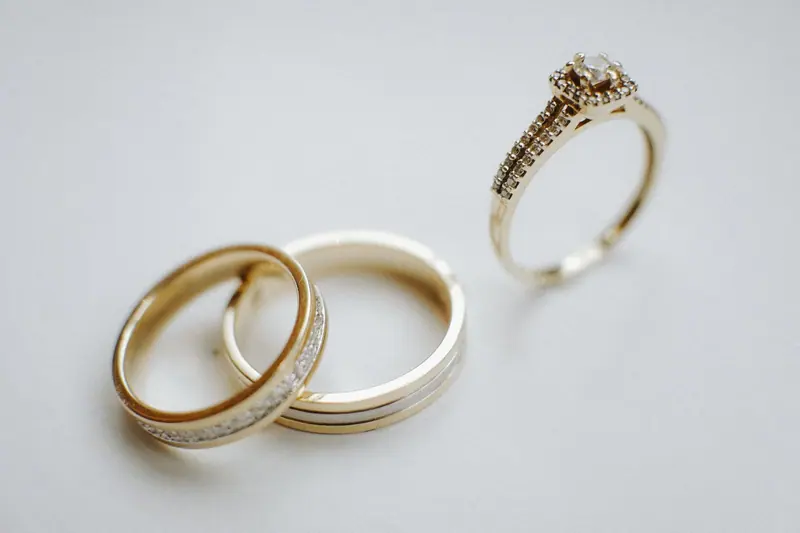
The actual differences
| Detail | White gold | Yellow gold |
|---|---|---|
| Composition (14k) | 58.3% gold + alloy (silver, nickel, palladium) + rhodium plating | 58.3% gold + copper + silver alloy |
| Composition (18k) | 75% gold + alloy + rhodium plating | 75% gold + copper + silver |
| Color | Bright silver-white (from rhodium plating) | Warm yellow |
| Maintenance | Re-plate rhodium every 18-24 months ($60-$150 per re-plate) | None (color is in the metal itself) |
| Cost (same karat) | Roughly identical | Roughly identical |
| Effect on diamond color | Makes the stone look whiter (good for D-F grades) | Hides yellow tints (good for J-M grades) |
| US market share, 2025 | ~60% of engagement rings | ~25% (up from 12% in 2018) |
| Skin tone fit | Most flattering on cool/pink undertones | Most flattering on warm/olive undertones |
| Durability | Slightly harder (rhodium adds surface hardness) | Slightly softer but no plating to wear off |
What "rhodium plating" actually means for white gold
White gold isn't naturally white. The base metal (gold mixed with palladium or nickel) is a slightly grayish-yellow. To make it look bright silver-white, jewelers electroplate a microscopically thin layer of rhodium (a platinum-group metal) over the surface.
The catch: rhodium plating wears off. The thickness varies by jeweler (typically 0.5 to 2.5 microns) and lasts 18 to 24 months for an engagement ring worn daily (lighter wearers can stretch to 30+ months; very active wearers may need re-plating closer to 12 months). Once it wears through, the underlying white gold shows through with a faintly yellow tinge, particularly on high-contact areas (the band underside, around the prongs).
Re-plating: a jeweler can re-rhodium the ring in about an hour. Costs $60-$150 depending on the jeweler and the complexity of the setting. Most buyers re-plate every 18-24 months for life.
For most people, this is a minor maintenance schedule. For people who don't want to think about jewelry maintenance at all, yellow gold is genuinely maintenance-free.
How the metal affects how the diamond looks
This is the underrated technical point that influences which metal is the smart pick:
- A D-F color diamond (colorless) looks slightly more colorless in a white-gold setting: the white metal reinforces the perception of icy whiteness
- A J-M color diamond (faint yellow) looks more yellow in a white setting (the contrast accentuates the tint) but blends in beautifully with yellow gold, which masks the tint
- A G-I color diamond (near colorless) works well in both: slight tint is barely visible in either setting
Practical implication: if your budget can't reach D-G color, yellow gold can hide 1-2 grades of yellow tint. A K-color diamond in yellow gold can look as bright as a G-color diamond in white gold from across a room.
This means yellow gold is sometimes the budget-smart move: buying a J-K color stone (cheaper) in yellow gold can deliver the same visual impression as a more expensive G-H stone in white gold.
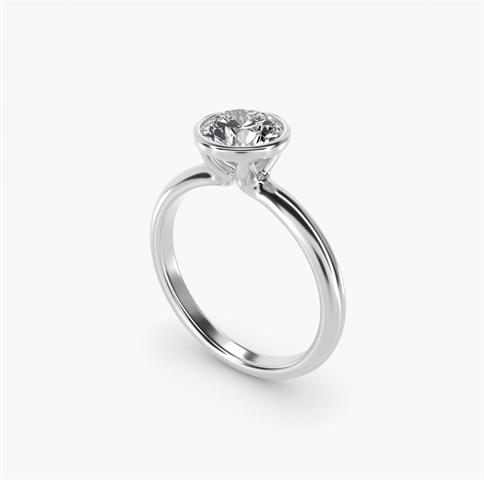
Bezel Solitaire
14k white gold · 2.5 mm band
Best with a D to F stone
Bright white metal that suits colorless D to F stones.
$1,836 ring, from
$1,310 setting + $526 stone
Check price at Blue Nile: Bezel Solitaire, 14k white gold (opens in a new tab)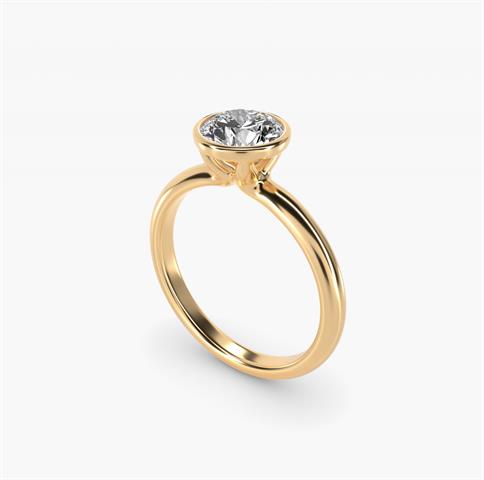
Bezel Solitaire
14k yellow gold · 2.5 mm band
Best with a G or H stone
Warm metal that masks a hint of color, so G to H stones look whiter.
$1,836 ring, from
$1,310 setting + $526 stone
Check price at Blue Nile: Bezel Solitaire, 14k yellow gold (opens in a new tab)Next: the diamond
We would pair these with a 1–1.5 ct lab-grown round, D to H color, VS2 or better.
What happens when you click: Blue Nile prices the setting and the stone separately. You open the setting, then choose a diamond, and it offers handpicked matches if you would rather not filter. Free shipping, free returns and a lifetime warranty at Blue Nile.
Prices checked September 24, 2026 at Blue Nile. Ring prices are the setting plus the cheapest stone at the spec above; most stones cost more than that. Prices change, so confirm at checkout. Product photos: Blue Nile. We earn a commission if you buy through these links.
Cultural and trend context
- 2010-2018: White gold and platinum dominated. Yellow gold was associated with "older" or "dated" engagement rings.
- 2019-2022: Yellow gold made a comeback in fashion and bridal jewelry. Vintage and Art Deco influences pushed it.
- 2023-2025: Yellow gold continued growing, now ~25% of new engagement rings (up from 12% in 2018). Especially popular with millennial and Gen Z buyers.
- Now (2026): The cultural penalty against yellow gold is essentially gone. It reads as a deliberate aesthetic choice, not "outdated."
How to actually decide
Match what your partner already wears. This is the single most reliable signal. Look at:
- Their daily-wear necklace, watch, bracelet, hoop earrings
- Whether they reach for silver/white or gold jewelry by default
- What metal their wedding-band-eligible relatives wore (often inherited preferences)
If they wear silver/white metals 80%+ of the time → white gold or platinum. If they mix freely → either works, slight default toward white gold for diamond visibility. If they wear yellow/rose gold 80%+ of the time → yellow gold or rose gold.
Don't pick based on what you prefer unless the engagement is genuinely a joint decision. The wearer's daily habits matter more.
What about rose gold and platinum?
Two adjacent options worth mentioning:
-
Rose gold: same 14k/18k karat scale, copper-heavier alloy that produces pink tone. Same maintenance profile as yellow gold (no plating). Currently ~10% of new engagement rings, leveling off after a 2018-2022 surge. Most flattering on warm/pink undertones.
-
Platinum: naturally white (no rhodium plating ever needed). Denser and more durable than white gold, better for active wearers. Costs 30-50% more than 14k white gold for the same setting. The "premium" choice if budget allows.
For most buyers, the comparison is yellow vs white gold. Rose gold is for buyers who specifically want the pink tone. Platinum is for buyers who want zero maintenance AND can pay the premium.
When yellow gold is the smart pick
- Your partner wears yellow/warm-toned jewelry day-to-day
- You're buying a J-M color diamond and want to hide the tint
- You don't want recurring maintenance (rhodium re-plating every 18-24 months)
- You like the warm, vintage-leaning aesthetic that's currently in fashion
- Your partner has warm/olive skin undertones that yellow metals flatter
When white gold is the smart pick
- Your partner wears silver/white-toned jewelry day-to-day
- You're buying a D-G color diamond and want the white setting to reinforce its colorless look
- You prefer the classic, contemporary look that white gold/platinum has dominated for 40+ years
- You're fine with periodic re-plating as a small maintenance commitment
- Your partner has cool/pink skin undertones
The honest take
Yellow gold is no longer the "wrong" choice it was perceived to be in 2010. If your partner wears warm-toned jewelry, yellow gold is probably the smarter pick: better aesthetic match, lower maintenance, and (if you're budget-constrained) more flexibility on diamond color grade.
White gold remains the safer default when you genuinely don't know what your partner prefers. It pairs with most skin tones, makes most diamonds look better, and matches the visual category most people associate with engagement rings. The maintenance schedule is real but minor.
The mistake to avoid: picking the metal you personally find prettier without checking what your partner actually wears. Engagement rings are worn daily for decades. Match it to the wearer, not your taste.