The actual difference at a glance
| Feature | Hidden halo | No halo (solitaire) |
|---|---|---|
| Top-down look | Solitaire (halo invisible) | Pure solitaire |
| Side profile | Visible ring of melee diamonds under center stone | Clean band under center stone |
| Setting cost premium | +25-40% over plain solitaire | Baseline |
| Maintenance | More crevices to clean | Easiest to clean |
| Center stone size needed | Any (halo doesn't affect face-up size) | Any |
| Snags clothing | Slightly more (more setting bulk) | Least |
What you get for the extra cost
The 25-40% premium pays for:
- 15-25 melee diamonds set into the gallery under the center stone (typically G-H color, VS clarity)
- More precise setting work: the hidden halo requires careful integration into the gallery without disrupting the prong placement
- More design visual interest from the side angle: the kind of detail other people don't always notice but you see every time you look down
Whether that's worth it depends on whether you specifically value the side-profile detail. Some people love it. Some genuinely never notice the difference once the ring is on.
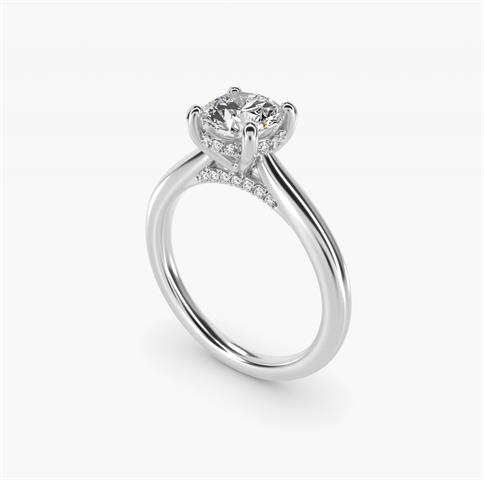
Petite Hidden Halo Solitaire Plus
Platinum · 1.6 mm band
Best if you want the side sparkle
Accent diamonds sit under the center stone: a solitaire from above, sparkle from the side.
$2,775 ring, from
$1,765 setting + $1,010 stone
Check price at Blue Nile: Petite Hidden Halo Solitaire Plus, Platinum (opens in a new tab)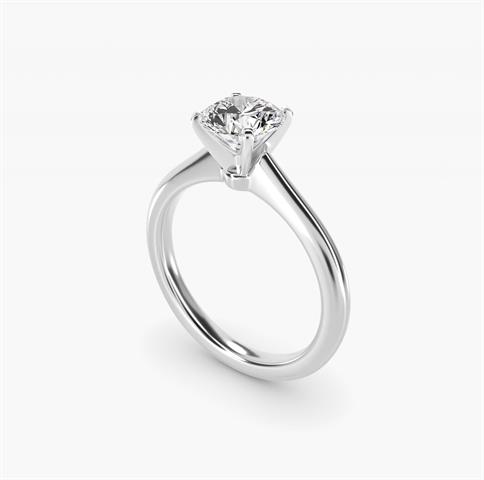
Petite Solitaire
Platinum · 1.8 mm band
Best if you want the cleanest look
The plain version of the same slim look, for about $435 less.
$2,340 ring, from
$1,330 setting + $1,010 stone
Check price at Blue Nile: Petite Solitaire, Platinum (opens in a new tab)Next: the diamond
We would pair these with a 1.5–2 ct lab-grown round, D to H color, VS2 or better.
What happens when you click: Blue Nile prices the setting and the stone separately. You open the setting, then choose a diamond, and it offers handpicked matches if you would rather not filter. Free shipping, free returns and a lifetime warranty at Blue Nile.
Prices checked September 24, 2026 at Blue Nile. Ring prices are the setting plus the cheapest stone at the spec above; most stones cost more than that. Prices change, so confirm at checkout. Product photos: Blue Nile. We earn a commission if you buy through these links.
When to choose hidden halo
- You spend time looking at your hand from above (typing, drawing, cooking, reading): the side profile is what you'll actually see
- You're getting a smaller center stone (under 1 ct): the hidden halo adds visual weight from the side without making the ring look "halo-y" from above
- You like the "quiet luxury" aesthetic: the hidden halo is a subtle status signal (you have to look closely to see it)
- You want the option to upgrade the center stone later: the hidden halo gallery accommodates a wider range of center stones than a tight solitaire setting
When to choose no halo (solitaire)
- You want minimum maintenance: no extra prongs, melee, or crevices to keep clean
- You're maximizing center-stone budget: every dollar not going to the halo goes to the center stone
- You prefer a classic, timeless aesthetic that won't read as a 2020s trend in 30 years
- You're getting a large center stone (1.5+ ct): at that size, a halo of any kind starts to feel busy
- You're rough on jewelry or have an active job: fewer setting elements = fewer things to repair
What about a visible halo?
A visible halo is the third option: a ring of melee diamonds around the center stone, fully visible from above. This adds the most face-up visual size (a 1 ct center can look like 1.4-1.5 ct), but it's the most "halo" of the three options. If you specifically want the bigger-looking center stone illusion, visible halo wins. If you don't, hidden halo gives you the design detail without the visual size boost.
The full hidden halo guide covers all three styles in depth.
The honest take
Most jewelers will recommend the hidden halo because it costs more and they make more on it. Don't let that bias you. The hidden halo is genuinely beautiful from the side, but if you're someone who never notices the side profile of your ring once you're wearing it, you're paying 25-40% extra for a detail you won't appreciate. A clean solitaire on a quality center stone is timeless, low-maintenance, and lets the diamond do the work. Both choices are right; the question is which one matches how you actually look at and wear jewelry.