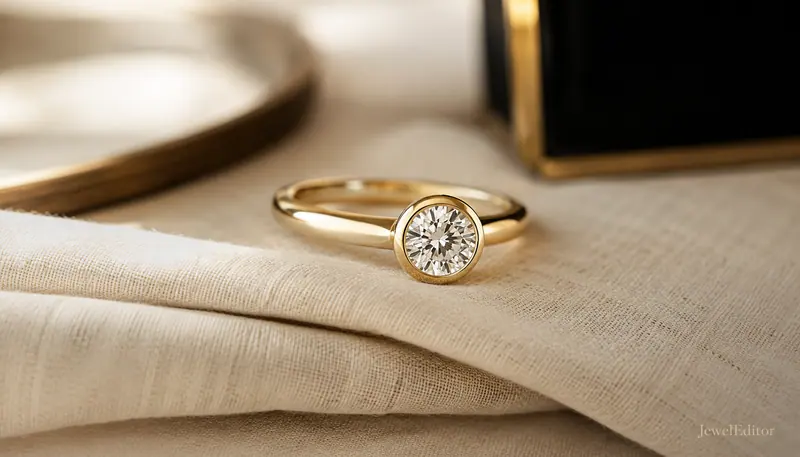
The 3-month-salary rule was 1939 ad copy. The bezel-as-traditional myth is older. At the diamond counter in 2026, the bezel setting is having a quiet renaissance, and most articles are 20 years behind on why.
A bezel setting holds a diamond in place with a thin metal rim that wraps the stone (picture a frame around a photograph) instead of with prongs (the small metal claws that grip a diamond from above in a classic solitaire). That single design choice changes everything about how a bezel setting engagement ring looks, wears and survives a decade of daily life.
This article is the case for the bezel, plus the honest trade-offs, plus where to buy one without paying the boutique markup that's quietly inflated this category for the past five years.
What the bezel actually is
The four-letter word every buyer needs decoded first.
Bezel is jeweler-talk for the metal rim that holds a stone in place. In an engagement ring, that rim replaces the prongs you might be used to seeing on a classic solitaire. There are two main flavors:
- Full bezel: the rim wraps the entire diamond at the level of its widest edge (the girdle). Maximum protection, lowest profile.
- Half bezel (also called partial bezel): the rim wraps only two opposite sides of the diamond, leaving the other two sides open to the air. More light enters the stone; less protection on the open sides.
For comparison: a prong setting is what most people picture when they hear "engagement ring": four or six small metal claws reach up from the band and grip the stone at single points around its edge. The most common version is the Tiffany-style six-prong setting that became the visual archetype for engagement rings in twentieth-century US advertising.
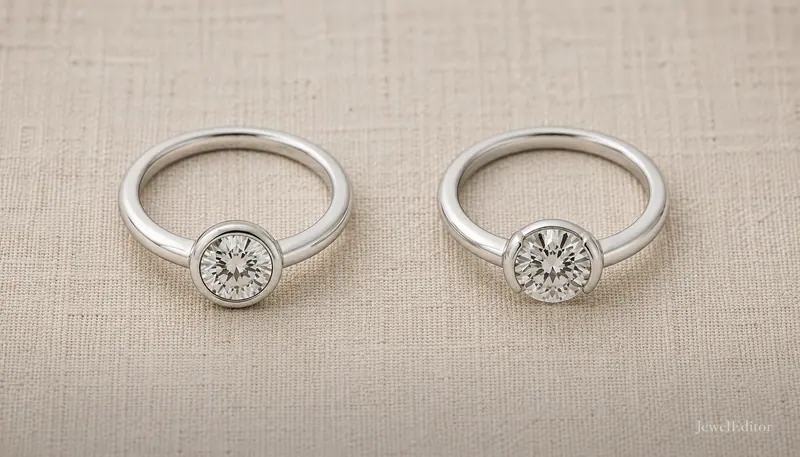
Both setting types do the same job: hold the diamond securely. They look completely different on the hand. A prong setting reads "engagement ring" the moment someone sees it. A bezel reads "ring." That distinction is the entire reason the bezel is having its moment.
Why bezel is having a moment
Three reasons, in the order you'll actually encounter them from buyers:
1. It looks modern, not traditional
A prong setting is the visual archetype of a twentieth-century US diamond ring. A bezel reads as contemporary, architectural, even Bauhaus-adjacent. If your aesthetic is minimalist or quiet-luxury (black coffee, linen shirts, white walls), a bezel is the engagement ring that doesn't fight you.
This is partly a generational shift. The Knot's most recent trend reporting flags "minimalist and modern" as the fastest-growing engagement ring style category among couples under 35, with bezel settings specifically named as a leading shape. Brides Magazine's editorial team has called it the "anti-engagement-ring engagement ring" (meant as a compliment).
2. It is safer for active hands
Prongs catch on hair, fabric and gloves. Every bench-trained jeweler can recount stories of clients who lost diamonds because a prong wore thin and bent open during ordinary wear. A bezel has no claws to snag and no thin metal points to wear.
For runners, climbers, surgeons, parents of small children, gardeners (anyone who actually wears their ring through real life rather than removing it for daily activity), this is the practical case. Working bench jewelers consistently recommend bezel settings to active wearers; the American Gem Society's find-a-jeweler directory is one place to find a vetted bench jeweler who can advise on setting choice in person.
3. The diamond looks bigger
The metal rim provides visual weight that "frames" the stone, much like how a thick mat makes an artwork look more substantial. It's a subtle effect (your eye reads the diamond plus the rim as the total visual mass) but the optical lift is real. A 1.0-carat round in a thoughtfully-sized bezel can read closer to 1.2 carats than a 1.0-carat in a thin prong setting.
This is the un-marketed advantage. Bezel-set diamonds don't actually look smaller than prong-set ones, despite the casual reader's first impression that "more metal must mean less stone."
The trade-offs: bezel vs prong, honestly
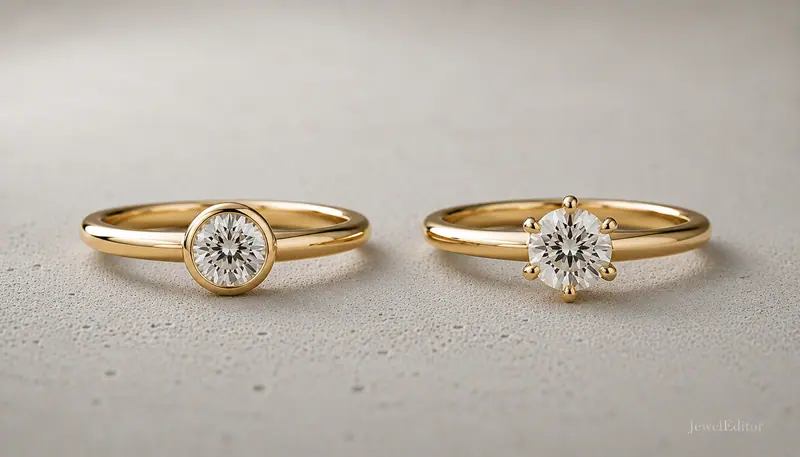
Bezel isn't strictly better. There are real reasons buyers go the other direction.
Per the GIA's analysis of light performance in finished settings, light return is dominated by the cut grade of the stone, not the setting. An Excellent-cut diamond in a bezel reads brighter than a Very-Good-cut diamond in a prong, every time. So the "bezel dims the diamond" concern is real but small and it disappears entirely if you optimize for cut grade (which you should at any budget).
The repair argument is the more material trade-off. A worn prong is a $20 fix at any decent bench. A worn bezel is more involved: the rim has to be re-formed around the stone without scratching the girdle. Confirm warranty coverage before purchase.
Best diamond shapes for a bezel
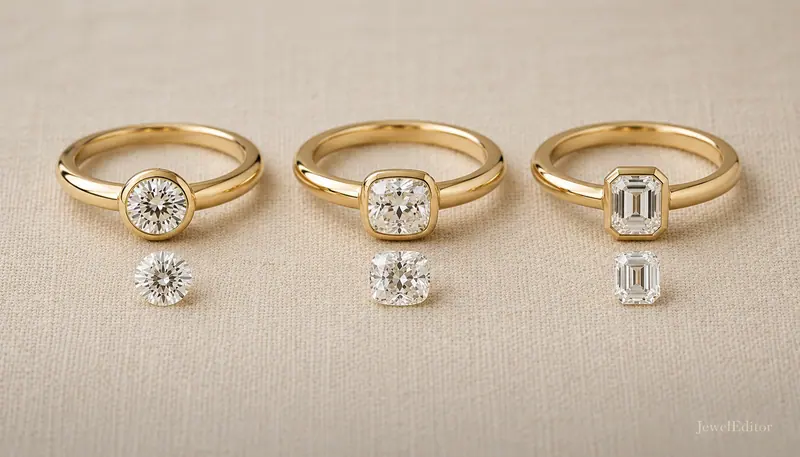
Bezels work better with some shapes than others. Pure aesthetic and practical truth:
Strong fit:
- Round brilliant: the most common engagement ring shape. The bezel suits its symmetry perfectly. Round is the dominant choice in bezel-set engagement-ring inventory at major US retailers.
- Cushion cut: soft corners flow into a bezel rim with no awkward gaps. Particularly elegant in matte-finish metal.
- Emerald cut: the rectangular shape gets architectural emphasis from the rim. Very modern, very on-trend.
Awkward fit:
- Marquise: the pointed tips are hard to bezel without making the rim look thick at the tips. Half-bezel works better; full bezel often doesn't.
- Pear: same problem at the point. Half-bezel preferred.
- Trillion: sharp 60° angles fight the curve of a bezel. Most bench jewelers will discourage you.
If you've already chosen a marquise or pear and you want a bezel-style aesthetic, half-bezel is the answer: the rim wraps the wider sides; the points stay open. You get the modern look without the design tension.
What $5,000 buys with a bezel setting
A complete bezel-set engagement ring at the $5,000 budget tier breaks down roughly like this:
The setting itself costs slightly more than an equivalent prong setting because more metal goes into a continuous rim than into four or six small prongs. In Blue Nile's catalog on 24 September 2026, the bezel cost $70 more than the tapered cathedral solitaire in the same metal and $375 more than the plainest comfort-fit band, so budget somewhere between $50 and $400 depending on which prong setting you are comparing it against.
Lab-grown diamond vs natural is the same trade-off it is in any setting: lab-grown gives you roughly 2.5 times the carat for the same total budget, with better resale on natural. The spread has widened far beyond the 60-80% the trade press described: on 24 September 2026 a 1.5ct D-VS1 lab-grown round started at about $1,010 at Blue Nile against $9,901 for the same spec in natural. For the wider trend see JCK Magazine and Mike Fried's Diamonds Pro pricing guide.
Where to buy a bezel-set engagement ring
A handful of retailers do bezel work well; most do not. Bezel craftsmanship is harder than prong craftsmanship, and the visible margin between a good bezel and a mediocre one is significant, especially when the rim covers a meaningful percentage of the diamond's face.
Our top recommendation is Blue Nile for three reasons specific to bezel settings:
- Largest bezel-style inventory of any major US retailer. Their "design your own ring" platform lets you pair a bezel setting with any loose diamond from their 160,000+ stone catalog, both natural and lab-grown.
- Transparent pricing on the setting separately from the stone: important for bezels because metal weight matters, and Blue Nile breaks out the setting cost so you can compare grams of platinum across options.
- Bezel work is included in their warranty (re-tipping is the more famous warranty item; bezel repairs are quietly excluded by some retailers and explicitly included by Blue Nile).
We recommend Blue Nile because they carry a strong bezel selection at this price tier, not because they paid for the position.
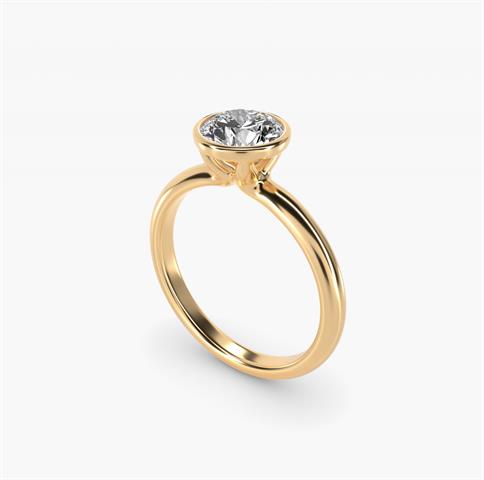
Bezel Solitaire
14k yellow gold · 2.5 mm band
Best with a G or H stone
Our pick at this tier. Yellow gold warms the rim and flatters G to H stones.
$2,320 ring, from
$1,310 setting + $1,010 stone
Check price at Blue Nile: Bezel Solitaire, 14k yellow gold (opens in a new tab)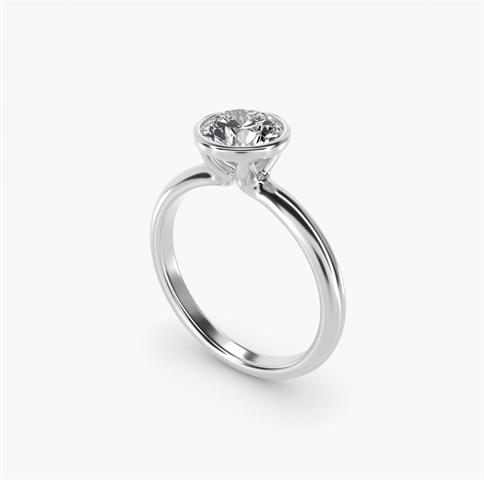
Bezel Solitaire
14k white gold · 2.5 mm band
Best with a D to F stone
The same design in white gold, for D to F stones.
$2,320 ring, from
$1,310 setting + $1,010 stone
Check price at Blue Nile: Bezel Solitaire, 14k white gold (opens in a new tab)Bezel Solitaire
Platinum · 2.5 mm band
Best for long-term durability
The most durable metal for a full rim, for about $470 more.
$2,790 ring, from
$1,780 setting + $1,010 stone
Check price at Blue Nile: Bezel Solitaire, Platinum (opens in a new tab)Next: the diamond
We would pair these with a 1.5–2 ct lab-grown round, D to H color, VS1 or better.
What happens when you click: Blue Nile prices the setting and the stone separately. You open the setting, then choose a diamond, and it offers handpicked matches if you would rather not filter. Free shipping, free returns and a lifetime warranty at Blue Nile.
Prices checked September 24, 2026 at Blue Nile. Ring prices are the setting plus the cheapest stone at the spec above; most stones cost more than that. Prices change, so confirm at checkout. Product photos: Blue Nile. We earn a commission if you buy through these links.
How Blue Nile bezels compare to the rest
A bezel-set 14k yellow gold solitaire with a 1.0-carat lab-grown D-VS1 round diamond came to about $1,840 at Blue Nile on 24 September 2026: $1,310 for the setting and from $530 for the stone. We priced Blue Nile directly and have not verified the other retailers on that date, so treat any cross-retailer comparison as a starting point rather than a quote.
Briefly, on each:
- Blue Nile: strongest catalog depth in bezel; transparent setting pricing; 30-day return policy; bezel work included in warranty. Our recommended default.
- James Allen: best-in-class 360° viewer for inspecting the stone before buying; dedicated bezel selection runs noticeably smaller than Blue Nile's.
- Brilliant Earth: thoughtful bezel options including some recycled-platinum bezels; sustainability story; pricing runs slightly higher.
- Vrai: Diamond Foundry's retail arm; very modern bezel aesthetic; smaller selection overall.
- Clean Origin: cheaper than the four above on lab-grown stones; uses IGI grading instead of GIA. IGI is legitimate but GIA is the preferred report at this price tier.
If you find a bezel design you genuinely love at any of the four alternatives, buy it there. Editorial integrity beats brand loyalty. We recommend Blue Nile because it's the strongest default for bezel specifically, not the only acceptable choice.
Editor's pick
Pair a 1.5-carat lab-grown D-VS1 round diamond from Blue Nile (from about $1,010 on 24 September 2026) with the 14k yellow gold bezel solitaire ($1,310) for a complete ring at about $2,320, less than half the $5,000 budget, which leaves room for resizing and the first rim-inspection.
14k is the practical metal choice at this tier. Platinum is the durability gold standard but adds ~$300-500 to the setting cost without visibly different results at this carat size.
Five things to check before you buy
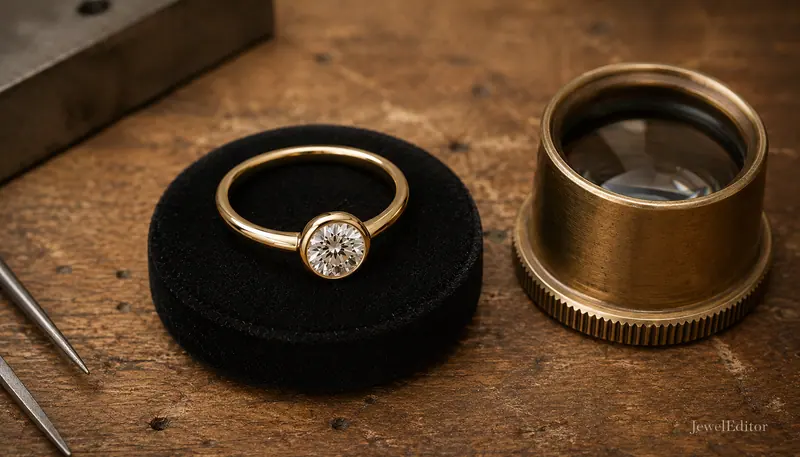
Five practical inspections at the diamond counter, each takes 10-30 seconds:
-
Metal thickness. Too thin and the rim dents at impact; too thick and the diamond looks visually small. The sweet spot is a 0.8-1.5mm wall depending on diamond size. Ask the salesperson. They'll know the spec.
-
Stone visibility from the side. Look at the ring from a side profile. Can you see the diamond's pavilion (the lower half) through the rim? You should see most of it. If the rim swallows half the stone, the bezel is too tall and the diamond will look smaller than it is.
-
Setting profile (height). Bezels come in high-profile (the diamond sits up off the band, like a cathedral mount) or low-profile (the diamond sits nearly flush with the band). For everyday wear, low-profile snags less and looks more contemporary. For evening wear or maximum visual presence, high-profile.
-
Metal alloy. Platinum is the durability gold standard but costs ~$300-500 more on the setting alone. 14k gold is the practical choice that holds up through a decade of daily wear. Avoid sterling silver. It tarnishes against skin oils and isn't suitable for permanent jewelry at this investment tier.
-
Warranty coverage on the bezel itself. Per the heads-up callout above, this is the most-skipped check. Get it in writing.
Common mistakes at this tier
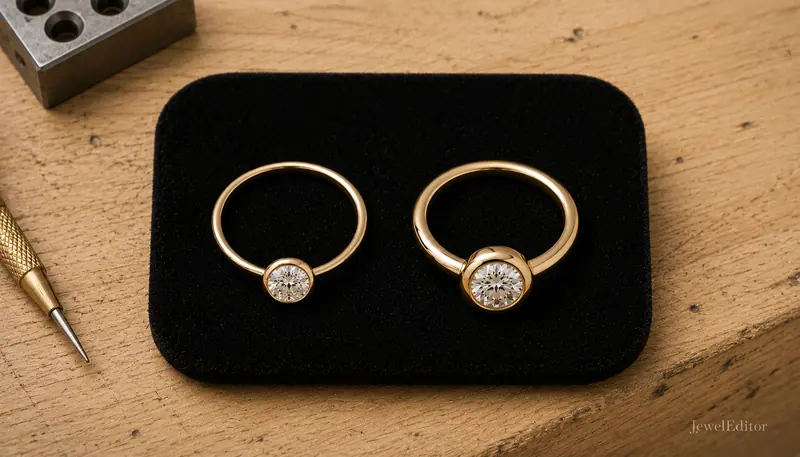
Four patterns kept showing up across the catalogs we compared. We list them here because they show up in real buyer regrets, and because the FTC's Jewelry Guides (16 CFR Part 23) require disclosure of certain things that retailers comply with technically but obscure practically.
Mistake one: choosing a bezel for "low maintenance" without checking the warranty. Bezels DO need maintenance, just different from prongs. The rim can dent at impact; the metal-stone interface needs occasional cleaning. Confirm what's covered before purchase.
Mistake two: skimping on cut grade because "the bezel hides a flat stone anyway." This is a salesperson myth. The bezel doesn't hide cut quality. It frames it. Demand Excellent cut at this tier. Walk away from "Very Good."
Mistake three: picking a thin-walled bezel for a 2-carat-plus stone. Too much weight on too little metal. The rim cracks at impact, the diamond loosens, the repair is expensive. Larger stones need proportionally thicker bezels.
Mistake four: buying a bezel ring sight unseen for an unknown finger size. The bezel changes the proportional appearance of the ring on the finger more than a prong setting does: the rim adds visual width that some hands carry well and others don't. If you're shopping online, plan for a return-and-resize cycle. Most reputable retailers cover this; confirm the policy.
Closing: three things to take away
- Bezel is the modernist's choice, not a compromise. It's a deliberate design statement: architectural, contemporary, anti-traditional. The diamond is not "hidden"; it's framed.
- It is genuinely safer for active wearers. No claws to snag, no prongs to wear. The functional case is real, not marketing.
- The trade-off is small. A few percent less light, slightly harder repairs. Almost invisible to the wearer; almost invisible to the friend who notices the ring.
If you want to run your specific budget against the broader spec ranges, the Budget Calculator takes 30 seconds. For the full editorial methodology, including how we evaluate retailers and which sources we trust, see our methodology page.
The TL;DR is this: bezel is the ring you actually want if you want the ring to recede into your hand instead of broadcasting from it. Most articles describe it as "for active people" or "modern alternative to prong." Both are true and both miss the point. The bezel is for the buyer who wants jewelry that quietly signals, not loudly. That preference is worth a setting choice.
Pair it with our $5,000 budget guide for the broader spec context, and you have everything you need to walk into the diamond counter (or open the Blue Nile design tool) with a clear answer to the salesperson's first question.
Last audited: 2026-09-24, with every Blue Nile price rechecked against live listings that day. JewelEditor Editorial.