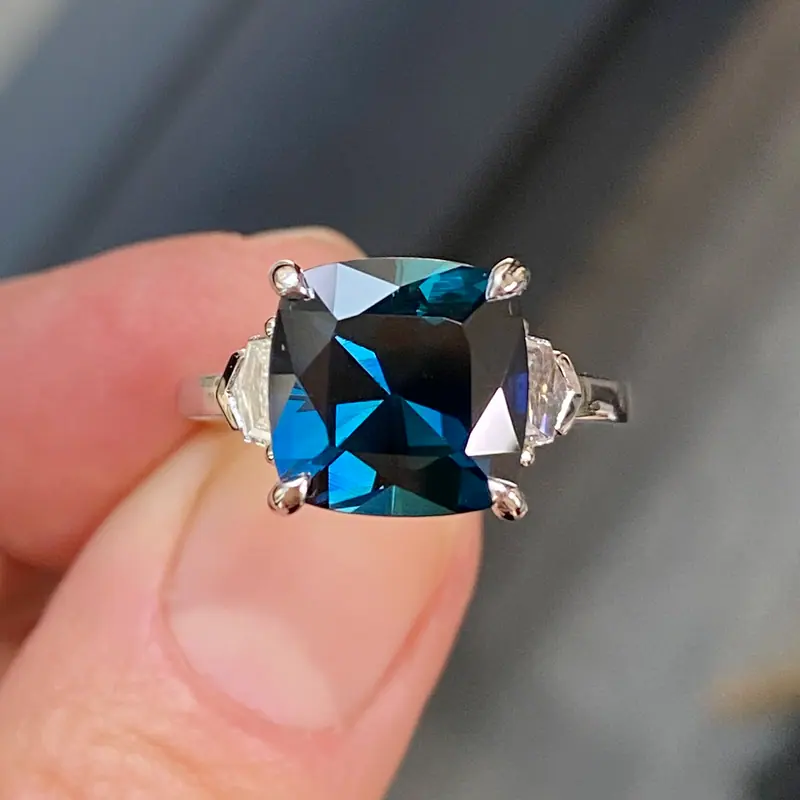
The best gemstones for engagement rings are the ones that survive being worn every day: diamond, moissanite, ruby, sapphire, alexandrite and spinel top the list, with aquamarine, morganite and tourmaline close behind if you treat them with care. Opal, moonstone, tanzanite, turquoise and pearl are beautiful, but better suited to special occasions.
That ranking is not our opinion. It comes from GIA, the Gemological Institute of America, which rates each stone on two separate things: hardness and toughness. This guide explains both, ranks 19 stones, and shows what one ring in each durability tier cost at Capucinne.
Hardness and toughness are not the same
GIA's Mohs scale explainer describes hardness as a stone's resistance to scratching, rated from 1 to 10 on the scale Friedrich Mohs introduced in 1822. It also says hardness differs from toughness, which is about surviving knocks: GIA's buying guide defines toughness as how well a gemstone resists breaking, chipping or cracking.
A ring needs both. A hard stone resists the fine scratches that dull its surface; a tough stone survives the knock against a doorframe. Emerald is GIA's example of the difference: it ranks 7.5 to 8 on the Mohs scale, yet GIA says it is not a tough gem.
Two more points from GIA:
- The scale is not linear. Diamond (10) and sapphire (9) are one step apart, but GIA notes that diamond is about four times harder than sapphire.
- 7 is the working line. GIA's buying guide treats a hardness of 7 or higher as durable enough for everyday wear, provided care is exercised.
Every common engagement ring stone, ranked
Hardness figures are GIA's, from the pages linked; the everyday-wear column quotes or summarizes GIA's own guidance.
| Stone | Mohs hardness | Everyday wear, per GIA | Our guide |
|---|---|---|---|
| Diamond | 10 (FTC) | The top of the scale; GIA rates it about four times harder than sapphire | Salt and pepper diamonds |
| Moissanite (lab-made) | 9.25 | "Highly suitable for everyday wear" | Moissanite vs diamond |
| Ruby | 9 | Suited to "a lifetime of active wear" | |
| Sapphire | 9 | "Ideal for everyday wear, especially in engagement rings" | Sapphire colors, teal sapphire, white sapphire vs diamond |
| Alexandrite | 8.5 | "Good durability for everyday wear" | |
| Cubic zirconia (lab-made) | 8 to 8.5 | Durable, but more prone to scratches over time | |
| Spinel | 8 | "Suitable for everyday wear" | |
| Topaz | 8 | Imperial topaz: "care should be taken to avoid strong blows" | |
| Aquamarine | 7.5 to 8 | Durable enough for engagement rings when cared for | |
| Morganite | 7.5 to 8 | "Requires more care than harder stones" | |
| Emerald | 7.5 to 8 | Not a tough gem; less suitable for daily wear | |
| Tourmaline | 7 to 7.5 | Within GIA's everyday-wear range | |
| Tsavorite garnet | 7 to 7.5 | Garnets have good toughness and are rarely treated | |
| Moss agate (chalcedony) | About 6.5 to 7 | Below or at GIA's 7 line; protect it | |
| Moonstone | 6 to 6.5 | Below GIA's 7 line | |
| Tanzanite | 6 to 7 | Fair-to-poor toughness; "not ideal for an engagement ring" | |
| Opal | 5 to 6.5 | Not tough; better for special occasions | |
| Turquoise | 5 to 6 | Porous; below GIA's 7 line | |
| Pearl | 2.5 to 3 | Far softer than any other stone here |
Sources for each row: GIA's buying guide (ruby, sapphire, spinel, morganite, tourmaline, tsavorite, emerald, tanzanite, opal); GIA's diamond alternatives article (moissanite, cubic zirconia, sapphire, ruby, alexandrite, spinel, topaz, aquamarine, morganite, emerald); GIA's pages on alexandrite, spinel, garnet, moonstone, opal, turquoise and pearl. Moss agate: GIA describes chalcedony as a microcrystalline form of quartz whose types include agate, and lists chalcedony varieties such as bloodstone at 6.5 to 7; GIA does not publish a separate figure for moss agate, so treat that row as an estimate.
The daily-wear tier: diamond, moissanite, ruby, sapphire, alexandrite, spinel
These are the stones you can wear every day without much worry. Ruby and sapphire are both corundum at 9, and GIA's buying guide describes them as suited to a lifetime of active wear. Alexandrite (8.5) and spinel (8) are less common but, per GIA, hold up well too.
If you want color, this is the tier to start in. Sapphire comes in nearly every color: our sapphire colors guide covers the range, and teal sapphire is one of the most popular choices now. For a colorless stone, see white sapphire vs diamond and moissanite vs diamond.
The with-care tier: aquamarine, morganite, tourmaline, tsavorite
At 7 to 8 these stones are within GIA's everyday-wear range, but they scratch more easily than corundum. GIA says morganite requires more care than harder stones, and aquamarine is durable enough for engagement rings when properly cared for. For a green stone, GIA suggests considering a more durable tsavorite garnet instead of emerald.
Emerald: hard but fragile
Emerald is the stone most people misjudge. Its hardness of 7.5 to 8 looks fine, but GIA says it is not a tough gem and less suitable for daily wear. GIA also notes emerald is often treated with oil and/or resin to improve clarity, and advises removing emerald rings during strenuous activities. If you love emerald, a protective setting such as a bezel or halo helps (more on that below).
The special-occasion tier: opal, moonstone, tanzanite, turquoise, pearl
These stones are softer, less tough, or both. GIA's buying guide describes opal and tanzanite as not-so-tough gems better suited to special occasions, and says tanzanite is not ideal for an engagement ring. Moonstone (6 to 6.5) and turquoise (5 to 6, and porous) sit below GIA's 7 line, and pearl, at 2.5 to 3, is far softer than anything else here.
That does not rule them out. It means choosing a protective setting, taking the ring off for rough work, and accepting that it will show wear sooner. They also suit jewelry that takes fewer knocks than a ring, such as earrings or a pendant.
Settings and treatments matter too
A protective setting helps. GIA says bezels, halos and other protective settings can play an important role in preventing chipping. A bezel surrounds the stone's edge; our guide to bezel settings covers the trade-offs. A setting does not stop scratches on the top of a soft stone.
Some treatments are not permanent. GIA warns that treatments such as coating and fracture filling can be removed by heat and strong chemicals, which matters if a jeweler ever re-tips prongs or cleans the ring. Ask whether a stone is treated before you buy; our sapphire colors guide explains the FTC's disclosure rule.
What each tier costs
Durability does not track price. These Capucinne rings, one per tier at about 0.7 to 1 carat in 14k gold, were checked on 25 October 2026, and the hardest stone in this set, the ruby, cost about the same as the opal:

Violetta Pear Ruby Solitaire
14k gold, any color · 0.7 ct pear ruby, bezel
Hardness 9: GIA calls ruby and sapphire suited to a lifetime of active wear.
$1,230 ring, 14k
Check price at Capucinne: Violetta Pear Ruby Solitaire, 14k gold, any color (opens in a new tab)
Halle Oval Morganite Ring
14k gold, any color · 0.75 ct oval morganite, diamond band
Hardness 7.5 to 8: fine for daily wear with more care than sapphire.
$1,240 ring, 14k
Check price at Capucinne: Halle Oval Morganite Ring, 14k gold, any color (opens in a new tab)
Ophelia Oval Aquamarine Ring
14k gold, any color · 0.75 ct oval aquamarine, diamond accents
Hardness 7.5 to 8: GIA says durable enough for engagement rings when cared for.
$1,620 ring, 14k
Check price at Capucinne: Ophelia Oval Aquamarine Ring, 14k gold, any color (opens in a new tab)
Zuri Hexagon Moss Agate Ring
14k gold, any color · 0.7 ct hexagon moss agate, bezel
A chalcedony, about 6.5 to 7: the bezel protects its edges.
$1,000 ring, 14k
Check price at Capucinne: Zuri Hexagon Moss Agate Ring, 14k gold, any color (opens in a new tab)
Round White Moonstone Solitaire
14k gold, any color · 0.8 ct round moonstone, rose cut
Hardness 6 to 6.5: below GIA’s 7 guideline for everyday wear.
$1,000 ring, 14k
Check price at Capucinne: Round White Moonstone Solitaire, 14k gold, any color (opens in a new tab)
Lois Heart Opal Solitaire
14k gold, any color · 1 ct heart Australian opal
Hardness 5 to 6.5: GIA suggests opal for special occasions rather than daily wear.
$1,210 ring, 14k
Check price at Capucinne: Lois Heart Opal Solitaire, 14k gold, any color (opens in a new tab)Prices checked October 25, 2026 at Capucinne. Prices change, so confirm at checkout. Product photos: Capucinne. We earn a commission if you buy through these links.
For comparison, a 1 ct natural diamond cost $3,019 for the stone alone at Blue Nile on 24 October 2026; our lab-grown diamond price guide has current prices by carat.
How we researched this
Hardness and wear guidance are from GIA's "Buying Guide: Colored Gemstone Engagement Rings" (2018), "Diamond Alternatives for Engagement Rings" (2025), its Mohs scale explainer (2012), and its individual gem pages, read on 24 and 25 October 2026. Diamond's hardness is from the FTC's definition of diamond. Where GIA gives no figure (moss agate), the page says so. Ring prices were recorded from Capucinne's own listings on 25 October 2026.
Sources: GIA, colored gemstone engagement ring buying guide; GIA, diamond alternatives for engagement rings; GIA, Mohs scale; GIA, imitation diamonds; GIA gem pages for alexandrite, spinel, garnet, moonstone, opal, turquoise and pearl; FTC Jewelry Guides, 16 CFR 23.12. Prices from Capucinne. JewelEditor Editorial.