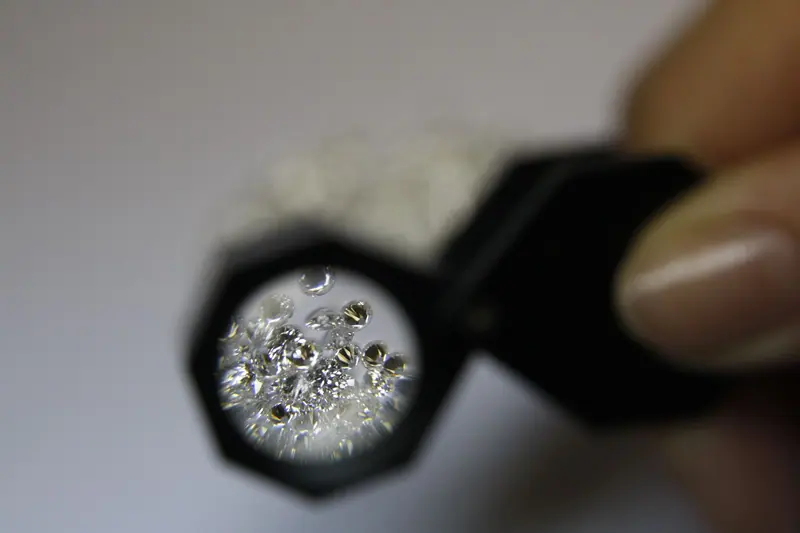
What is a salt and pepper diamond? It is a natural diamond full of visible black and white inclusions, the tiny crystals and marks most diamonds are graded down for. In a salt and pepper diamond they are the point: they give the stone a speckled, smoky grey look that no two stones share.
GIA, the Gemological Institute of America, described them in its journal Gems & Gemology in 2023 as diamonds with eye-visible black and white inclusions, often cut into nonstandard shapes. This guide covers what that means for how they look and wear, what to ask before you buy, and what 127 salt and pepper rings cost at Capucinne compared with clear diamonds.
What makes a diamond "salt and pepper"
Every natural diamond has some clarity characteristics. GIA explains that they form when small crystals are trapped in the diamond as it grows, and that pressure and stress during growth can cause others. On GIA's clarity scale, diamonds with the most visible inclusions are graded Included (I1, I2 and I3), where inclusions are obvious and may affect transparency, brilliance and durability.
A salt and pepper diamond is a stone with a great many of these: dark "pepper" inclusions and white "salt" ones, spread through the stone. The amount varies widely, from a pale grey stone with a few dark flecks to one that looks almost charcoal. The rings below show that range.
Are salt and pepper diamonds real diamonds?
Yes. Under section 23.12 of the FTC Jewelry Guides, a diamond is a mineral consisting essentially of pure carbon crystallized in the isometric system, with a hardness of 10. A salt and pepper diamond meets that definition; it is simply more heavily included than most stones sold for engagement rings.
They are natural diamonds. If you are comparing them with lab-grown stones, our guide to whether lab-grown diamonds are real covers what separates the two.
Why they became popular
GIA's 2023 report, "Misfit Diamonds: Beauty in the Imperfect," came from a supplier showing salt and pepper diamonds at a trade show, cut as hexagons, octagons, cushions and pears. The supplier described their appeal as strongest among younger designers and consumers, who, in his words, are not necessarily interested in flawless gems and look instead for a distinctive "perfect imperfection." He also called them a more budget-friendly option.
Durability: the question to ask
A salt and pepper diamond is as hard as any diamond, so it resists scratching. Inclusions affect something different: how well the stone resists chipping or breaking. (Our guide to the best gemstones for engagement rings explains hardness and toughness for every common ring stone.)
GIA's clarity guide notes that inclusions at the Included grades may affect durability. Its article on what to know about clarity adds three specifics:
- Certain inclusions, especially near the girdle (the stone's outer edge), can make a diamond more vulnerable to damage.
- If a stone is hit precisely on a feather or other surface-reaching inclusion, it might chip.
- Very deep feathers that run from the crown to the pavilion can be a durability concern.
So ask the jeweler two questions about the actual stone: does any inclusion reach the surface, and are there inclusions near the girdle? If you are hard on your hands, ask about a setting that surrounds the stone's edge, such as a bezel; our guide to bezel settings explains the trade-offs.
Cut and paperwork: what the listings show
We read Capucinne's 108 rings with "salt and pepper" in the title on 19 October 2026. Two things stood out.
Many are not round brilliants. Of the listings that stated a cut for the center stone, 18 said rose cut, 4 said brilliant, 1 step cut and 1 a slice; the rest did not say. Shapes run to hexagons, kites, pears and half moons, matching the nonstandard shapes GIA's report describes. Cut style changes how a diamond looks face-up, so watch a video of the actual stone rather than relying on one photo.
Paperwork is thin. None of the 108 listings mentioned a grading report, and 100 gave the center stone's weight as approximate ("approx 1 ct"). That does not mean the stones are misdescribed, but it does mean you are buying on photos and the seller's description. If you want a weight you can rely on, ask for it, and for a lab report if one exists.
What salt and pepper diamonds cost
Counting every Capucinne ring titled or tagged "salt and pepper," 127 rings were in stock in 14k yellow gold on 19 October 2026: from $830 to $13,210, with a median of $3,250. Twenty-eight cost under $2,000 and 55 under $3,000.
Compared with clear diamonds at the same size, using the Blue Nile prices from our October Diamond Price Sheet (captured 20 October 2026; the sheet is free at the bottom of this page):
| 1 carat, round | Price | What it covers |
|---|---|---|
| Salt and pepper (Capucinne Amy ring) | $1,980 | Complete ring in 14k gold, with side diamonds |
| Clear natural (G color, VS2, Excellent cut, GIA) | $3,019 | Loose stone only; a setting is extra |
| Clear lab-grown (D color, VS1, IGI) | $541 | Loose stone only; a setting is extra |
So a salt and pepper diamond is usually cheaper than a clear natural diamond of the same size, as GIA's supplier said. But it is not the cheapest diamond: a clear lab-grown stone costs far less. Choose salt and pepper for the look, and because it is natural, rather than to save the most money. These are different retailers and different products, so treat the table as a guide to the gap, not an exact comparison.

Lucia Hexagon Salt and Pepper Ring
14k gold, any color · 0.5 ct hexagon, rose cut, split band
A pale grey stone: salt and pepper ranges from light to almost black.
$1,220 ring, 14k
Check price at Capucinne: Lucia Hexagon Salt and Pepper Ring, 14k gold, any color (opens in a new tab)
Selene Round Salt and Pepper Solitaire
14k gold, any color · 0.5 ct round, listed as gray/black
A classic solitaire shape with a speckled grey stone.
$1,280 ring, 14k
Check price at Capucinne: Selene Round Salt and Pepper Solitaire, 14k gold, any color (opens in a new tab)
Amy Round Salt and Pepper Diamond Ring
14k gold, any color · 1 ct round brilliant, diamond accents
A complete 1 carat ring for less than the cheapest clear natural 1 carat stone alone ($3,019).
$1,980 ring, 14k
Check price at Capucinne: Amy Round Salt and Pepper Diamond Ring, 14k gold, any color (opens in a new tab)
Julie Pear Salt and Pepper Ring
14k gold, any color · 1.3 ct pear, beaded band
A darker, more heavily included stone than the Lucia.
$2,240 ring, 14k
Check price at Capucinne: Julie Pear Salt and Pepper Ring, 14k gold, any color (opens in a new tab)
Hexagon Salt and Pepper Cluster Ring
14k gold, any color · 1.5 ct hexagon, rose cut, salt and pepper marquise accents
Uses salt and pepper diamonds for the accents too.
$2,810 ring, 14k
Check price at Capucinne: Hexagon Salt and Pepper Cluster Ring, 14k gold, any color (opens in a new tab)Prices checked October 23, 2026 at Capucinne. Prices change, so confirm at checkout. Product photos: Capucinne. We earn a commission if you buy through these links.
The five rings above, re-checked on 23 October 2026, run from a pale grey 0.5 carat hexagon to a dark 1.5 carat cluster, which shows how much the look varies.
Is a salt and pepper diamond right for you?
Choose one if you love the grey, speckled look, you want a natural diamond, and you prefer a stone no one else has. Pick the stone by eye: lighter stones read as soft grey, heavily included ones as dark and smoky.
Think twice if you want maximum brilliance (GIA notes that heavy inclusions may affect transparency and brilliance), you are hard on your hands, or you want a stone with standard grading paperwork. A clear diamond, natural or lab-grown, does those better; our lab-grown vs natural diamond comparison helps you choose between those two.
Either way, the questions are the same: how is it cut, does any inclusion reach the surface, what is the exact weight, and can you see it on video in daylight?
How we researched this
The description and buyer appeal come from GIA's Gems & Gemology Spring 2023 report "Misfit Diamonds: Beauty in the Imperfect" (Stone-Sundberg and Chen). Clarity and durability guidance is from GIA's diamond clarity page and its 2018 article on diamond clarity, and the definition of diamond from section 23.12 of the FTC Jewelry Guides. We read Capucinne's salt and pepper listings from the store's own catalog on 19 October 2026 for cut, paperwork and carat statements and for 14k prices, and re-priced the five rings shown on 23 October 2026. Clear-diamond prices are from our Blue Nile capture of 20 October 2026.
Sources: GIA, Gems & Gemology, Misfit Diamonds, 2023; GIA, Diamond Clarity; GIA, Seven Things to Know About Diamond Clarity; FTC Jewelry Guides, 16 CFR 23.12. Prices from Capucinne and Blue Nile. JewelEditor Editorial.