The actual difference at a glance
| Detail | Moissanite | Lab-grown diamond | Natural diamond |
|---|---|---|---|
| What it is | Silicon carbide (SiC), different mineral entirely | Carbon, same as natural | Carbon, mined |
| Mohs hardness | 9.25 | 10 | 10 |
| Refractive index | 2.65–2.69 | 2.42 | 2.42 |
| Dispersion (fire) | 0.104 (2.4× more than diamond) | 0.044 | 0.044 |
| Visible difference | More rainbow flash, slightly different brilliance | None vs natural | Baseline |
| 1.5 ct equivalent price | ~$400-$800 | from about $1,010 | from $8,150 |
| GIA grading | Not graded by GIA (different mineral) | Usually IGI, sometimes GIA | Yes, by GIA |
| Resale value | ~5-15% of original | 15-30% of original | 35-55% of original |
| "Is it a diamond?" | No, different mineral | Yes, chemically identical to natural | Yes |
Diamond prices above are Blue Nile listings for a 1.5 ct G-VS1 round, checked 24 September 2026. Moissanite prices are typical US online retail rather than a figure we priced that day.
What moissanite actually looks like
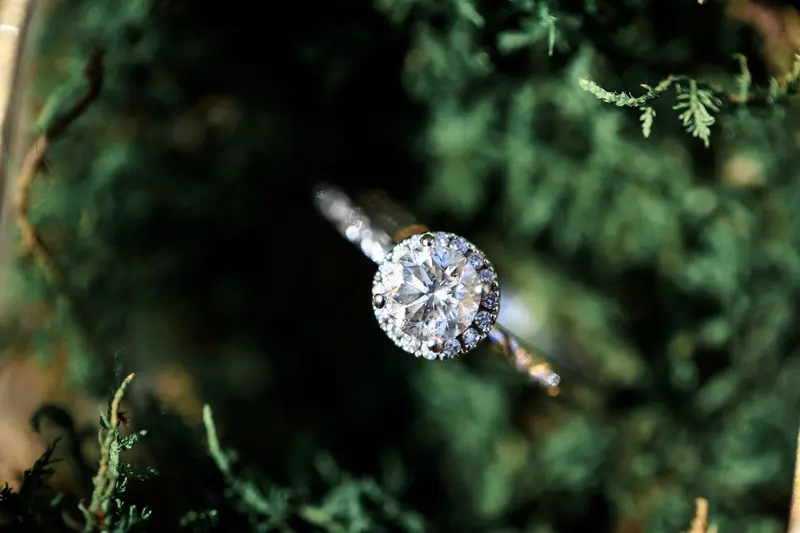
Moissanite has two and a half times more "fire" (the rainbow-colored flashes when light hits) than diamond. To some eyes this looks more sparkly and more spectacular than diamond. To other eyes, particularly experienced jewelers, it looks slightly "off": more colorful flash than diamond should have, sometimes called a "disco-ball" or "rainbow" effect.
Two practical implications:
- In low/medium light (most daily wear), the difference is essentially invisible to non-experts. Moissanite looks like a beautiful, sparkly diamond.
- In bright direct light (sunlight, jewelry-store halogen), the rainbow flash shows up. Some buyers love this; some find it tells the eye "this isn't a natural diamond."
Why moissanite is so much cheaper
Moissanite is lab-grown silicon carbide, produced by a small number of manufacturers (Charles & Colvard is the original; the patent expired in 2018 and prices have dropped further as competition entered). It uses different production technology than lab-grown diamond and the raw material is genuinely cheap.
At a 1.5 ct equivalent (moissanite is sold by approximate diamond size rather than actual carat weight: a 1.5 ct moissanite faces up like a 1.5 ct diamond but weighs ~1.35 ct actual):
- Charles & Colvard Forever One (premium moissanite): ~$700-$900
- Higher-end no-name moissanite (Etsy, Amazon): ~$200-$500
- Lab-grown diamond 1.5 ct G-VS1: from about $1,010 (Blue Nile, 24 September 2026), most listings under $1,600
- Natural diamond 1.5 ct G-VS1: from $8,150 (Blue Nile, 24 September 2026), most listings $9,000 to $12,500
At $400-$800, you can have a 2-3 ct moissanite that visually outweighs even a 1.5 ct lab-grown diamond.
When moissanite is the right call
- Maximum visible size matters and your budget is under $1,500: moissanite is the only path to a 2 ct stone at that budget
- You like the more colorful sparkle: "disco-ball" flash is a feature for some, not a bug
- You see the ring as a long-term keep, not a future-sale asset: moissanite resale is near-zero
- You're ideologically opposed to the diamond industry entirely (some buyers feel this way regardless of lab-grown availability)
- You want the option to upgrade later: sell almost nothing back, but you bought cheap, so the loss is small
When moissanite is the wrong call
- Cultural acceptance matters to you, your partner, or your family: moissanite is consistently described as "not a real diamond" in social contexts, fair or not
- You're buying at $2,000+: at that budget, lab-grown diamond delivers the same visual size with the cultural "it's a diamond" recognition
- You think you might want to upgrade the center stone in 5-10 years: moissanite resale value is essentially zero; you'd be giving up the original purchase entirely
- Resale matters at all: natural diamond retains the most value, lab-grown some, moissanite essentially none
What about "cubic zirconia"?
Cubic zirconia (CZ) is a third option: much softer (Mohs 8.5), lower refractive index, cheaper still (~$30-$100 for 1.5 ct equivalent). It looks reasonable when new but cloudy/scratched within 1-2 years of daily wear. Generally used for fashion jewelry, not engagement rings. Skip CZ for an engagement ring. Moissanite costs only ~$300-$500 more and lasts a lifetime instead of a year.
The honest take
Moissanite is a legitimate engagement-ring choice that gets dismissed too quickly by people who've never actually compared it side-by-side with diamond. At 1.5-2 ct equivalent under $1,000, it's the only realistic path to a substantial-looking stone for budget-constrained buyers.
But it isn't a diamond. If you or your partner cares about that (which is a perfectly valid thing to care about), moissanite is the wrong choice. Lab-grown diamond solves the budget problem (60-80% cheaper than natural) without the "is this a real diamond" question. For most buyers between $1,500 and $5,000 budget, lab-grown diamond is the smarter middle ground, and the gap has narrowed further: a 1.5 ct lab-grown stone started at about $1,010 on 24 September 2026: better cultural acceptance, better resale, identical chemistry to natural.
Moissanite's best case: deliberately substantial size at the lowest possible price, with full acceptance that you're not buying a diamond.