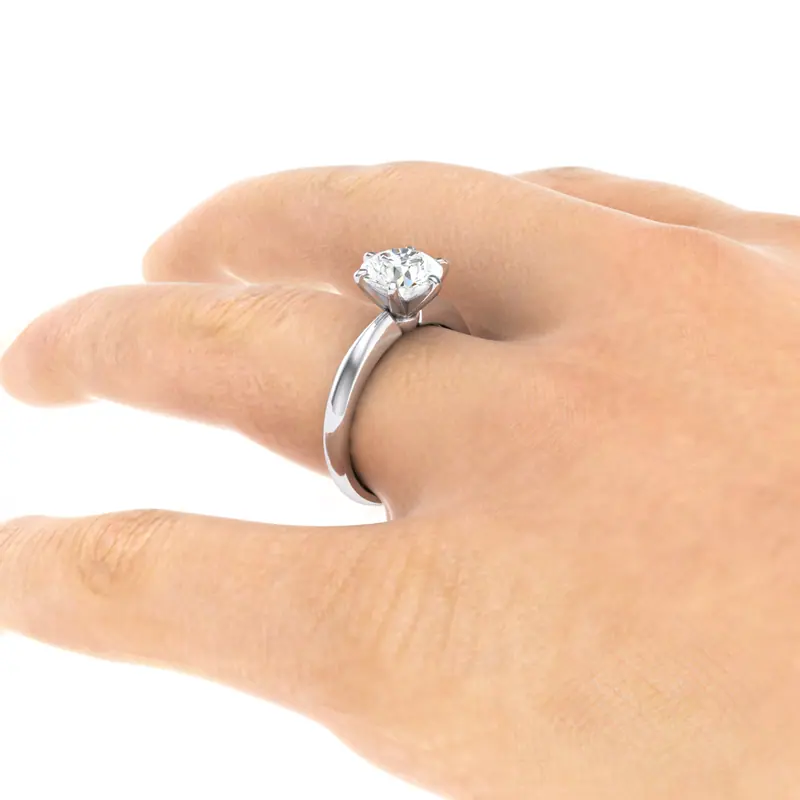
White sapphire vs diamond comes down to three differences: what they are made of, how hard they are, and how strongly they bend light. Diamond is carbon; white sapphire is colorless corundum. Diamond is harder, 10 against 9 on the Mohs scale, and its refractive index is far higher.
The fourth difference used to be price, with white sapphire as the budget option. That has changed. On 24 October 2026, a complete 1 carat lab-grown diamond ring cost less than many white sapphire rings, and this guide shows the numbers.
The measurable differences
| White sapphire | Diamond | |
|---|---|---|
| Mineral | Corundum (GIA) | Carbon crystallized in the isometric system (FTC 23.12) |
| Chemistry | Aluminum oxide, Al₂O₃ | Carbon |
| Mohs hardness | 9 | 10 |
| Refractive index | 1.762 to 1.770 | 2.42 |
| Specific gravity | 4.00 | About 3.52 |
Sapphire figures are from GIA's sapphire page; diamond figures from the FTC's definition of diamond.
Hardness: both work for an everyday ring
Mohs hardness measures how well a stone resists scratching. At 9, sapphire is harder than the beryls (aquamarine, emerald) and tourmaline, which GIA lists at 7 to 8, and GIA notes that synthetic sapphire is durable enough to be used for supermarket scanner windows. Diamond, at 10, is harder still.
In practice, both are hard enough for an engagement ring worn every day. Diamond's extra hardness is an advantage, not a reason to rule sapphire out. Our guide to the best gemstones for engagement rings ranks 19 stones by hardness and toughness.
Light: the biggest visible difference
Refractive index measures how strongly a stone bends light. Diamond's is 2.42; white sapphire's is about 1.76. That is a large gap, and it is the measurable reason the two look different side by side.
Two cautions keep this honest:
- Cut matters as much as material. GIA's research on diamond light performance treats cut proportions, symmetry and the contrast of light and dark areas as what drives how bright a stone looks, and GIA notes that a gem's refractive index sets the ideal cutting depth to avoid a washed-out "window." A well-cut white sapphire can look better than a poorly cut diamond.
- So compare, don't assume. Look at the two stones next to each other in the same light, or on video, before deciding.
A 1 carat white sapphire is smaller than a 1 carat diamond
Carat is a unit of weight, not size, and sapphire is denser than diamond: its specific gravity is 4.00 against about 3.52 for diamond. So the same weight takes up less space. By that arithmetic, a 1 carat white sapphire has about 12% less volume than a 1 carat diamond (3.52 divided by 4.00 is 0.88), and it will look a little smaller face-up for the same cut and shape.
That matters when you compare prices. A white sapphire and a diamond of the same carat weight are not the same size, so compare their measurements in millimeters as well as their weight. Our guide to what carat means explains how weight and size relate.
Price: white sapphire is no longer automatically cheaper
We priced both on 24 October 2026:
| 1 carat option | Price | What it covers |
|---|---|---|
| Lab-grown diamond, Blue Nile (1.02 ct, D, VS1, IGI) | $538 | Loose stone |
| Plus Blue Nile Classic Comfort Fit setting, 14k | $935 | Setting only |
| Lab-grown diamond ring, complete | about $1,473 | Stone and setting |
| White sapphire ring, Capucinne Amy (0.9 ct, VS) | $1,780 | Complete ring, with small diamond accents |
| Natural diamond, Blue Nile (1.01 ct, G, VS2, Excellent, GIA) | $3,019 | Loose stone only; a setting is extra |
So a white sapphire is much cheaper than a natural diamond, but a lab-grown diamond now often costs about the same or less. Lab-grown prices have fallen hard: JCK reported a wholesale lab-grown index down 96% since 2018. These are two retailers with different pricing, and the Capucinne ring has extra diamonds, so treat the table as a guide to the gap rather than an exact match. Our lab-grown diamond price guide has prices at every size.
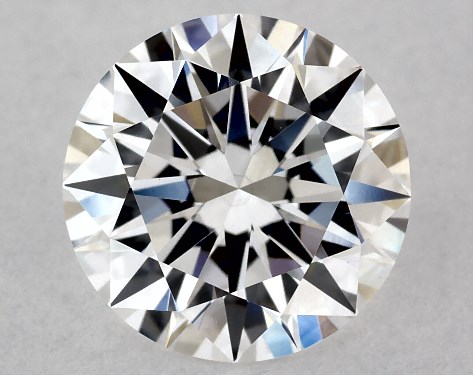
1.02 ct round lab-grown diamond
D color, VS1, Ideal cut · Graded by IGI
The cheapest 1 carat round lab-grown diamond at Blue Nile on 24 October 2026. The link opens the same search, cheapest first.
$538 loose diamond
Check price at Blue Nile: 1.02 ct round lab-grown diamond, D color, VS1, Ideal cut (opens in a new tab)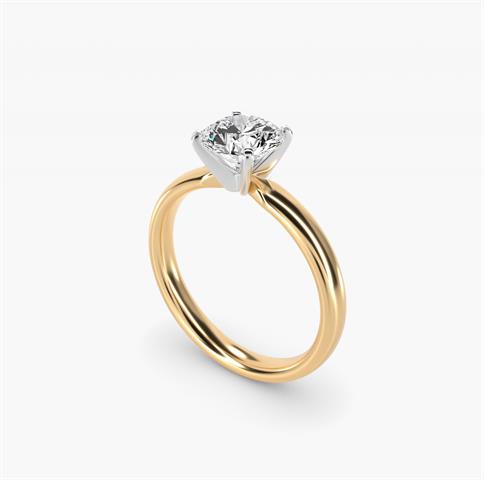
Classic Comfort Fit Solitaire
14k yellow gold · 2.5 mm band
With the stone above: about $1,473 for a complete 1 carat lab-grown diamond ring.
$935 setting only
Check price at Blue Nile: Classic Comfort Fit Solitaire, 14k yellow gold (opens in a new tab)What happens when you click: Blue Nile prices the setting and the stone separately. You open the setting, then choose a diamond, and it offers handpicked matches if you would rather not filter. Free shipping, free returns and a lifetime warranty at Blue Nile.
Prices checked October 24, 2026 at Blue Nile. Prices change, so confirm at checkout. Product photos: Blue Nile. We earn a commission if you buy through these links.
White sapphire rings, priced
If you prefer white sapphire, for its softer look or simply because it is a sapphire, these are Capucinne's white sapphire rings, re-checked on 24 October 2026:

Rain Marquise White Sapphire Ring
14k gold, any color · 0.5 ct marquise, London blue topaz sides
The lowest-priced white sapphire ring in this set.
$1,390 ring, 14k
Check price at Capucinne: Rain Marquise White Sapphire Ring, 14k gold, any color (opens in a new tab)
Amy Round White Sapphire Ring
14k gold, any color · 0.9 ct round, VS clarity, diamond accents
The closest in size to a 1 carat diamond solitaire.
$1,780 ring, 14k
Check price at Capucinne: Amy Round White Sapphire Ring, 14k gold, any color (opens in a new tab)
Colette Baguette White Sapphire Ring
14k gold, any color · 0.4 ct baguette, princess diamond accents
An Art Deco design with a step-cut center stone.
$1,790 ring, 14k
Check price at Capucinne: Colette Baguette White Sapphire Ring, 14k gold, any color (opens in a new tab)
Aimee Square White Sapphire Ring
14k gold, any color · 0.7 ct square, diamond cluster
Set in a cluster of small white diamonds.
$2,570 ring, 14k
Check price at Capucinne: Aimee Square White Sapphire Ring, 14k gold, any color (opens in a new tab)Prices checked October 24, 2026 at Capucinne. Prices change, so confirm at checkout. Product photos: Capucinne. We earn a commission if you buy through these links.
Natural, lab-created and treated sapphire
White sapphires can be natural or grown in a lab, and either can be treated. The FTC Jewelry Guides set two rules worth knowing:
- Under section 23.25, a lab-created sapphire must be described with a word such as "laboratory-created" or "laboratory-grown" right before the stone name.
- Under section 23.24, a seller must disclose a treatment that is not permanent, creates special care needs, or significantly affects the stone's value.
Ask the seller both questions: is it natural or lab-created, and has it been treated? The same rules apply to lab-grown diamonds; our guide to whether lab-grown diamonds are real explains them.
Which should you choose?
Choose white sapphire if you like its look, want a sapphire for its own sake, or want a natural stone for well under the price of a natural diamond. Pick a good cut and compare it in person if you can.
Choose a lab-grown diamond if you want the brilliance of diamond and the lowest price for the size. On today's prices it can cost less than a white sapphire ring.
Choose a natural diamond if you want a mined diamond and accept paying several times more; our lab-grown vs natural diamond comparison covers that choice. And if moissanite is also on your list, see moissanite vs diamond. For blue and other colored sapphires, see our sapphire colors guide.
How we researched this
Sapphire properties are from GIA's sapphire page and diamond properties from section 23.12 of the FTC Jewelry Guides; the note on cut and brightness is from GIA's research on light performance and on colored stone brightness. Disclosure rules are from sections 23.24 and 23.25 of the FTC Guides. Prices were recorded on 24 October 2026: Blue Nile's cheapest 1 to 1.1 carat round lab-grown and natural (G or better, VS2 or better, Excellent cut) diamonds sorted by price, the Classic Comfort Fit 14k setting, and Capucinne's white sapphire rings from the store's own listings.
Sources: GIA, Sapphire; GIA, light performance and diamond cut; GIA, colored stone darkness and brightness; FTC Jewelry Guides, 16 CFR 23.12, 23.24 and 23.25; JCK, July 2026. Prices from Blue Nile and Capucinne. JewelEditor Editorial.