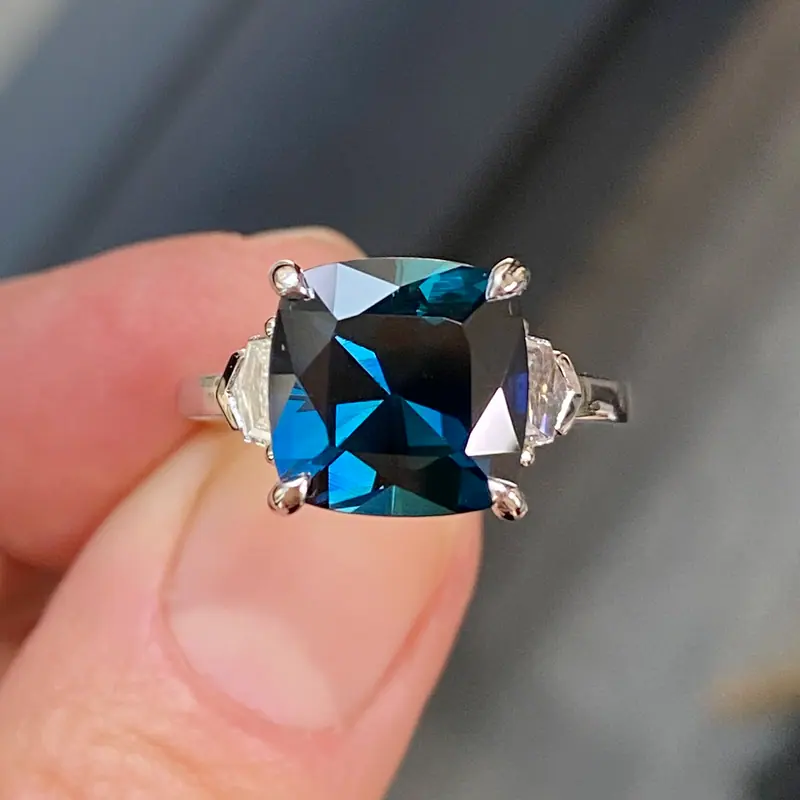
A teal sapphire is a sapphire whose color sits between blue and green. It is the same mineral as every other sapphire, corundum, with the same hardness of 9. What makes it teal is only the color, and "teal" is a trade name rather than one of GIA's sapphire color names, so two stones sold as teal can look quite different.
This guide covers what GIA's research says about teal sapphire, why treatment is the question to ask, how sellers name the color, and what 74 teal sapphire rings cost at Capucinne.
What makes a sapphire teal
GIA explains that when the trace elements in corundum are iron and titanium, the result is blue sapphire, and its list of fancy sapphire colors includes green. Teal stones sit between the two, and the balance varies from stone to stone: some read as a greenish blue, others as a bluish green.
That is why the name alone tells you little. Across the 140 teal listings at Capucinne we read on 19 October 2026, the store described the color in more than a dozen ways, including "teal (green and blue)," "teal/blue," "teal/green," "mint/teal," "teal/grey" and "deep teal." Our sapphire colors guide covers the full range of colors and what GIA rates most highly.
Why teal sapphires became popular
GIA's journal Gems & Gemology published a study of Montana sapphire in 2023, and it notes that demand is increasing as consumers become more interested in the less saturated blue and teal and fancy-color sapphires. Teal offers a colored center stone that is clearly not a diamond, with sapphire's durability.
Where teal sapphires come from
The same GIA study found that pale blue and pale green sapphires make up the bulk of production from Montana's secondary deposits, and that most of those colors are somewhat pale, especially when unheated. Vibrant, saturated colors do occur naturally, it says, but they are more common in heated stones.
Sellers rarely tell you the origin. None of Capucinne's 140 teal listings named a mining region in its description, and three titles said "Ceylon," the old name for Sri Lanka. If origin matters to you, ask, and expect to need a lab report to confirm it.
Treatment: the question to ask
This is the most important point for a teal sapphire. GIA's Montana study says the majority of these sapphires entering the market have been heat treated, and that most require, or at least benefit from, carefully controlled high-temperature heating.
Under section 23.24 of the FTC Jewelry Guides, a seller must disclose a treatment if it is not permanent, creates special care needs, or significantly affects the stone's value. In practice, many listings say nothing. Of Capucinne's 140 teal listings, 17 stated a treatment: 9 said unheated and 8 said low-temperature heat. The other 123, including all five rings below, said nothing either way.
That is not evidence of anything hidden, but it is the question to put to any seller: has this stone been heated, and is there a lab report? The FTC's disclosure rule exists because treatment can significantly affect a stone's value.
How to choose a teal sapphire
GIA's quality factors for sapphire apply to teal as well:
- Color first. GIA says color has the greatest influence on a sapphire's value, and that more intense, uniform color is more valuable. With teal, also decide whether you want it blue-leaning or green-leaning, because sellers' names will not tell you.
- Evenness. GIA notes that color zoning, areas of different color within one stone, is common in sapphire. Look at the stone face-up in photos and video.
- Clarity. GIA says inclusions generally make a stone less valuable, though most sapphires have some.
- Durability. At 9 on the Mohs scale (GIA), sapphire is hard enough for a ring worn every day. Diamond, at 10, is harder.
Teal sapphire vs other blue-green gems
If it is the blue-green color you love, sapphire is not the only option. These are the stones it is most often weighed against, with the hardness and color notes from GIA's own gem pages:
| Stone | Mineral | Mohs hardness (GIA) | Color, per GIA |
|---|---|---|---|
| Teal sapphire | Corundum | 9 | Between blue and green (a trade name) |
| Blue-green tourmaline | Tourmaline | 7 to 7.5 | Traces of iron, and possibly titanium, are thought to cause its green and blue colors; Paraíba tourmaline is a vivid copper-colored blue to green |
| Aquamarine | Beryl | 7.5 to 8 | The best are blue to slightly greenish blue |
| Emerald | Beryl | 7.5 to 8 | Green |
Mohs hardness measures how well a stone resists scratching, so on a ring worn every day, sapphire at 9 has a clear edge over stones at 7 to 8. That is the main practical reason to choose teal sapphire over these alternatives for an engagement ring. If you prefer the look of aquamarine, tourmaline or emerald, Capucinne sells all three; expect to treat them more gently. Our guide to the best gemstones for engagement rings ranks all of them by hardness and toughness.
Sources: GIA's pages on tourmaline, aquamarine and emerald.
What a teal sapphire ring costs
We read every Capucinne ring with "teal" in its title that was in stock in 14k yellow gold on 19 October 2026: 74 rings, from $1,050 to $15,850, with a median of $4,355. Twenty cost under $3,000 and 48 under $5,000. Stone size, color, side diamonds and the design all affect where a ring falls in that range.
The five below, re-checked on 23 October 2026, run from a 0.25 carat solitaire to a 4 carat statement ring. Their photos also show how far "teal" can range from blue to green.

Ekanshi Trillion Teal Sapphire Ring
14k gold, any color · 0.25 ct trillion, bezel solitaire
The lowest-priced teal ring in Capucinne’s range; a deep, blue-leaning teal.
$1,050 ring, 14k
Check price at Capucinne: Ekanshi Trillion Teal Sapphire Ring, 14k gold, any color (opens in a new tab)
Freya Triangle Teal Sapphire Ring
14k gold, any color · 0.5 ct triangle, bezel solitaire
A greener teal than the Ekanshi, which shows how wide the color range is.
$3,040 ring, 14k
Check price at Capucinne: Freya Triangle Teal Sapphire Ring, 14k gold, any color (opens in a new tab)
Luisa Emerald Cut Teal Sapphire Ring
14k gold, any color · 1 ct emerald cut, princess diamond accents
A lighter, brighter teal than the two solitaires.
$2,710 ring, 14k
Check price at Capucinne: Luisa Emerald Cut Teal Sapphire Ring, 14k gold, any color (opens in a new tab)
Rita Cushion Teal Sapphire Ring
14k gold, any color · 2 ct cushion, diamond accents
A little above Capucinne’s median teal ring price of $4,355.
$5,130 ring, 14k
Check price at Capucinne: Rita Cushion Teal Sapphire Ring, 14k gold, any color (opens in a new tab)
Deidre Shield Teal Sapphire Ring
14k gold, any color · 4 ct shield, step cut solitaire
A 4 carat statement stone, near the top of Capucinne’s teal range.
$11,600 ring, 14k
Check price at Capucinne: Deidre Shield Teal Sapphire Ring, 14k gold, any color (opens in a new tab)Prices checked October 23, 2026 at Capucinne. Prices change, so confirm at checkout. Product photos: Capucinne. We earn a commission if you buy through these links.
If you are weighing a teal sapphire against a diamond on budget, our guide to engagement rings under $5,000 shows what a diamond costs at each size, and what carat means explains how stone weight works for sapphires too.
How we researched this
The color, origin, demand and treatment findings come from GIA's 2023 Gems & Gemology study of Montana sapphire (Palke, Renfro, Hapeman and Berg) and GIA's sapphire description, quality-factor and overview pages, read on 19 and 23 October 2026. Disclosure rules are from section 23.24 of the FTC Jewelry Guides. We read all 140 Capucinne listings with "teal" in the title from the store's own catalog on 19 October 2026 for color names, origin and treatment statements, and the 14k prices of its 74 in-stock teal rings; the five rings shown were re-priced on 23 October 2026.
Sources: GIA, Gems & Gemology, Montana sapphire, 2023; GIA, Sapphire Quality Factors; GIA, Sapphire Description; GIA, Sapphire; FTC Jewelry Guides, 16 CFR 23.24. Prices from Capucinne. JewelEditor Editorial.