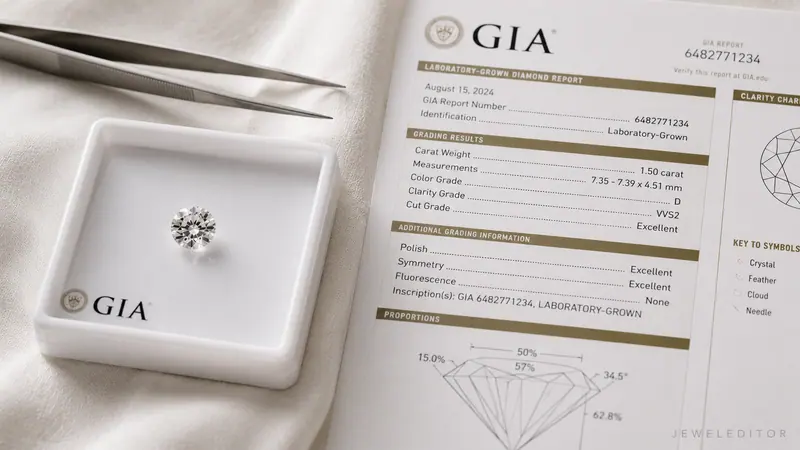
GIA diamond grading is how the Gemological Institute of America (the most established gem lab in the world, founded in 1931) evaluates the four characteristics that determine a diamond's quality: color, clarity, cut and carat weight. The output is a grading report that documents each property and acts as the closest thing the diamond industry offers to a "certificate of authenticity."
This guide is the working layer of GIA grading. What each of the four Cs actually measures, how the grading is conducted in the lab and what the report tells you that the retailer's listing doesn't.
The four Cs, decoded
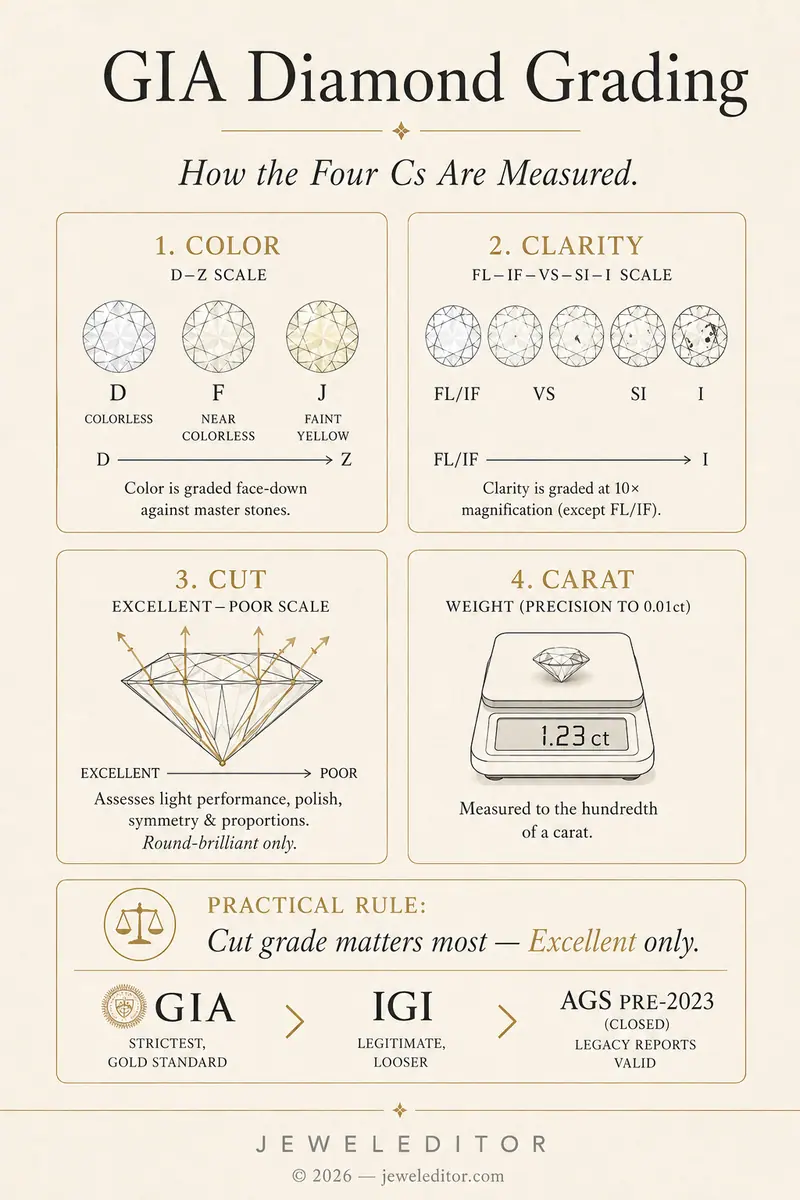
GIA introduced the four Cs framework in the 1950s, and it has become the industry-standard vocabulary for diamond quality. Each C measures one dimension of the stone; the report grades each independently. The four together describe the stone's full spec.
A brief summary of each, then the deeper look at how GIA actually measures them:
| C | What it measures | GIA scale |
|---|---|---|
| Color | Absence of yellow/brown tint | D (colorless) to Z (light yellow) |
| Clarity | Size and visibility of inclusions and blemishes | Flawless (FL) to Included (I3) |
| Cut | Optical performance (light return) | Excellent to Poor (round-brilliant only) |
| Carat | Precise weight | Exact, to 0.01 ct |
The four Cs are not weighted equally in determining how the diamond actually looks to the wearer. Cut grade matters most: a poorly-cut high-color diamond looks dull; a well-cut moderate-color diamond looks brilliant. Carat weight, while determining size, doesn't determine visible quality the way cut does.
Color: the D-Z scale
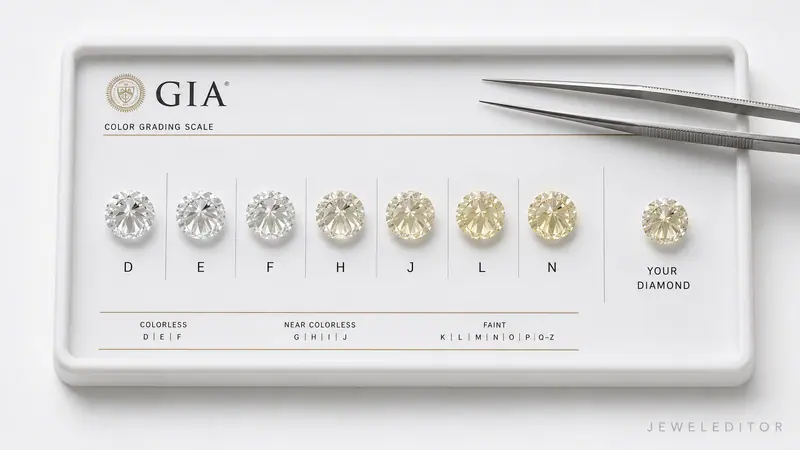
GIA's color scale runs from D (perfectly colorless) through Z (light yellow). The scale measures the absence of yellow or brown tint in white diamonds. Diamonds with any other body color (blue, pink, green) fall under "fancy color" grading, which uses an entirely different scale.
The grades collapse into five visible groupings that matter to buyers:
- Colorless (D-F): no detectable color in any normal viewing condition. The prestige tier.
- Near Colorless (G-J): faint warmth visible only against a higher master stone. The practical sweet spot for most engagement-ring buyers.
- Faint (K-M): detectable warmth in normal lighting; pairs well with yellow gold.
- Very Light (N-R): visible yellow tint; rarely chosen for engagement rings.
- Light (S-Z): pronounced yellow; near-fancy territory.
Graders place the diamond table-down (pavilion up) on a neutral grading tray under D65 standardized illumination, then compare the stone to GIA's master-stone set. Color is assigned based on the closest match.
For the complete D-Z explainer including the buying decision framework and an interactive comparison tool, see our Diamond Color Scale GIA guide. The companion Color Grade Visualizer lets you see what each grade looks like under different lighting and metal pairings.
Clarity: the Flawless to Included scale
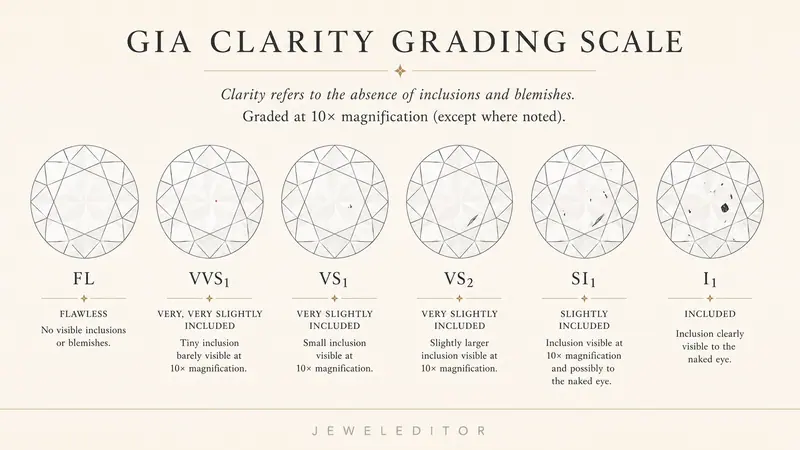
Clarity grades describe internal flaws (inclusions) and surface flaws (blemishes) visible under 10× magnification. The complete scale, simplified:
- Flawless (FL): no inclusions or blemishes visible at 10×. Extremely rare; commands the highest premium.
- Internally Flawless (IF): no inclusions at 10×; minor surface blemishes only. Still very rare.
- VVS1, VVS2: Very, Very Slightly Included. Tiny inclusions difficult for a skilled grader to find at 10×. Invisible to the naked eye in all viewing conditions.
- VS1, VS2: Very Slightly Included. Small inclusions detectable at 10×. Almost always invisible to the naked eye. The engagement-ring sweet spot.
- SI1, SI2: Slightly Included. Inclusions visible at 10× and sometimes visible to the naked eye on close inspection. SI1 stones can still be "eye-clean" depending on inclusion location.
- I1, I2, I3: Included. Inclusions clearly visible to the naked eye and may affect transparency or durability. Avoid for engagement rings.
GIA grades clarity by examining the stone under 10× magnification with a trained gemologist's loupe. The grader documents the type, size, position and number of inclusions, then assigns a grade based on overall clarity character.
The key phrase to remember: "eye-clean." A VS2 that is eye-clean (meaning inclusions are not visible to the naked eye in normal viewing) is functionally identical to a VVS1 to anyone who isn't using a loupe. Paying for VVS or FL clarity at the engagement-ring tier is paying for a grade label, not for visible quality.
For an SI1 stone, eye-cleanness depends on where the inclusions sit. An SI1 with inclusions near the table (top) may show visible flaws; an SI1 with inclusions near the pavilion (bottom) covered by metal in the setting may read as eye-clean. Always inspect the actual stone (via 360° video at minimum, in person ideally) before committing to SI clarity.
Cut: the most important C
Cut measures how well the diamond returns light to the viewer: what your eye reads as "sparkle" or "brilliance." It's the spec that matters most to visible quality, and GIA grades it only for round-brilliant diamonds.
The GIA cut grade scale:
- Excellent: maximum light return; the brightest, most visually dynamic finish. Optimal proportions, polish and symmetry.
- Very Good: close to Excellent but with slight compromises in proportions or symmetry. Difference is visible under direct lighting.
- Good: acceptable light return but visibly less brilliant. Avoid at the engagement-ring tier.
- Fair: significant compromises; the stone reads as dull. Skip.
- Poor: major compromises in proportions; stone looks lifeless. Definitely skip.
The single most important buying rule on cut: Excellent only. A 1.0-carat Excellent-cut diamond looks brighter and often visually larger than a 1.3-carat Very-Good-cut at the same color and clarity, because cut determines light performance, and your eye reads light performance as both "brilliance" and "size."
The cut grade encompasses three sub-components:
- Proportions: table width, crown angle, pavilion depth, etc. Proper proportions maximize light return.
- Polish: the surface finish. Excellent polish maximizes reflectivity.
- Symmetry: alignment of facets. Excellent symmetry ensures light bounces evenly through the stone.
For fancy shapes (marquise, oval, pear, emerald, cushion, etc.), GIA does NOT issue a cut grade, only polish and symmetry grades. The buyer has to inspect the stone visually for light performance, particularly looking for the "bowtie" effect in elongated shapes. For the fancy-shape specifics, see our marquise diamond engagement rings guide.
Carat: the precise weight
Carat is the simplest of the four Cs to measure: it's the diamond's weight, with 1 carat equal to 0.2 grams (200 milligrams). GIA reports carat weight to the second decimal place, so a stone is "1.45 ct" or "1.50 ct" precisely, not "approximately 1.5 ct."
The pricing implication of precise carat measurement matters more than buyers realize. Diamond prices have size thresholds at certain weight points:
- 0.99 ct vs 1.00 ct: the 1.00 ct threshold creates a noticeable price jump (10-15% premium) for crossing into the "1-carat" category, even though the visible difference is tiny.
- 1.49 ct vs 1.50 ct: similar threshold at 1.50.
- 1.99 ct vs 2.00 ct: similar threshold at 2.00.
Buyers who care more about value than about hitting a round-carat threshold can save 8-12% by buying just under a threshold (0.95-0.99 ct, or 1.45-1.49 ct) at the same color, clarity and cut spec, with no visible size difference to the wearer.
GIA reports also include the diamond's millimeter dimensions, which correlate more directly to visible size than carat weight does. A 1.00 ct round-brilliant should measure approximately 6.5 mm in diameter (within standard tolerances). Diameter, not weight, is what the wearer's eye actually reads.
For the carat-by-carat budget framework (what each tier delivers across spec), see our engagement rings under $5,000 budget guide.
How gia diamond grading actually works in the lab
The lab process is more controlled than most buyers realize. Each step is standardized to minimize grader variation:
Step 1: Receipt and identification. The diamond arrives at GIA. Each stone is logged, measured and assigned a unique report number. Lab-grown stones receive the "Laboratory-Grown Diamond Report" track; natural diamonds receive the standard report.
Step 2: Carat weight and measurements. Precise electronic scales measure weight to 0.001 ct (rounded to 0.01 ct on the report). Optical measurement tools record millimeter dimensions.
Step 3: Color grading. Multiple trained gemologists independently grade the stone against master stones under D65 illumination. The diamond is placed table-down on a neutral grading tray; color is assigned based on the closest master-stone match. If graders disagree, additional graders are consulted until consensus is reached.
Step 4: Clarity grading. Independent trained gemologists examine the stone under 10× magnification, documenting all inclusions and blemishes. The grade reflects the type, size, position and number of flaws.
Step 5: Cut grading (round-brilliant only). Optical instruments measure proportions; trained graders assess polish and symmetry. The overall cut grade combines all three sub-components.
Step 6: Fluorescence. The stone is exposed to ultraviolet light; any visible fluorescence is graded (None, Faint, Medium, Strong, Very Strong) along with its color (typically blue, occasionally yellow or other).
Step 7: Laser inscription. The report number is laser-engraved on the diamond's girdle (the thin edge between top and bottom). For lab-grown stones, "Laboratory-Grown" is also inscribed.
Step 8: Report issuance. The grading report is printed and shipped with the diamond back to the submitting jeweler or retailer.
The process typically takes a few weeks from submission to report issuance, depending on the queue and stone complexity. The cost is paid by the submitter (usually the wholesaler or retailer) and is built into the diamond's retail price; the buyer doesn't pay GIA directly, but the cost is real and embedded in what you pay at the counter.
This level of standardization is what makes the GIA report the most trusted single document in the diamond industry. Other gem labs follow similar processes; the consistency and rigor of GIA's grading is what separates it from the alternatives.
What the report doesn't tell you
A GIA report is the most reliable spec documentation in the diamond market, but it has limits worth understanding.
It doesn't tell you the stone's actual appearance. Two diamonds at the same four-Cs spec can look noticeably different. Variations in inclusion location, fluorescence interaction and minor cut variations within the same grade band all affect visible quality. The report describes specs, not appearance. Always inspect the actual stone (or its 360° video) before committing.
It doesn't grade fluorescence as part of clarity. Fluorescence is documented separately on the report. Strong blue fluorescence can affect appearance (making a J-grade stone appear closer to G-H in sunlight, or rarely causing a milky look), but it isn't penalized in the clarity or color grade.
It doesn't issue cut grades for fancy shapes. Only round-brilliant gets a cut grade. For marquise, oval, pear, emerald and other fancy shapes, the buyer has to use polish and symmetry grades plus visual inspection to assess cut quality.
It doesn't certify ownership. The report documents the diamond's spec at time of grading. It doesn't track ownership transfers, theft or recovery.
It doesn't guarantee resale value. The report establishes spec; market value depends on current demand, retailer markup and other factors outside GIA's scope.
For the broader context on what to verify when buying, including the post-purchase verification process and how to use the GIA Report Check tool, see our companion guide on GIA-certified lab-grown diamonds, which covers the verification workflow in detail (the workflow is the same for natural and lab-grown).
Closing: three things to take away
- GIA grading is the industry-standard verification of diamond spec. Trust IGI when GIA isn't available; treat AGS pre-2023 reports as legitimate but historic; insist on GIA at 1.0+ carat engagement-ring purchases.
- Cut grade matters most. A 1.0-carat Excellent-cut diamond looks brighter and visually larger than a 1.3-carat Very-Good-cut at the same color and clarity. Excellent only.
- The report tells you spec, not appearance. Always inspect the actual stone (or 360° video) before committing. Two diamonds at the same four-Cs spec can look meaningfully different.
For the color-specific deep dive, see our Diamond Color Scale GIA guide and the Color Grade Visualizer. For lab-grown grading specifics, see our GIA-certified lab-grown diamonds guide. For the budget allocation framework across the four Cs, see our engagement rings under $5,000 guide.
The TL;DR is this: GIA grading is the buyer's most reliable line of defense against retailer over-grading. The report doesn't tell you whether to buy the diamond. That's still your call based on appearance, budget and what the ring means. But the report tells you what you're buying. For an engagement-ring purchase typically priced $3,000-$12,000, the spec verification is the most useful piece of due diligence built into the purchase. The grading cost is embedded in the retailer's price, so the buyer captures the verification without paying a separate fee.
Last audited: 2026-09-24. JewelEditor Editorial. Grading methodology drawn from the Gemological Institute of America and its consumer-facing 4Cs reference, with cross-references to the American Gem Society and the International Gem Society research library. Pricing context via Mike Fried's Diamonds Pro buying guides. Industry coverage via JCK Magazine. Engagement-ring spending data via The Knot's 2025 Jewelry & Engagement Study.