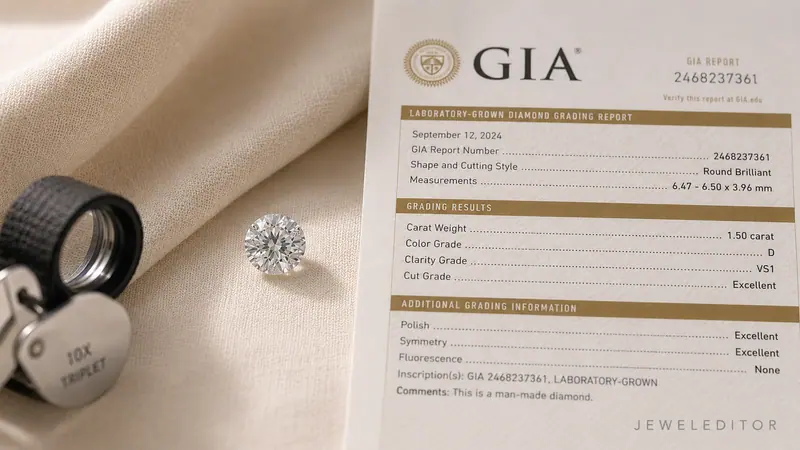
A gia certified lab grown diamond (or "GIA-certified lab-grown diamond" in standard editorial style) is not the same as an ungraded lab-grown diamond. The difference is documented authenticity: third-party verification of every spec, plus a laser-inscribed report number on the stone's girdle that links the physical diamond to its grading certificate. For a buyer spending $3,000+ on a lab-grown engagement ring, GIA certification is the most useful piece of due diligence available.
This guide is the practical layer most lab-grown buying guides skip: what the report actually tells you, how to verify it's genuine and the steps to take after purchase to confirm you got the stone you paid for.
What "GIA-certified" actually means
The Gemological Institute of America (GIA) is the most established diamond-grading organization in the world. Founded in 1931, GIA introduced the D-Z color scale in 1953 and the four Cs framework that the entire industry uses today. When a diamond is "GIA-certified," it has been examined by GIA's gem lab and accompanied by an official grading report.
For lab-grown diamonds specifically, GIA issues the GIA Laboratory-Grown Diamond Report, the lab-grown counterpart to GIA's natural diamond report. The methodology is fully aligned between the two reports today: same D-Z color scale, same Flawless-to-Included clarity scale, same Excellent-to-Poor cut grade for round-brilliants. The differences are in the document header (the report is labeled "Laboratory-Grown Diamond Report"), the girdle inscription (which includes "Laboratory-Grown" as part of the laser engraving) and additional comments fields noting the growth method (HPHT or CVD) and any post-growth treatments when known.
The history of GIA's lab-grown grading explains some of the legacy reports still floating around the market:
- 2007: GIA began grading lab-grown diamonds using descriptive grade ranges (e.g., "near colorless" rather than specific letter grades). The decision was partly to avoid implying lab-grown stones held identical market value to naturals.
- 2019: GIA transitioned lab-grown reports to the standard D-Z letter grading used for natural diamonds. The shift was driven by improvements in lab-grown consistency and market maturity.
If you encounter an older GIA lab-grown report (pre-2019), the descriptive grades it uses don't translate directly to D-Z letters. They represent ranges. A pre-2019 "near colorless" lab-grown stone could be anywhere from G to J today. For current-market purchases, only post-2019 GIA reports with full D-Z grading are relevant.
What the GIA report actually tells you
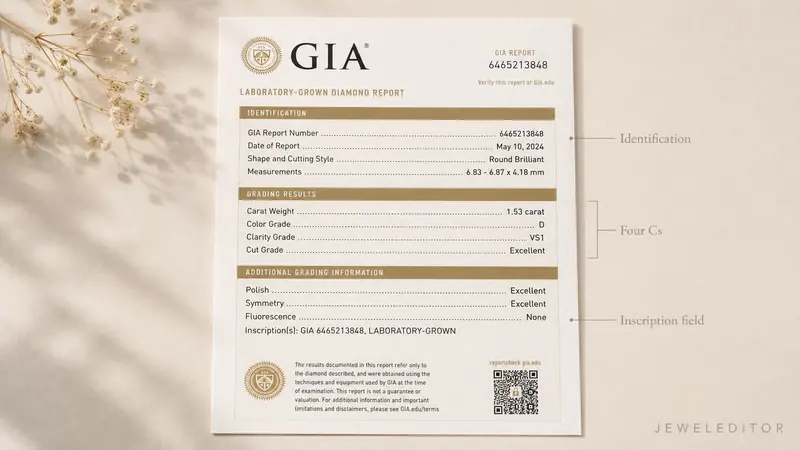
A GIA Laboratory-Grown Diamond Report includes the following fields. We'll walk through what each one means and what to verify.
Identification block
- Report number: unique to the diamond. Used for verification via GIA's online Report Check tool.
- Date of issue: when GIA examined the stone. Reports older than 5 years can warrant a re-grade if anything has changed (cut, clarity due to damage).
- Shape and cutting style: round-brilliant, princess, cushion, etc.
Carat and measurements
- Carat weight: the precise weight to two decimal places. A stone listed as "1.50ct" could legally weigh 1.495-1.504; the report gives the exact figure.
- Measurements: millimeter dimensions (length × width × depth for fancy shapes; diameter and depth for round-brilliant).
The four Cs
- Color grade: D through Z. (Lab-grown stones are typically D-G; lower grades exist but are uncommon in engagement-ring inventory.)
- Clarity grade: Flawless (FL), Internally Flawless (IF), VVS1, VVS2, VS1, VS2, SI1, SI2, I1, I2, I3.
- Cut grade: Excellent, Very Good, Good, Fair, Poor. (Only for round-brilliant. GIA does not issue cut grades for fancy shapes like marquise, oval or emerald.)
- Polish and symmetry: separate Excellent-to-Poor grades. Excellent on both is the standard at the engagement-ring tier.
Additional fields
- Fluorescence: None, Faint, Medium, Strong, Very Strong; and the fluorescence color (typically blue, sometimes yellow or other).
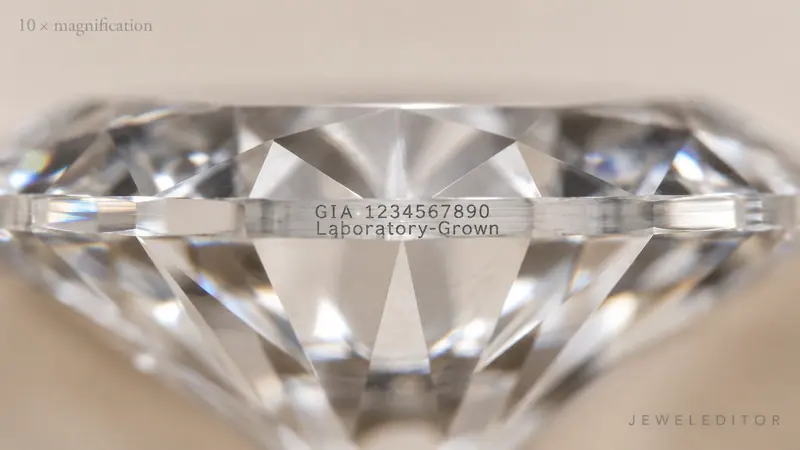
- Inscription: the report number laser-engraved on the diamond's girdle (the thin edge between the top and bottom of the stone). This is the single most important field for post-purchase verification.
- Comments: any additional GIA notes about the stone (e.g., identification of the growth method as HPHT or CVD, any post-growth color or clarity treatments or other identifying observations).
The lab-grown-specific identifier
The report header explicitly identifies the stone as "Laboratory-Grown." The girdle inscription includes "Laboratory-Grown" as part of the laser engraving: a permanent, on-stone identifier that survives any setting or re-cut.
This is the FTC's Jewelry Guides (16 CFR Part 23) compliance layer. Every lab-grown diamond must be disclosed as such, and the laser inscription makes the disclosure permanent and verifiable.
How to verify a GIA lab-grown report after purchase
Five practical steps. Each takes minutes; together they confirm you received the stone you paid for.
1. Match the report number to the girdle inscription
The single most important verification step. Every GIA-graded diamond has its report number laser-inscribed on the girdle (the thin edge between the top and bottom of the stone). A jeweler's 10× loupe (about $40 at most online retailers) is sufficient to read the inscription on a 1.0ct+ stone.
Hold the diamond table-up (face-up). Rotate it until you see the girdle clearly. Look for a string of letters and numbers, typically formatted like "GIA 1234567890" with "Laboratory-Grown" sometimes alongside or on a separate line of the inscription. The number should match exactly to the report number on the certificate. If the numbers don't match, you're holding a different stone than the one graded. Return it.
2. Confirm the report is genuine
Visit GIA's Report Check tool, a free verification service. Enter the report number. The tool returns the carat, color, clarity, cut and other fields recorded by GIA. Compare to the printed report you received. If they match, the report is genuine. If they don't, the report may be fraudulent or altered.
This step takes about 30 seconds and rules out one of the most common diamond-fraud patterns: a real diamond with a fake (or someone else's) report.
3. Confirm carat and measurements
The carat weight on the report should match the seller's listing exactly (to two decimal places). If the listing said "1.50ct" and the report says "1.42ct," the seller may have rounded up or substituted a different stone. The measurements section gives the diamond's exact millimeter dimensions; a 1.50ct round should measure approximately 7.4mm in diameter (within a small tolerance).
4. Verify the four Cs match the listing
Color, clarity, cut, polish, symmetry: all should match exactly what the seller listed. If you bought a "D-VS1 Excellent" and the report says "G-VS2 Very Good," the seller substituted a lower-spec stone. Return.
5. Get an independent appraisal within 30 days
A bench-trained gemologist (find one through the American Gem Society's directory) will charge $50-$150 for an appraisal that verifies the four Cs independently and assigns a replacement value for insurance purposes. The GIA report establishes the spec; the appraisal establishes the value and the chain of custody for insurance claims. Both are useful.
GIA vs IGI vs AGS: which lab matters
Three major gem labs operate in the lab-grown space. Smaller labs exist, but they don't appear in reputable retailer inventory, so we won't cover them here.
GIA (Gemological Institute of America): the gold standard. The most rigorous grading, the most consistent across stones, the broadest industry recognition. GIA grading carries the highest resale value retention. A large share of premium lab-grown stones (1.0ct+) at major US retailers come with GIA reports; the rest typically come with IGI.
IGI (International Gemological Institute): the legitimate alternative. IGI grades a higher volume of lab-grown stones than GIA (especially smaller stones and stones from emerging-market retailers) and is the standard for many cheaper online sellers. IGI's grading is generally credited as slightly looser than GIA's, meaning an IGI-graded color or clarity grade may be a step lower if the same stone were re-examined by GIA. The grades are still useful and broadly accurate; just calibrate for the slightly different rigor.
AGS Laboratories (American Gem Society Laboratories) ceased operations in early 2023. Any AGS-graded lab-grown stone available today is pre-2023 inventory. The AGS reports are still valid (they document the stone's grades at the time of grading), but no new AGS reports are being issued. For the lab-grown buyer in 2026, AGS is a non-factor.
The practical buying rule:
- Know what you are actually choosing between. IGI is now the default for lab-grown at the major retailers, not a budget alternative: on 24 September 2026, Blue Nile's lab-grown listings were mostly IGI, with a minority carrying GIA or GCAL. Insisting on GIA narrows your choice sharply, and falling lab-grown prices have made the old dollar thresholds meaningless. A 1.5-carat D-VS1 lab-grown stone started at about $1,010 that day.
- Where GIA is worth chasing: larger stones you may want appraised or insured later, and any stone whose grades sit near a boundary you care about (for example D versus E, or VS1 versus VS2), since a slightly looser grade changes the label more than the look.
- Whichever lab grades it, verify the report number on the lab's own site and match the girdle inscription before the return window closes.
- For AGS-graded stones, verify the report was issued before January 2023 (when AGS Labs closed). If yes, the grading is valid; if no, the report is suspicious.
Common confusions on lab-grown reports
Four patterns recur in buyer confusion about GIA lab-grown reports:
Confusion 1: "GIA-certified" means anything graded by GIA. Strictly, "GIA-certified" is the common-usage phrase for "graded by GIA," but GIA itself uses the term "GIA-graded" rather than "GIA-certified." Sellers use both interchangeably. The distinction is semantic; the substance is identical.
Confusion 2: Lab-grown reports are different documents than natural reports. The lab-grown report is formally distinct (different header, different document layout, lab-grown identifier in the inscription), but the grading methodology is identical to the natural-diamond report. For the buyer reading either report, the four Cs and their meaning are the same.
Confusion 3: GIA grades all lab-grown stones the same way. Not quite. GIA has issued lab-grown reports since 2007, but the methodology shifted in 2019 (from descriptive grades to the D-Z letter scale). Pre-2019 GIA lab-grown reports use descriptive ranges; post-2019 use D-Z letters. For current purchases, only post-2019 letter-grade reports are directly comparable to natural-diamond grades.
Confusion 4: A GIA report makes lab-grown a "real diamond." A GIA report verifies the diamond's properties (it confirms the stone is indeed a diamond, lab-grown specifically, with the documented spec). The report doesn't change the diamond's status. Lab-grown diamonds are chemically and physically real diamonds whether they're GIA-graded, IGI-graded or ungraded. The FTC's 2018 ruling on diamond terminology explicitly confirmed this. The report is a verification of properties, not a credentialing of authenticity.
Why a GIA certified lab grown diamond matters for your purchase
For a buyer evaluating a lab-grown engagement ring, the GIA grading is the closest thing to a guarantee that what you're buying matches what's listed. Without grading, you're relying entirely on the retailer's self-grading, which can be optimistic, inconsistent or in worst-case-scenario, fraudulent.
A GIA-graded lab-grown stone:
- Has been examined by a third-party gem lab with established grading rigor
- Has a laser inscription that ties the physical stone to its certificate
- Can be verified independently via GIA's online tool
- Holds modestly better resale value than the ungraded equivalent at the same spec
The premium for buying a GIA-graded lab-grown over an ungraded equivalent is typically a few hundred dollars on a 1.0-1.5ct stone, well worth it for the verification it provides.
For the broader lab-grown decision framework (pricing, retailer selection, the lab-grown vs natural tradeoff), see our lab grown diamonds for engagement rings guide. For the budget allocation context at the $5,000 tier, see our engagement rings under $5,000 budget guide. For the underlying color-grade decision (which the GIA report documents), see our Diamond Color Scale GIA guide. The companion Color Grade Visualizer lets you compare grades side-by-side under different lighting and metal pairings.
Closing: three things to take away
- GIA-certified lab-grown is not the same as ungraded lab-grown. The report is the receipt; the inscription is the proof. Both are worth the few-hundred-dollar premium over ungraded equivalents.
- The girdle inscription is the verification step nobody mentions. Match the inscribed report number to the certificate under a 10× loupe. If they don't match, you have a different stone than the one graded.
- GIA > IGI > pre-2023 AGS. At 1.5ct+ engagement-ring purchases, insist on GIA. At smaller / budget purchases, IGI is acceptable but reads slightly looser. AGS reports older than January 2023 are valid; AGS reports newer than that are suspicious.
The TL;DR is this: a GIA report turns lab-grown from a faith-based purchase ("the retailer says this stone is D-VS1") into a verifiable purchase ("the GIA report confirms this stone is D-VS1, and the inscription on the girdle proves I have the right stone"). For an engagement-ring purchase that's typically $3,000-$8,000, the verification is worth the modest premium. Skip the verification at your own risk.
Last audited: 2026-09-24, with lab-report practice rechecked against live Blue Nile listings that day. JewelEditor Editorial. Grading methodology and report-format details drawn from the Gemological Institute of America, with cross-references to the 4Cs reference site and GIA's Report Check tool. FTC ruling on diamond terminology via the Jewelry Guides (16 CFR Part 23). Post-purchase verification recommendations align with bench-jeweler practice as documented by the American Gem Society. Industry pricing context via trade coverage in JCK Magazine and Mike Fried's Diamonds Pro pricing guide.