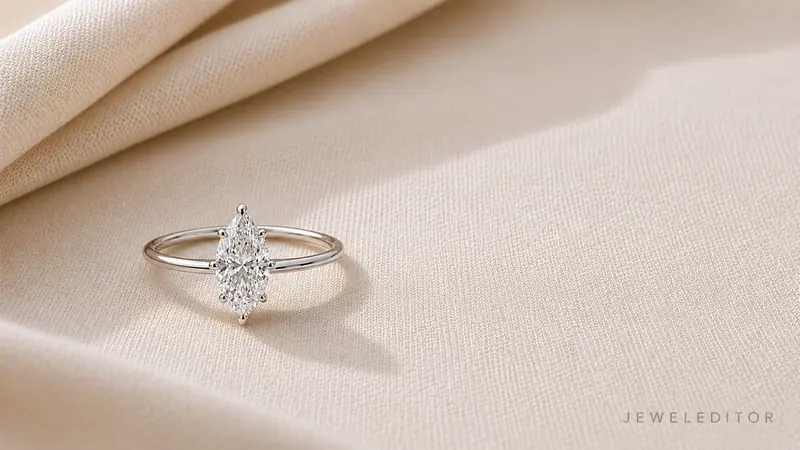
A marquise diamond engagement ring is the shape that quietly delivers more visible stone per dollar than any other common engagement-ring cut. The shape itself is built for size illusion: elongated, pointed at both tips, designed to spread a given carat weight across the maximum face-up area. At 1.0 carat, a marquise covers roughly the same finger area as a 1.4-carat round. That's the under-marketed advantage.
This guide is the case for the marquise, plus the trade-off nobody mentions (the bowtie effect), the buying-decision framework and the settings that actually work with the pointed tips.
Why a marquise looks bigger than it is
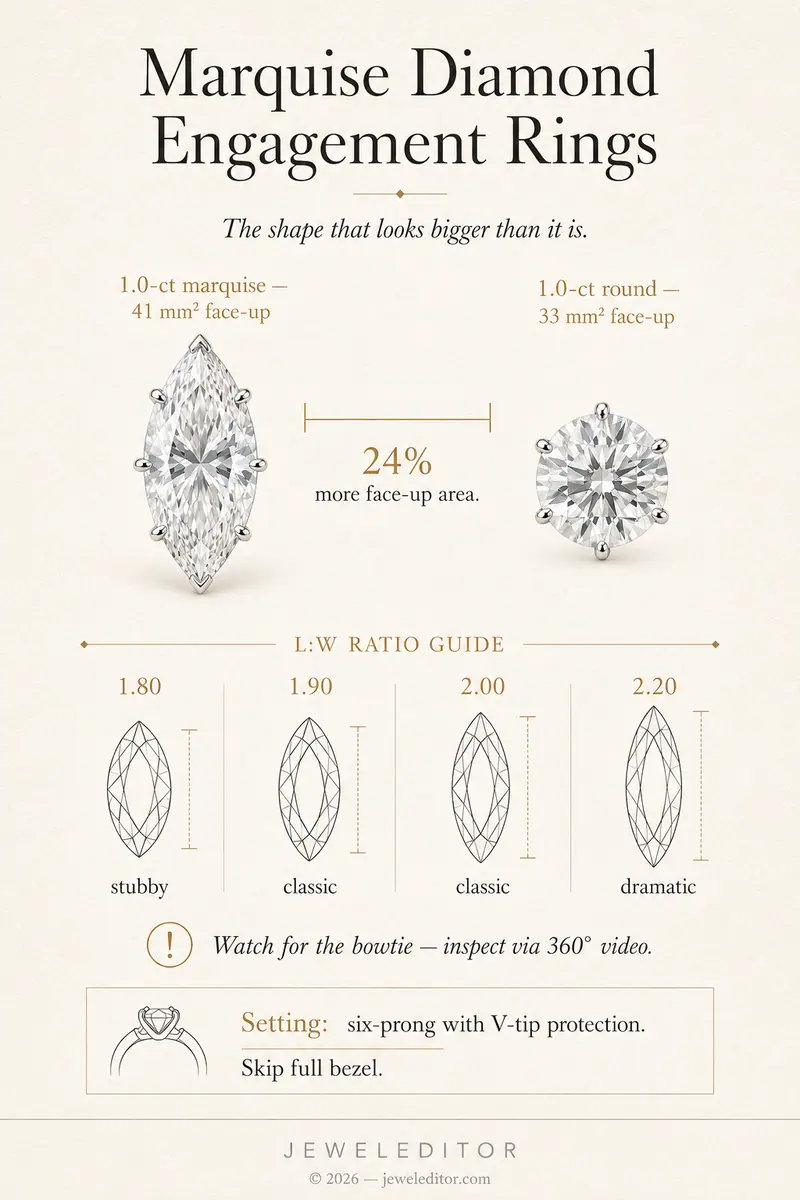
The marquise shape has the highest face-up area per carat of any common engagement-ring cut. This isn't a marketing claim. It's geometry. A round-brilliant spreads its crystal weight across a roughly circular silhouette; a marquise spreads the same weight across a longer, narrower silhouette with two pointed ends. The result: more of the diamond is visible from above, less is hidden in the pavilion (the part below the girdle that you don't see when the stone is mounted face-up).
Concrete comparison at the standard 1.0-carat weight:
| Shape | Face-up dimensions | Approximate face-up area |
|---|---|---|
| Round brilliant | 6.5 × 6.5 mm | 33 mm² |
| Oval | 7.7 × 5.5 mm | 33 mm² |
| Marquise | 10.2 × 5.1 mm | 41 mm² |
| Pear | 9.0 × 5.5 mm | 39 mm² |
| Cushion | 5.5 × 5.5 mm | ~27 mm² |
| Emerald | 7.0 × 5.0 mm | 27 mm² |
A 1.0-carat marquise covers roughly 24% more face-up area than a 1.0-carat round, and about 50% more than a 1.0-carat cushion at the same weight. The eye reads face-up area, not carat weight, so the marquise reads as "bigger" at every budget tier.
This is the marquise's quiet advantage. The shape was reportedly commissioned in the 1740s by the court of Louis XV. The king is said to have asked a stonecutter to design a cut that would emphasize the lips of his mistress, the Marquise de Pompadour (hence the shape's name). Whether that origin story is fully accurate or partially folkloric (gem historians lean folkloric), the shape's intent (maximum visual presence from the same crystal weight) has carried through to today.
The bowtie: the problem nobody mentions
Every marquise diamond has some bowtie effect. This is the single most-underdiscussed aspect of the cut, and the reason marquise (along with oval and pear) requires far more visual inspection than a round-brilliant before purchase.
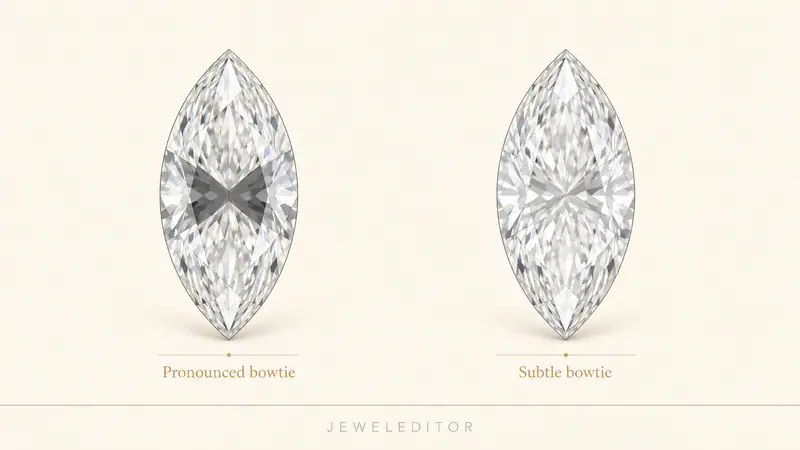
The bowtie is a dark band (roughly the silhouette of a literal bowtie) that appears across the center of the diamond, perpendicular to the long axis. It's caused by light leaking out the bottom of the stone instead of reflecting back through the table. When the pavilion proportions are too shallow, or when the cut alignment is poor, the central area doesn't return enough light, and the eye reads it as a dark band.
The question isn't whether your marquise has a bowtie. The question is whether it's pronounced (visible at every angle, the stone looks darker in the middle in all lighting) or subtle (only visible at certain tilts, mostly invisible in normal wear).
How to spot it:
- Hold the stone face-up under daylight. A pronounced bowtie will look like a dark horizontal band across the middle.
- Tilt the stone gently. A real bowtie persists across multiple angles. A "shadow" from positioning will move or disappear when you tilt.
- Compare two marquise of similar weight. A side-by-side reveals bowtie differences immediately.
The grading workaround is non-trivial: GIA does not issue a cut grade for marquise (or any fancy shape, only round-brilliant). Cut is the single biggest determinant of how a diamond actually looks, and it's the one C the report doesn't tell you about for these shapes. You have to inspect visually.
What you can use from the GIA report:
- Symmetry: Excellent. Off-symmetry marquise (one tip higher than the other, asymmetric pavilion facets) is the most common cause of pronounced bowtie. Walk away from "Very Good" symmetry on marquise.
- Polish: Excellent. Surface polish affects light return at the table. A "Good" polish on a marquise makes any bowtie more visible.
- Pavilion depth: 41-43%. Shallow pavilions (below 40%) are bowtie-prone. The report shows the depth percentage.
- Table width: 50-58%. Wider tables (above 60%) lose light return; tighter tables (below 50%) reduce face-up area.
The retailer workaround: buy from a vendor with high-resolution 360° video. James Allen pioneered this format; Brilliant Earth and Blue Nile now offer it on most marquise inventory. The 360° rotation lets you see the bowtie effect at every angle before committing.
How marquise looks on the hand
Marquise has a perceptual property that round-brilliants don't have: it changes the visual proportions of the wearer's finger.
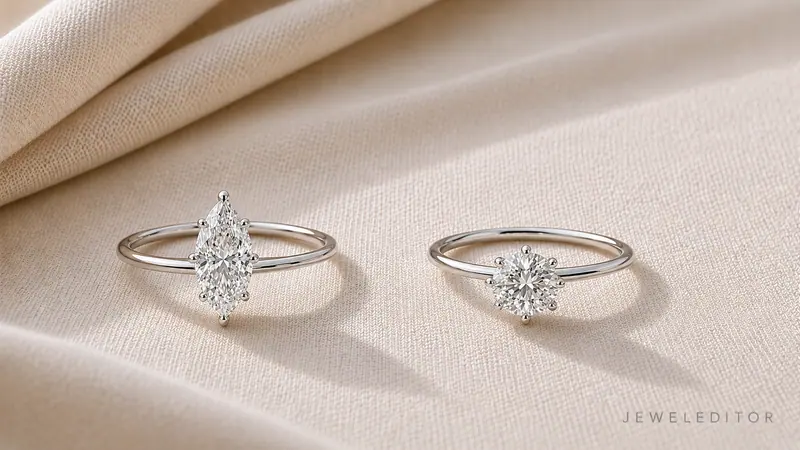
Worn east-west (long axis running across the finger, perpendicular to the bone), a marquise stretches horizontally across the knuckle area. The eye reads this as visual length. The finger appears longer and slenderer than it actually is. This is the orientation most modern marquise settings use, and it's the strongest hand-flattering effect of the shape.
Worn north-south (long axis running along the finger, parallel to the bone), the elongation reads as ring length rather than finger length. The effect is more traditional, historically common in older settings, but doesn't flatter the finger the way east-west does.
For shorter fingers, east-west marquise is among the most visually flattering shape choices in the engagement-ring market. The elongation creates the illusion of slenderness; the substantial face-up area reads as proportionally substantial without overwhelming a smaller hand. For long fingers, the effect is more subtle. The marquise still adds visual presence, but the elongation doesn't dramatically change perceived proportions.
The actionable point: when shopping for a marquise setting, ask for east-west orientations specifically. Many retailer photos show marquise rings north-south because it's the easier camera angle, not because it's the preferred wear orientation.
Settings that work, and what to skip
The marquise's pointed tips are both its visual signature and its structural weak point. Two tips mean two points of vulnerability: each can chip if struck, and each requires a setting that protects the stone without obscuring the silhouette.
Six-prong with V-tip protection is the safety standard. Two prongs at each pointed tip (forming a V around the point) plus two on the long sides. The V-tip cap protects the most vulnerable area of the stone (the actual point) from impact and snagging.
Halo settings work particularly well with marquise. The halo of small accent diamonds protects the points while adding visual size and complementing the elongated shape. The combination is one of the most visually arresting in the contemporary engagement-ring market and shows up heavily in social-media imagery for that reason.
East-west settings (band running along the long axis of the marquise) read as modern and contemporary. The shoulders of the band rise to meet the stone naturally; the silhouette is unbroken.
North-south settings (band running perpendicular to the marquise's long axis) read as traditional. The band runs across the short dimension; the stone visually sits "on top" of the band.
What to skip with marquise:
- Full bezel settings. The continuous metal rim of a full bezel is awkward at the pointed tips. The metal has to either round the points (making them look less pointed and defeating the shape's visual signature) or actually wrap the points (creating thin metal at vulnerable angles, which dents easily). Half-bezel can work, but the prong setting is almost always cleaner. For the case for and against bezel, see our bezel setting engagement rings guide.
- Thin-walled two-prong solitaires. A marquise solitaire engagement ring with only two prongs leaves the pointed tips unprotected and looks structurally underbuilt for the shape. Four-prong is the minimum; six-prong with V-tip protection is the safety standard.
- Tension settings where the stone is held by pressure between two band ends, visually striking but structurally risky for any pointed-tip shape.
What to look for when buying a marquise
The buying-decision framework, marquise-specific.
Length-to-width ratio
This is the visual signature of the shape, and the spec that most affects how the marquise reads on the hand. The classic range is 1.85 to 2.00. This is the ratio that most market inventory uses and that most buyers find balanced. A 1.0-carat marquise at a 2.00 ratio is about 10.2 mm × 5.1 mm.
More elongated ratios (2.05 to 2.20) read as dramatic and modern. The stone looks longer and more architectural. Below 1.80 reads as stubby; the marquise loses its signature elongation. Above 2.20 reads as visually unbalanced on most fingers.
Pick the ratio that matches the wearer's hand and aesthetic. If you're choosing for someone else and can't ask, 1.90-2.00 is the safest classic.
Cut quality (without a cut grade)
GIA doesn't grade cut on fancy shapes. The workaround is to use the report's symmetry, polish and proportion specs as proxies, and to inspect the stone visually (or via 360° video) for the bowtie effect.
- Symmetry: Excellent only. "Very Good" symmetry on a marquise often produces visible asymmetry at the tips, where small misalignments are most noticeable.
- Polish: Excellent. Strong polish on the table maximizes light return; weak polish amplifies the bowtie.
- Pavilion depth: 41-43%. This is the sweet spot for marquise light return. Below 40% is bowtie-prone; above 44% creates "deep" stones that look smaller face-up than their weight implies.
- Table width: 50-58%. Wider tables (above 60%) trade brilliance for size; tighter tables maintain light performance.
Color and clarity
- Color: Marquise shows color slightly more than a round-brilliant. The elongated shape creates more side-on light path, which makes warmth more visible. In white-metal settings, stay D-H. In yellow gold, K-L is fine.
- Clarity: VS1 or VS2. The pointed tips are vulnerable to inclusions; SI grades on marquise can show visible flaws at the points where the cut is thinnest.
For the broader 4Cs framework (color, clarity, cut, carat), see our Diamond Color Scale GIA guide for the color-specific decision and our engagement rings under $5,000 budget guide for how to allocate across the four Cs at this budget.
Lab-grown marquise
The lab-grown case for marquise is particularly strong because the shape's face-up advantage compounds with the lab-grown price advantage. A 1.5-carat lab-grown marquise covers roughly the same face-up area as a 2.0-carat natural round, at a fraction of the cost. Checked at Blue Nile on 24 September 2026: a 2.0-carat natural round started at $13,246 in G-H VS2 or better and at $16,789 in D, VS1 or better, while natural marquise at that weight in D-F started at $25,497. A 1.5-carat lab-grown marquise in D-F, VS1 or better started at $958. For most buyers, lab-grown marquise is the size-per-dollar maximum in the engagement-ring market, and it no longer needs anything like a $5,000 budget.
For the broader lab-grown decision framework, pair this with our lab grown diamonds for engagement rings guide.
Where to buy a marquise diamond engagement ring
The cut variability on fancy shapes makes retailer selection more important here than for rounds. The 360° video tool is no longer a nice-to-have. It's how you avoid the bowtie trap.
Our top recommendation is Blue Nile for three reasons specific to marquise:
- Deep marquise inventory across natural and lab-grown: consistently larger than most competitors at the engagement-ring spec range, giving you enough stone variety to find one without bowtie issues.
- High-resolution stone imagery on every listing: not as 360°-rotational as James Allen, but detailed enough to spot bowtie issues before adding to cart.
- A full report on every marquise stone. Natural marquise at Blue Nile carries GIA; lab-grown marquise mostly carries IGI, with some GIA and GCAL. Either way the report includes symmetry, polish and proportion data, the proxies you need when there's no cut grade.
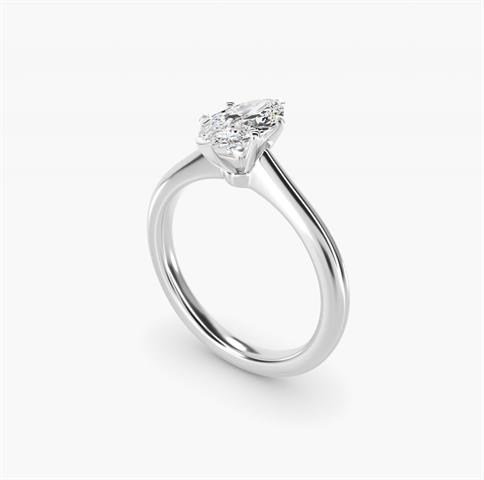
Petite Solitaire
Platinum · 1.8 mm band
Best for showing the shape
A slim platinum band that keeps the attention on the long shape of the stone.
$1,872 ring, from
$1,330 setting + $542 stone
Check price at Blue Nile: Petite Solitaire, Platinum (opens in a new tab)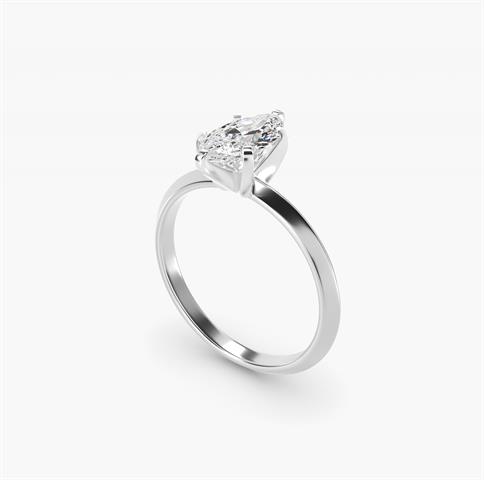
Knife Edge Solitaire (James Allen collection)
14k white gold · 2.0 mm band
Best on a tight budget
A knife-edge band that echoes the pointed ends of a marquise.
$1,467 ring, from
$925 setting + $542 stone
Check price at Blue Nile: Knife Edge Solitaire (James Allen collection), 14k white gold (opens in a new tab)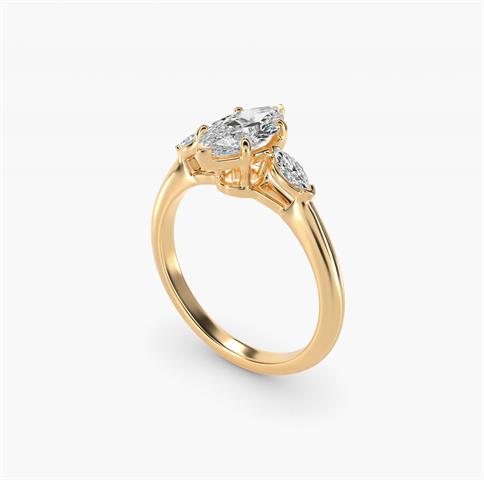
Marquise Lab-Grown Three Stone (James Allen collection)
14k yellow gold · 1.8 mm band
Best if you want side stones
Two marquise lab-grown side stones flank the center diamond you choose.
$2,162 ring, from
$1,620 setting + $542 stone
Check price at Blue Nile: Marquise Lab-Grown Three Stone (James Allen collection), 14k yellow gold (opens in a new tab)Next: the diamond
We would pair these with a 1–2 ct lab-grown marquise, D to H color, VS2 or better.
What happens when you click: Blue Nile prices the setting and the stone separately. You open the setting, then choose a diamond, and it offers handpicked matches if you would rather not filter. Free shipping, free returns and a lifetime warranty at Blue Nile.
Prices checked September 24, 2026 at Blue Nile. Ring prices are the setting plus the cheapest stone at the spec above; most stones cost more than that. Prices change, so confirm at checkout. Product photos: Blue Nile. We earn a commission if you buy through these links.
James Allen deserves a specific call-out for marquise: their 360° viewer is best-in-class, and on a fancy shape that's more useful than on a round-brilliant. If you want to inspect the bowtie effect at every angle before committing, James Allen is the strongest tool. Selection is smaller than Blue Nile's; pricing is comparable.
Briefly on the others:
- Brilliant Earth: strong sustainability narrative, more curated marquise selection (filters out the bowtie-prone stones); pricing runs slightly higher
- Vrai: Diamond Foundry's lab-grown arm, smaller selection but very modern aesthetic in the marquise category
- Clean Origin: cheapest on lab-grown; IGI grading rather than GIA
If you find a specific marquise you love at any of these retailers, buy it there. Editorial integrity beats brand loyalty.
Common mistakes when buying a marquise
Four patterns recur in marquise buying regrets:
Mistake one: not inspecting bowtie. Cut variability on fancy shapes is the largest in the diamond market. A "good-looking" marquise on paper (Excellent symmetry, proper proportions) can still have a pronounced bowtie if the pavilion alignment is off. Inspect the actual stone: via 360° video at minimum, in person if possible.
Mistake two: choosing length-to-width ratio outside 1.85-2.10. Stubby (below 1.80) or overly elongated (above 2.20) ratios look visually unbalanced on most fingers. The classic 1.85-2.00 range is classic for a reason.
Mistake three: bezel-set marquise. The pointed tips are functionally incompatible with a continuous bezel rim. The metal has to either round the points (losing the shape's signature) or wrap the points (creating thin, dent-prone metal). Use a prong setting with V-tip protection instead.
Mistake four: skimping on symmetry grade. "Very Good" symmetry on a marquise often produces visibly asymmetric points or off-axis culet alignment, the kind of defect that's invisible on a round-brilliant but immediately noticeable on the elongated marquise shape. Excellent symmetry only.
Closing: three things to take away
- The marquise is the size-per-dollar maximum in the engagement-ring market. 24% more face-up area than a round at the same carat weight; the eye reads face-up area, not weight.
- Cut quality matters more here than on any round-brilliant. GIA doesn't issue a cut grade for marquise. You have to inspect visually for the bowtie effect. 360° video is the practical tool.
- Six-prong with V-tip protection is the safety standard. The pointed tips are vulnerable; the setting needs to protect them without obscuring the silhouette. Skip bezel; consider halo.
If you want to run your budget against the broader spec framework, the Budget Calculator takes 30 seconds. Our recommended retailer for marquise specifically is Blue Nile (best inventory). James Allen is the strongest alternative if remote 360° inspection matters more to you than catalog breadth. We earn commissions on referrals to Blue Nile and disclose that because editorial integrity beats every selling angle.
The TL;DR is this: a marquise diamond engagement ring is the shape that quietly delivers more visible diamond per dollar than any other common cut. The shape itself is built for this. Match the length-to-width ratio to the wearer's hand, demand Excellent symmetry, inspect for bowtie, and you've bypassed the fancy-shape buying trap that most marquise buyers fall into.
Last audited: 2026-09-24, with every Blue Nile price rechecked against live listings that day. JewelEditor Editorial. Shape and grading methodology drawn from the Gemological Institute of America and its 4Cs reference site. Cut-quality commentary on fancy shapes via Mike Fried's Diamonds Pro shape guides and the International Gem Society research library. Engagement-ring shape preference trends via The Knot's 2025 Jewelry & Engagement Study and trade coverage in JCK Magazine.