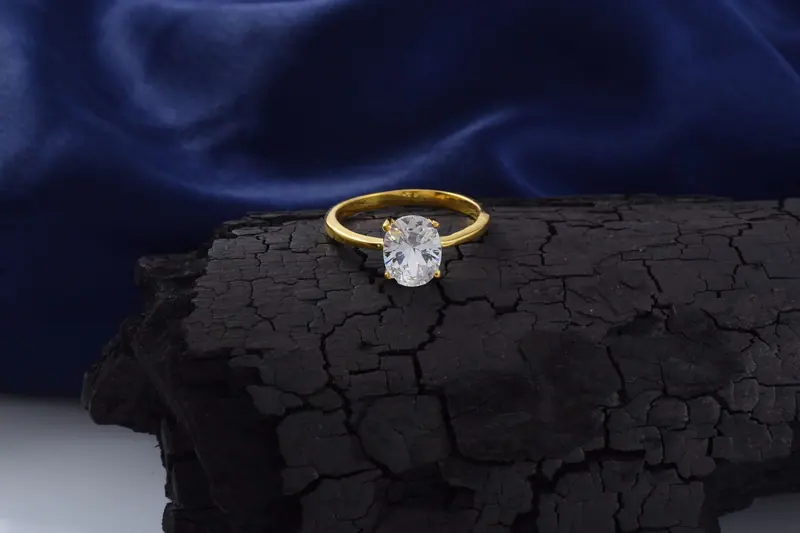
The actual comparison
| Detail | Round-brilliant | Oval |
|---|---|---|
| Face-up area (1 ct, same cut quality) | ~33 mm² | ~38 mm² (+15%) |
| Brilliance / sparkle | Highest of any shape | 85-90% of round |
| Cut grade availability | Excellent grade widely available | No GIA Excellent (cut is judged on length:width and bowtie) |
| Resale value | Best, strongest demand | ~70-80% of equivalent round |
| Price per carat (same color/clarity) | baseline | 15-25% less |
| Finger elongation | Neutral | Elongates the finger |
| Bowtie risk | None | Yes, must inspect |
| Setting style flexibility | Maximum | High |
What "looks 10-15% bigger" actually means
A 1.5-carat round-brilliant has a face-up diameter of about 7.4mm and 43 mm² area. A 1.5-carat oval at a 1.40 length-to-width ratio measures about 9.0 × 6.5 mm with about 49 mm² of visible area, roughly 14% more visible face-up than the equivalent round.
The reason: round-brilliants are cut deeper to maximize light return, which "hides" some of the weight in the pavilion. Ovals are cut shallower, so more of the carat weight spreads across the visible top.
Practical impact: if you want a "looks like a 2-carat round" effect, a 1.75-carat oval typically delivers it.
Why round wins on sparkle
Round-brilliant has 58 facets arranged in a precisely-engineered pattern that's been refined for over 100 years. The math of light return through 58 facets at modern proportions produces the highest possible "fire" (rainbow flashes) and "brilliance" (white light return) of any diamond shape.
Oval has 56-58 facets but the elongated shape means light doesn't return as evenly. Some ovals show subtle to pronounced bowtie effect: a darker shadow across the center of the stone where light leaks out the bottom instead of reflecting up. The bowtie is shape-inherent, not a flaw. It can be minimized by cut quality but never fully eliminated.
Why oval wins on price
Two reasons:
- More yield from the rough. Cutters can extract more usable weight from a rough diamond when shaping an oval than when shaping a round. Lower cutting waste = lower price per finished carat.
- Lower demand. Round-brilliant has dominated the engagement market since the 1950s. Anything other than round carries a small "fancy shape" discount. Oval's discount is moderate (~15-25%); marquise and pear discounts are larger (~25-40%).
The size of that discount has become unreliable, so check both shapes on the day. In a spot check at Blue Nile on 24 September 2026, 1.5 ct lab-grown ovals started at $1,085 against $1,010 for rounds, and natural 1.5 ct ovals at G, VS1 started at $9,161 against $8,149 for rounds: in both cases the oval was the dearer entry price, even though ovals still tend to run cheaper through the middle of the range.
When round is the right call
- Sparkle is the most important quality to you: round-brilliant is unmatched
- You're optimizing for resale value: round commands the highest secondary-market premium
- You want the safest, most timeless choice: round has been the dominant engagement shape since the 1950s
- You can't or won't inspect the stone via 360° video: round has no bowtie risk
When oval is the right call
- Visual size matters more than maximum sparkle: oval delivers 10-15% more face-up per carat
- You want the finger-elongating effect: oval makes hands look more slender
- Budget is tight and you want to maximize what your money buys: oval costs less per carat
- You like the slightly more "modern" or "fashion-forward" look vs the classic round
What to check if you buy oval
- Length-to-width ratio. Most buyers prefer 1.35-1.50, close to "classic oval" proportions. Below 1.30 looks stubby, above 1.55 starts to look stretched.
- Bowtie severity. Inspect via 360° video (most online retailers provide this). A small, subtle bowtie is acceptable; a pronounced black band is a deal-breaker.
- Symmetry. Ovals are particularly sensitive to asymmetry. One end fatter than the other looks "off" on the hand even though it's hard to articulate why.
- Outline curvature. Some ovals are too "pointy" at the ends (almost moval), others are too round (almost circular). The classic oval has smooth, continuous curvature.
The honest take
Choose round if you'd kick yourself for picking anything less sparkly. Round-brilliant is the maximum-sparkle, maximum-resale, maximum-safe choice. There's no scenario where you'll regret it.
Choose oval if you'd kick yourself for not getting the bigger-looking stone. Oval delivers visibly more visual size per dollar, and the slight sparkle reduction is genuinely subtle in real-world wear. The elongating effect on the hand is a bonus most ovals deliver beautifully.
For lab-grown buyers in particular, oval is often the smarter call. The price savings let you go bigger or improve color/clarity at the same budget, and the resale gap (which is bigger for oval) doesn't matter because lab-grown resale is poor for both shapes.