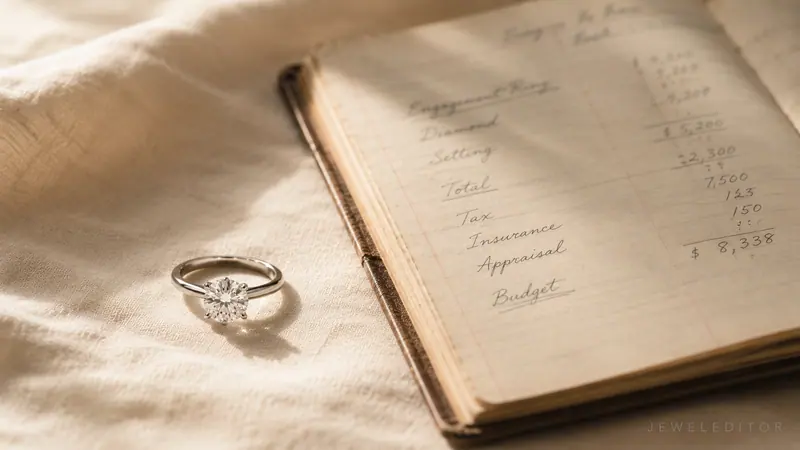
The 3 month salary engagement ring rule is 1939 advertising copy, not financial advice. It's the most-cited piece of "common wisdom" in the engagement-ring market, and it has no basis in tradition, etiquette or personal finance. Like most enduring marketing slogans, it survives because it's memorable, not because it's true.
This is the case for ignoring it.
Where the 3 month salary engagement ring rule actually came from
In 1938, the Oppenheimer family (owners of De Beers, the South African diamond cartel that controlled roughly 80% of the world's rough diamond supply) was facing a problem. Diamond demand had collapsed during the Great Depression, and the American market in particular was buying a fraction of what it had bought a decade earlier. De Beers needed to revive engagement-ring purchasing without flooding the market with cheap stones (which would have collapsed prices).
The solution was advertising. De Beers hired the American agency N.W. Ayer & Son, which spent the next decade reshaping the cultural meaning of engagement rings in the United States. Ayer's strategy had three parts:
- Establish diamonds as the engagement-ring stone (before the campaign, sapphires, rubies and pearls were equally common).
- Tie ring spending to a percentage of income, so the price target would scale with wages over time without requiring constant ad-copy updates.
- Frame the ring as a symbol of lifelong commitment: the famous "A Diamond Is Forever" tagline, introduced in 1947.
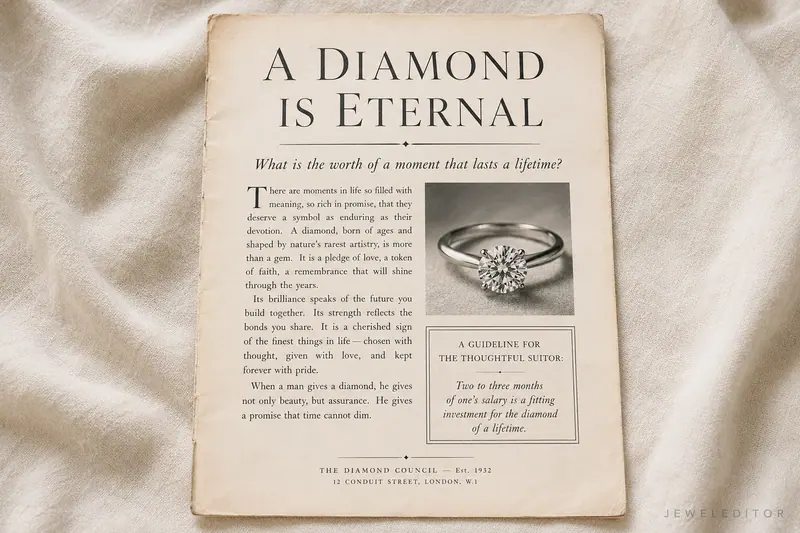
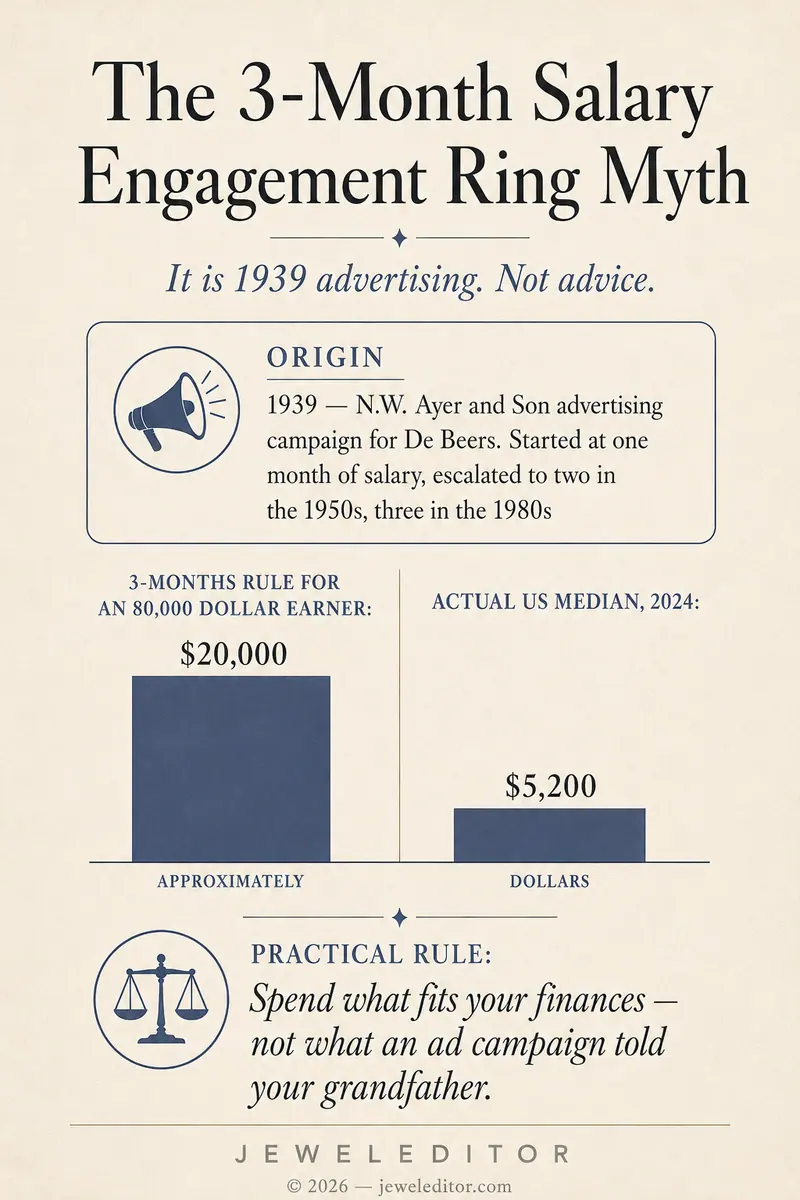
The "one month's salary" rule was introduced in 1939. By the 1950s it had become "two months." By the 1980s, with diamond margins under competitive pressure from emerging markets, De Beers escalated the suggestion to "three months." Every escalation was deliberate marketing, designed to expand the ring-spending baseline as wages rose.
This history is well-documented. Edward Jay Epstein's 1982 Atlantic Monthly piece Have You Ever Tried to Sell a Diamond? traces the campaign in detail; the broader history of the De Beers marketing operation is covered in industry coverage at JCK Magazine. The "3 months' salary" rule is not folk wisdom that emerged organically. It's an invented marketing rule that became cultural inheritance.
What people actually spend
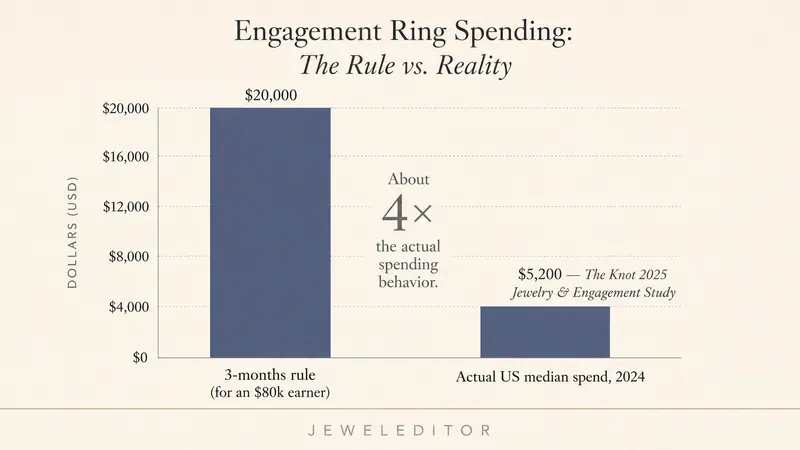
The data tells the real story. The Knot's 2025 Jewelry & Engagement Study, the most comprehensive annual survey of US engagement-ring spending, reports the median US spend at $5,200.
That's about a third of what the three-months rule prescribes for a buyer earning $80,000 a year (which would dictate roughly $20,000). It's about half of what the two-months rule prescribes ($13,300). Even the one-month rule ($6,700) is above the median.
In other words: most buyers already ignore the rule. What they may not realize is how much they're ignoring it. The cultural assumption is that "everyone" follows the rule, so deviating feels like a failure. The reality is that the rule is the deviation; the median behavior is the norm.
A few additional data points worth knowing:
- The median spend has been flat (inflation-adjusted) since 2018. Engagement-ring spending has settled at a level that no longer tracks salary growth. The rule's "percentage of income" framing assumes ring prices and incomes move in tandem; they haven't for nearly a decade.
- Lab-grown adoption among under-35 buyers is now a majority of new engagement-ring purchases. This is the largest single factor in the rule's irrelevance: lab-grown diamonds give roughly two and a half times the carat for the same dollar spend, which means a $2,645 lab-grown ring now looks like an $11,500 natural one at the same spec. The rule's underlying assumption (more dollars = more visible ring) broke when lab-grown reached scale.
- Regional variation is meaningful. Median spend skews higher in the Northeast (where costs of living and median incomes are higher) and lower in the South and Midwest, per The Knot's own regional-breakdown reporting. The same percentage-of-salary rule produces very different "right" budgets depending on where you live, which further illustrates that the rule is a marketing artifact, not a personal-finance principle.
For a full breakdown of what $5,000 actually buys in 2026, across both lab-grown and natural diamonds, see our engagement rings under $5,000 buying guide.
Why the rule survived even as practice diverged
If most people don't follow the rule, why does it still come up?
Three reasons:
1. It's the only number in the market. When a buyer asks "how much should I spend on an engagement ring?" they encounter the 3-months rule before they encounter any of the actual spending data. Search results, jewelry retailers, family wisdom: all default to the rule. The data (The Knot's $5,200 median) is downstream of the rule in attention; the rule wins by default.
2. It serves the seller. A higher rule benefits the diamond industry, even if buyers ignore it in practice. The rule sets a ceiling for "appropriate" spending, and any actual purchase below the ceiling feels like a compromise. The compromise framing nudges buyers to spend more than they would without the anchor.
3. It feels like tradition. Three months' salary has the texture of long-standing custom. It has been around long enough (over 85 years now) that most buyers' parents and grandparents heard the same rule. The rule predates many of the buyer's living relatives' engagements. That generational continuity makes it feel like inherited wisdom rather than advertising, which is exactly what the original campaign was designed to achieve.
The honest framing: the 3-months rule is a marketing artifact that has aged into cultural infrastructure. It will persist for another generation regardless of what actual spending behavior is. But its presence as a "rule" doesn't make it correct for any specific buyer in 2026.
What to spend instead
The replacement for the rule isn't another number. It's a question.
What does the ring need to do, for the wearer, for the buyer, for the relationship?
Some buyers want a substantial visible stone because that visibility matters to the wearer's sense of being chosen. Some buyers want a meaningful but financially-light purchase because the engagement is one expense in a larger life budget that includes the wedding, the move, the down payment, the kids. Some buyers want a stone that connects to a specific family history (heirloom resetting, a particular metal). Some buyers want anti-traditional minimalism: a bezel setting, a lab-grown stone, a budget under $3,000.
None of these is the wrong answer. The wrong answer is spending more (or less) than you can comfortably afford because of a 1939 advertising slogan.
A practical framework, replacing the rule:
| Priority | Approximate spend | What it looks like |
|---|---|---|
| Value + size | $1,500-$3,000 | 1.5-2.0 ct lab-grown solitaire in 14k gold |
| Median | $3,000-$6,000 | 2.5-3.0 ct lab-grown D-VS1 in platinum, OR 1.0-1.2 ct natural |
| Statement | $6,000-$12,000 | 4 ct or larger lab-grown OR 1.3-1.5 ct natural with designer setting |
| Tradition / heirloom | varies | Natural diamond, possibly heirloom-quality, often passed down |
Match the spend to the priority. Run your specific situation through the Budget Calculator for a quick sanity-check against your actual finances.
For the lab-grown vs natural decision (the single biggest factor in what your money buys at any tier), see our lab grown diamonds for engagement rings guide. For the color, clarity, cut and carat allocation, see our Diamond Color Scale GIA guide and the broader 4Cs treatment in the budget guide.
The conversation nobody has
The most underrated piece of advice on engagement-ring budgets is the simplest: talk to your partner about it.
Engagement-ring expectations are among the most-avoided premarital money conversations. The avoidance is partly cultural (the ring is "supposed" to be a surprise) and partly defensive (neither party wants to be the one who sets a "wrong" budget). The result is that many engagement-ring purchases happen in a vacuum: the buyer guessing what the wearer wants, the wearer hoping the buyer guesses right and the relationship absorbing whatever financial reality lands.
The conversation doesn't have to be specific. You don't need to settle on a dollar figure together (though you can if it helps). You need to align on:
- What the ring is for. A symbol of commitment? A statement piece? A family heirloom-to-be? Different answers point to different spending priorities.
- What you can comfortably afford. Not the maximum either of you could spend; the amount that doesn't create financial stress as you go into the engagement.
- What you'd both regret. Either spending too little (the wearer feels devalued) or spending too much (the relationship absorbs the financial strain).
These are not romantic conversations. They are practical. They are the same kinds of conversations any couple has when buying a house, planning a wedding or making any other large financial commitment together. Engagement rings are simply the first major joint financial decision most couples encounter, and the avoidance pattern around them tends to recur in every joint financial decision afterward.
Closing: three things to take away
- The 3-months rule is 1939 advertising copy. It was invented by N.W. Ayer & Son for De Beers; it has no basis in tradition, etiquette or personal finance. Ignore it as such.
- The actual median spend is $5,200. Per The Knot's 2025 study. That's about a third of what the three-months rule prescribes for a typical earner. The median is the norm; the rule is the deviation.
- The right amount is the one that fits your situation and reflects what the ring means. That number is rarely the rule. Have the conversation with your partner; spend what makes sense; don't let advertising from 1939 dictate the 2026 decision.
The TL;DR: a 1939 advertising campaign created a rule that more than 85 years later still shapes engagement-ring buying anxiety more than actual buying behavior. The rule has outlived its accuracy by several decades. The median US buyer ignores it without realizing it. The right amount is the amount that fits, and that's a question only the buyer and their partner can answer.
Last audited: 2026-09-24, with the spend tiers rechecked against live Blue Nile listings that day. JewelEditor Editorial. Historical context drawn from Edward Jay Epstein's 1982 Atlantic Monthly piece Have You Ever Tried to Sell a Diamond? and industry coverage in JCK Magazine. Spending data from The Knot's 2025 Jewelry & Engagement Study. Industry pricing context via Mike Fried's Diamonds Pro buying guides. For a cross-reference on engagement-ring history, see the International Gem Society's research library.