The four real retailer categories
Most "where to buy" advice lumps all retailers together. They're genuinely different businesses with different economics.
1. Online specialty (Blue Nile, James Allen, Brilliant Earth, Whiteflash, Vrai, With Clarity)
These dominate the smart-shopper market. 40-60% lower prices than mall jewelers because they don't carry physical inventory. Diamonds ship from grading labs or wholesalers on order. The cost savings get passed through.
Strengths:
- Lowest prices per spec
- HD 360° video of the actual stone before purchase
- Strong GIA / IGI report integration
- 30-day no-questions return
- Free shipping + free insurance on transit
- Lifetime upgrade programs (Blue Nile, James Allen, Brilliant Earth all offer)
Weaknesses:
- No in-person try-on before purchase
- Customer service is remote (chat / phone)
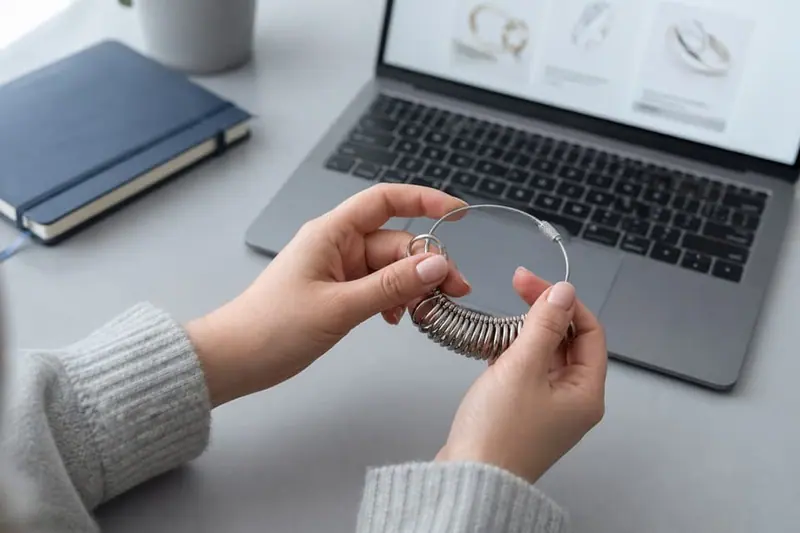
- Sizing relies on home measurement
2. Mall chains (Kay, Jared, Zales)
These three are owned by Signet Jewelers, which also owns Blue Nile and James Allen, putting the same parent company on both sides of this market. Helzberg Diamonds is a separate mall-chain competitor (owned by Berkshire Hathaway) with broadly similar economics. Mall stores carry physical inventory, have showrooms, and offer immediate try-on.
Strengths:
- Walk in, walk out same day
- In-person try-on
- Financing readily available
- Brick-and-mortar feels "real"
Weaknesses:
- Significantly higher prices (often 40-80% premium over online specialty for equivalent specs)
- Limited selection per store
- Sales pressure can be intense
- Frequent "sale" prices that compress to "regular" prices (beware perceived discounts)
3. Independent local jewelers
Family-owned, regional shops. Highly variable in quality and price.
Strengths:
- Direct relationships
- Custom design capability (the killer feature)
- Trusted local sources for repairs over decades
- Can negotiate price
Weaknesses:
- Limited diamond inventory (often have to special-order)
- Hit-or-miss on competitive pricing
- Quality varies widely
- Limited online reviews to vet
4. Direct-to-consumer + lab-grown specialty (Pure Lab Gems, MiaDonna, Clean Origin, Plum Diamonds)
A new category. Lab-grown specialists with direct supplier relationships, often even lower prices than the big online specialty retailers.
Strengths:
- Lowest prices on lab-grown specifically
- Mission-driven (ethical / sustainable angle)
- Generally good return policies
Weaknesses:
- Less established than Blue Nile/JA (track record is shorter)
- Inventory smaller
- Limited natural diamond options
Specific picks per budget tier
Budget under $2,000
Best choice: James Allen or Brilliant Earth (lab-grown). At this tier, lab-grown is the only realistic path to a substantive stone. Both retailers have strong sub-$2,000 lab-grown inventory in solid settings.
Budget $2,000-$5,000
Best choice: Blue Nile, James Allen, or Whiteflash. This is the heart of the smart-shopper online specialty market. You can buy a 2.5-3.0 ct lab-grown or a 1.0-1.2 ct natural at quality specs (Blue Nile listings, checked 24 September 2026).
Budget $5,000-$10,000
Best choice: Blue Nile (Astor cut for natural), James Allen (True Hearts for lab-grown), or Whiteflash (A CUT ABOVE for super-ideal cut). At this tier, you can be choosy about cut grade: pay for super-ideal proportions rather than just "Excellent."
Budget $10,000+
Best choice: Whiteflash, Brian Gavin, or a high-end independent. Above $10K, paying for premium cut quality (super-ideal, with documented light performance) is the right tradeoff. Mall stores still don't make sense at this budget. You'd be paying for showroom overhead.
Custom or family heirloom redesign
Best choice: independent local jeweler. Online specialty retailers don't truly do custom; they do "configure a setting + center stone." For genuine custom design or heirloom reset, an independent who'll sit with you for hours and sketch designs is the right move.
How to actually buy from an online retailer (the process)
- Set your budget using a budget calculator, not the 3-month-salary rule
- Decide lab-grown vs natural: at most budgets under $8K, lab-grown wins on visible size
- Filter for spec range: Excellent cut, G-H color, VS1-VS2 clarity is the typical sweet spot
- Compare across 2-3 retailers at the same spec: prices vary 5-15% even at the major specialty retailers
- Watch the 360° video: every reputable retailer offers this. If a stone doesn't have one, skip it.
- Verify the report number on GIA.edu or IGI.org before purchase
- Read the return policy: 30 days, free return shipping, no restocking fee is the standard you should expect
- Place the order: engagement-ring sales are usually finalized in the cart, no negotiation phase
What to avoid
- Pawn shops: diamond authentication is hard to verify, recourse is non-existent
- Costco / Sam's Club: surprisingly competitive pricing, but limited selection and no return-with-trade-in flexibility
- Etsy "wholesale" sellers: often resell from the same wholesale supplier as the major retailers, but with no return policy and weaker dispute resolution
- Mall jewelers when budget is meaningful: the price premium is genuinely 40-80% over online specialty for equivalent specs
- Anyone who won't show you the GIA/IGI report before you pay: non-negotiable
The honest take
For 90% of buyers, the right answer is Blue Nile, James Allen, or Brilliant Earth. They have the inventory, the pricing, the return policies, and the customer service infrastructure to handle most purchases well. The "independent jeweler vs online" debate is mostly a wash for standard configurations. Pick the path that matches how you actually shop.
The single biggest mistake is paying mall-jeweler prices for an inventory tier the online specialty retailers carry at 40-60% less. If you're walking into a Kay or Jared without first looking at the equivalent stone on Blue Nile, you're almost certainly overpaying.
For specific tier recommendations and tested examples, see Engagement Rings Under $5,000: The Honest Sweet Spot.